
What Is a Heavy Bottomed Saucepan | The Core Cookware Spec
This post contains affiliate links. As an Amazon Associate, we earn from qualifying purchases.
A heavy-bottomed saucepan is defined by a combination of weight, material layers, and construction that prioritizes even heat distribution and retention. The term specifically refers to cookware with a thick base, typically achieved through multi-layer “fully clad” metal or a thick “disk bottom” design, with a total weight often exceeding 4 pounds. This construction minimizes hot spots and scorching, making it ideal for tasks requiring steady, controlled heat like sauces, reductions, and candy making.
The weight and thickness are the result, not the goal. The goal is even heat. A pan can be heavy for the wrong reasons, like a poorly conductive cast iron pot, and fail at the very tasks “heavy bottom” is meant to solve.
What follows: the four physical specs that define a true heavy-bottomed pan, the one cooking job where a light pan is actually better, and the manufacturer data that shows where the thickness really is.
Key Takeaways
- “Heavy bottom” means fully clad or a thick disk bottom; the former heats the entire pan evenly, while the latter can scorch food on the sidewalls.
- A benchmark weight is over 4 pounds for a quality 3-quart model, per America’s Test Kitchen’s testing standards.
- Cast iron is a poor choice for candy making despite being heavy; its thermal responsiveness is too slow for precise sugar work.
- Light-bottomed pans have advantages for quick temperature changes, like sautéing garlic, or for high-volume boiling where even heat is less critical.
- Check the base diameter matches your stove’s burner; an induction-suitable base that doesn’t reach the edges will cook unevenly.
The 4-Point Heavy Saucepan Checklist
Forget vague marketing. A heavy-bottomed saucepan proves itself with four tangible attributes you can check before you buy.
First, pick it up. A 3-quart model from a reputable brand should feel substantial, often weighing over 4 pounds empty. America’s Test Kitchen uses this as a benchmark for sturdiness. That weight comes from material, not just size. Next, examine the side profile. Run your finger along the rim down to the base. In a fully clad pan, the thickness feels consistent. In a disk-bottom pan, you’ll feel a distinct, thick lip at the base where the extra metal disk is attached.
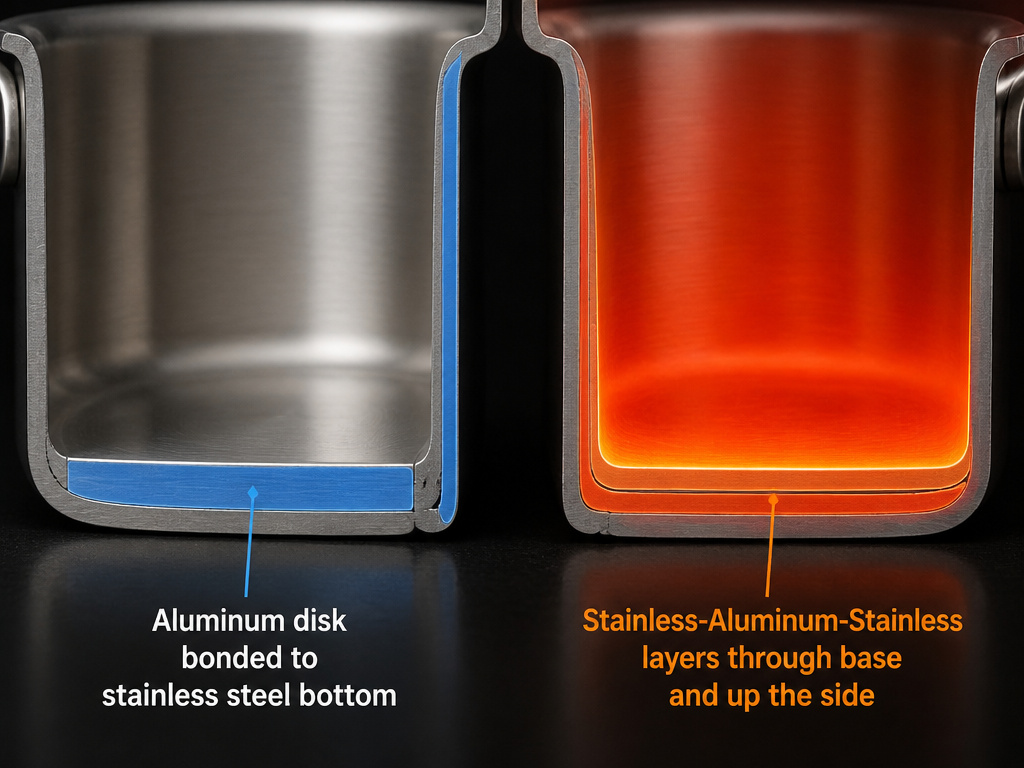
A fully clad saucepan has the same layered metal construction from its rim to its base, ensuring heat transfers evenly across the entire cooking surface and up the sides. A disk-bottom pan attaches a thick slab of conductive metal only to the base, leaving thinner, less responsive sidewalls.
Third, check the base for induction compatibility if you need it. Look for a label, but also understand that some “induction suitable” bases have a magnetic layer that doesn’t extend to the very edge. This creates a smaller effective heating zone and can lead to uneven cooking. Finally, assess the handle. It must be firmly riveted and remain cool. A secondary helper handle on a 4-pound pan full of liquid is a safety feature, not a luxury.
| Checkpoint | What to Look For | Why It Matters |
|---|---|---|
| Weight | Over 4 lbs for a ~3-qt pan | Indicates sufficient material mass for heat retention and stability. |
| Construction | Seamless, consistent thickness from rim to base (fully clad) | Promotes even heating across the entire pan, preventing sidewall scorching. |
| Induction Base | Full-coverage magnetic layer to the outer edge | Ensures the entire bottom heats on an induction cooktop, not just the center. |
| Handle Security | Tight, flush rivets; heat-resistant material; secondary helper handle | Prevents accidents when moving a heavy, hot, and full pan. |
These points move you from a generic idea to a specific, functional piece of cookware. The next layer is understanding why two pans with the same weight can perform so differently.
“Heavy Bottom” vs. “Fully Clad”: The Construction Divide
The term “heavy bottomed saucepan” often masks two different manufacturing approaches. Knowing the difference is the single biggest factor in whether your pan scorches sauces or cooks them cleanly.
A disk-bottom pan is the older, more cost-effective method. A manufacturer takes a thin pan, often made of a single layer of stainless steel, and bonds a thick disk of aluminum or copper to its base. This disk does an excellent job of spreading heat laterally across that base. The problem sits above it. The thin sidewalls heat slowly and unevenly compared to the powerful base. When you’re simmering a thick béchamel or reducing a wine sauce, the food clinging to those sides can scorch before the center is ready. You get the weight, but not the evenness.
Where this goes sideways: Assuming all heavy pans are created equal. A disk-bottom pan is fine for boiling pasta, but for a delicate hollandaise or a fruit curd, that sidewall scorch risk is real and happens in the last three minutes of cooking.
A fully clad pan solves this by building the entire vessel, bottom and sides, from multiple layers of metal. A typical clad sandwich is stainless steel-aluminum-stainless steel. The aluminum core runs throughout, conducting heat uniformly up the sides as well as across the base. There is no thermal disconnect. This is why brands like All-Clad have become the standard for professional and serious home cooking. The pan responds predictably to heat adjustments because the entire mass changes temperature together.
The choice is often between appropriate and inappropriate, not simply good and bad. A disk-bottom pan is a legitimate, cheaper tool for boiling, steaming, or making soup.But if your primary use for a saucepan is tasks sensitive to burning, the investment in fully clad construction is non-negotiable.
The Vollrath Spec Sheet: Where “Heavy” Gets Measured
Manufacturer specifications remove all guesswork. Let’s ground the concept in a real product line. Vollrath’s commercial-grade saucepans provide concrete numbers.
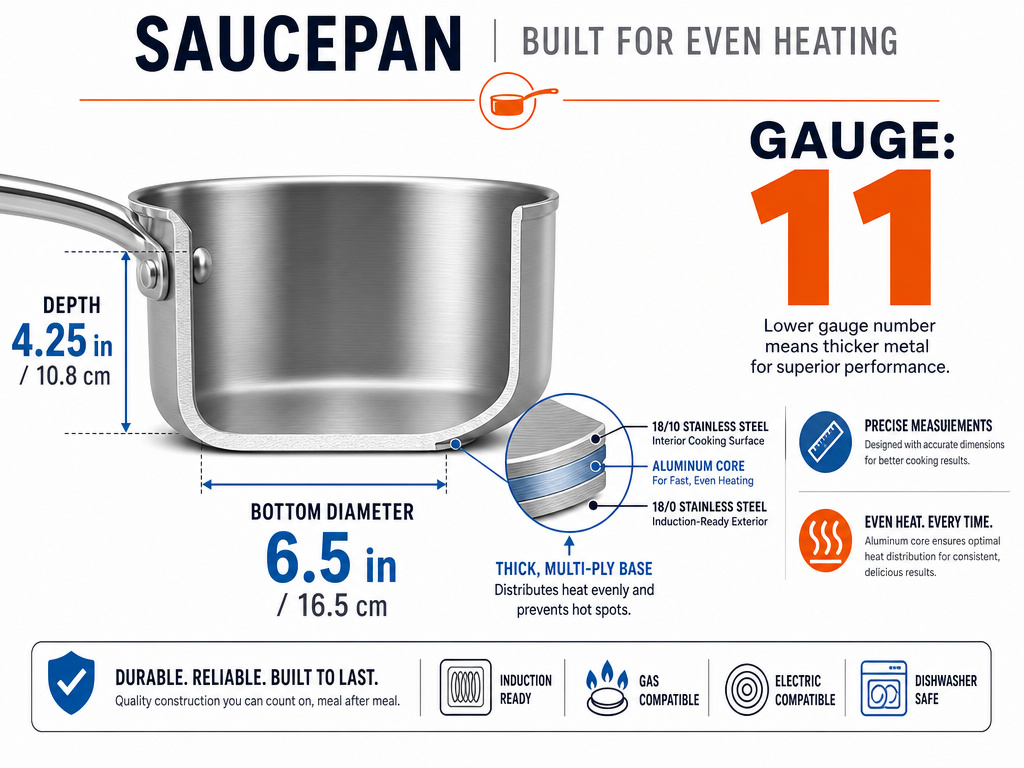
Take the Vollrath model 434212. Its spec sheet lists a capacity of 2 3/4 quarts (2.6 L), a bottom diameter of 6 1/2 inches (16.5 cm), and a depth of 4 1/4 inches (10.8 cm). The key entry is “Gauge: 11”. In cookware, a lower gauge number indicates thicker metal. While gauge alone doesn’t define “heavy bottom,” a gauge 11 aluminum body combined with a commercial design points to a robust, warp-resistant pan built for even heating. This is the language of real performance, not marketing.
These specs matter for fit and function. A bottom diameter that closely matches your stove burner’s size ensures efficient energy transfer. A depth measurement tells you if the pan is suited for reductions (taller sides) or easier stirring (shorter sides). When you’re comparing heavy-bottom saucepans, moving from abstract ideas to these measurable data points is how you avoid buying a pan that’s simply heavy, rather than intelligently built.
Light vs. Heavy: When Thin Metal Wins
The advice always seems to be “get the heaviest pan you can.” That’s wrong for at least three specific scenarios. A light-bottomed pan isn’t a compromise; it’s the right tool.
First, consider thermal responsiveness. If you’re sautéing minced garlic in oil, you need to pull it from the heat the second it turns golden. A thick, heavy pan retains so much heat that it continues cooking the garlic toward bitter after you move it off the burner. A thin pan cools almost instantly, giving you precise control. Second, for high-volume boiling, like making stock or blanching vegetables for a crowd, even heat distribution is less critical than sheer capacity and speed. Commercial kitchens use thin, light stockpots for this reason. The water circulates the heat.
Third, there’s cost and physical weight. A lightweight aluminum small saucepan is a perfect, inexpensive dedicated pot for melting butter or heating a single serving of soup. And if you have wrist issues or simply hate hefting a massive pot, a lighter option for everyday tasks is a valid quality-of-life choice.
The rule is simple: match the pan’s thermal mass to the task’s need for thermal stability. Needing quick temperature changes means a lighter pan. Needing steady, unwavering heat means a heavy-bottomed cookware piece. Most home kitchens benefit from having both types.
What a Heavy Saucepan Is Not (And What to Use Instead)
Some cookware gets miscategorized as a good heavy-bottomed option because it’s physically weighty. This misapplication leads directly to failed recipes.
Cast iron is the prime example. It is incredibly heavy and holds heat brilliantly. That makes it terrible for candy making, the very task often cited as needing a “heavy bottom.” Why? Candy making requires you to quickly and precisely adjust temperature to hit specific sugar stages. Cast iron’s thermal mass makes it sluggish; it overshoots and holds heat too long, guaranteeing burnt caramel. As one expert source bluntly put it, cast iron for this job has “horrible heat conduction.”
For candy, you need responsive, even conductivity. A copper saucepan is the historic gold standard, as copper reacts to heat changes almost instantly. A fully clad stainless steel pan is a excellent, more affordable modern alternative. Both provide the evenness without the thermal lag.
Similarly, a non-stick saucepan with a thick base can be heavy, but the coating limits its versatility. You can’t deglaze it over high heat to make a pan sauce, and the coating degrades over time. It’s a specialized tool for delicate foods that stick, not a primary, all-purpose saucepan for culinary uses. A heavy-bottomed pan, in its truest form, is a foundational workhorse made of durable, uncoated metal.
Choosing Your Workhorse: A Decision Flowchart
You don’t need a heavy saucepan for every job. You need the right pan for your most common tasks. This flow cuts through the noise.
Start with your primary use. Is it making pan sauces, reductions, or custards? If yes, you need even heat and responsiveness. Your path leads directly to a fully clad stainless steel saucepan like those from All-Clad or Tramontina. This is the default recommendation for a reason.
Is your main goal to boil water, cook grains, or make large batches of soup? Even heat is less critical here than capacity and speed to boil. A disk-bottom stainless steel pan or a clad pan with a smaller capacity (like a medium saucepan) will work fine and cost less.
Do you make candy or temper chocolate more than once a year? If yes, consider a dedicated copper sugar pan or a very high-quality clad pan. For everyone else, a standard clad saucepan is sufficient. Finally, do you cook on an induction cooktop? This final question overrides the others. You must verify the base is fully magnetic across its entire diameter, not just a center disk. Many best heavy-bottom pans are induction-ready, but you must check.
Common mistake: Buying a giant pan for every task. A 1.5-quart heavy saucepan is more useful for daily sauce-making than a 4-quart behemoth. Size the pan to the burner and the portion.
This logic applies whether you’re buying a single pan or a multi-piece saucepan set. A set often includes a small, medium, and large saucepan. Identify which one you’ll use for heat-sensitive work, likely the 2-3 quart medium size, and ensure it has the best construction. The others can be more utilitarian.
Frequently Asked Questions
Is a Dutch oven a heavy-bottomed saucepan?
No. A Dutch oven is a heavy pot with thick walls and a tight-fitting lid, designed for braising and slow-cooking in an oven. A saucepan is designed for stovetop use, with higher, straighter sides for reducing liquids and a shape conducive to stirring and whisking. While both are heavy-bottomed, their forms dictate their functions.
Can I use a heavy-bottomed saucepan on an induction cooktop?
Only if it’s specifically marked as induction-compatible. The base must contain a magnetic ferrous metal (like magnetic stainless steel or an iron layer). Some pans have an induction disk that doesn’t cover the entire bottom, which leads to uneven heating. Always check for full-base coverage.
How do I clean a heavy stainless steel saucepan?
Hand-wash with warm, soapy water and a non-abrasive sponge. For baked-on residue, fill with water, bring to a simmer, and then scrub gently. Avoid harsh steel wool, which can scratch the surface. While many are dishwasher-safe, handwashing preserves the finish and prevents water spotting.
What size heavy-bottomed saucepan is most versatile?
3-quart saucepan is the most versatile size for most households. It’s large enough to cook pasta for two, make a batch of soup or sauce, and small enough for precise tasks like melting chocolate or making a custard. It typically matches standard burner sizes well.
Are all heavy saucepans oven-safe?
Not all. Check the manufacturer’s specifications. Oven safety depends on the materials used in the handle and any knobs. Stainless steel handles are generally oven-safe to high temperatures, while handles with silicone grips or plastic components have lower heat limits, often around 400°F to 450°F.
Before You Go
A heavy-bottomed saucepan is a specific tool defined by layered metal construction, a weight over 4 pounds, and a design that moves heat evenly from the center of the base all the way up the sides, rather than by a vague sense of heft. This makes it the default for any stovetop task where control matters, sauces, candy, grains.
Remember that a light pan has its place for quick changes and simple boils. And cast iron, while heavy, fails at the precise work a true heavy saucepan excels at. Your best bet is a 3-quart fully clad stainless steel model. It’s the one pan that turns “simmer” from a hopeful instruction into a reliable result.
