
What Is a Large Saute Pan? Defining the High-Sided 14-Inch Pan
This post contains affiliate links. As an Amazon Associate, we earn from qualifying purchases.
A large sauté pan is a 12- to 14-inch wide pan with tall, straight sides, a flat bottom, and a lid. Its design maximizes surface area for searing while containing splatter and liquid for braising, making it the single best pan for cooking one-pan meals for four to six people.
That definition covers the shape. The real difference is in the job. A large sauté pan isn’t just a bigger skillet. It’s a braising and batch-cooking tool that replaces both a frying pan and a Dutch oven for weeknight dinners.
What follows is a breakdown of the three specs that actually matter, a side-by-side comparison of the materials you’ll choose from, and the specific models that deliver on the promise without costing a fortune in wasted space or performance.
Key Takeaways
- A true large sauté pan starts at 12 inches in diameter (measured across the top), with straight sides at least 2.5 inches tall. This shape is non-negotiable for its function.
- Capacity is misleading. A “5-quart” pan from one brand can be 12 inches wide, while another is 14 inches. Always check the top diameter first—it decides how much food you can sear at once.
- Commercial-grade aluminum pans like the Vollrath Wear-Ever are built for restaurant abuse but often void home-kitchen warranties. Their 2-gauge 3004 aluminum heats fast and evenly, but they lack a non-reactive interior.
- For most home cooks, a clad stainless steel pan like the Viking Professional 5-Ply is the default. It sears, deglazes, and goes straight into a 600°F oven without reacting to tomatoes or wine.
- Ceramic nonstick options like the GreenPan Rio are for low-and-slow cooking only. Their 350°F oven-safe limit rules out finishing a chicken under the broiler.
The 3 Defining Features of a Large Saute Pan
Forget marketing terms like “chef’s pan” or “braiser.” If it doesn’t have these three physical traits, it’s not a large sauté pan.
A large sauté pan is defined by a cooking surface diameter of 12 to 14 inches, straight vertical sides at least 2.5 inches high, and a flat bottom. This geometry creates a wide searing zone while containing enough liquid for braising or sauce reduction without a separate pot.
The first is the width. Twelve inches is the starting line. This isn’t a suggestion. A 10-inch pan is a skillet. A 12-inch pan lets you sear six chicken thighs without crowding. A 14-inch pan, like the Vollrath Wear-Ever Classic Select 7.5 Qt model, handles two whole sliced cabbages or four pounds of mushrooms in one batch. Crowding food steams it. A large sauté pan’s primary job is to prevent that.
Second are the straight sides. Sloped sides, like on a skillet, let you toss food. Straight sides contain it. They stop oil splatter on your stove. More importantly, they create vertical space for liquid. You can add a cup of wine or stock to deglaze after searing chicken, and it won’t spill over. This turns a searing step into a braising step in the same pan.
Third is the flat bottom. This seems obvious, but warping is the silent killer of performance. A warped pan makes contact only in the center on an electric coil, creating a hot spot that burns your fond. Commercial pans use thick, impact-resistant aluminum like 3004 alloy to resist warping under high BTU commercial burners. Home-grade pans need a clad bottom (aluminum or copper sandwiched between steel) to spread the heat.
Large Saute Pan vs. Skillet: The Geometry of Cooking
This is the most common point of confusion. Both pans fry. Their shapes dictate everything else.
A skillet has sloped sides. This design helps with flipping and turning food—think pancakes, eggs, or searing a single steak. The slope also makes pouring out grease or sliding food onto a plate easier. Its capacity is limited because the sides aren’t tall.
A large sauté pan has straight sides. You lose the easy flip, but you gain containment. The straight walls are why you can start a bolognese in one: brown the meat (wide surface area), then add tomatoes and wine (tall sides contain the liquid), and simmer for an hour without transferring to a pot.
Where this goes sideways: Using a skillet for a braise. The liquid evaporates too quickly up the sloped sides, leaving you with burned food at the bottom and undercooked food on top. The recipe timings will never work.
The straight sides also mean more of the pan’s surface area is in contact with the heat source, not just the flat bottom. In a clad stainless steel pan like the Viking Professional 5-Ply, the aluminum core runs up the sides. This gives you even heat for reducing a pan sauce, where a skillet would have cooler edges and the sauce would reduce unevenly.
| Feature | Large Saute Pan | Skillet (Frying Pan) |
|---|---|---|
| Side Profile | Straight, vertical (2.5″+) | Sloped, flared |
| Primary Use | Searing + braising, one-pan meals, batch cooking | Searing, frying, flipping, single-portion cooks |
| Liquid Capacity | High – contains sauces and braising liquids | Low – liquids easily spill over sloped sides |
| Splatter Containment | Excellent | Poor |
| Best For | Chicken cacciatore, stir-fries for four, searing large batches of vegetables | Fried eggs, pancakes, searing a single steak |
How to Measure a Saute Pan Correctly
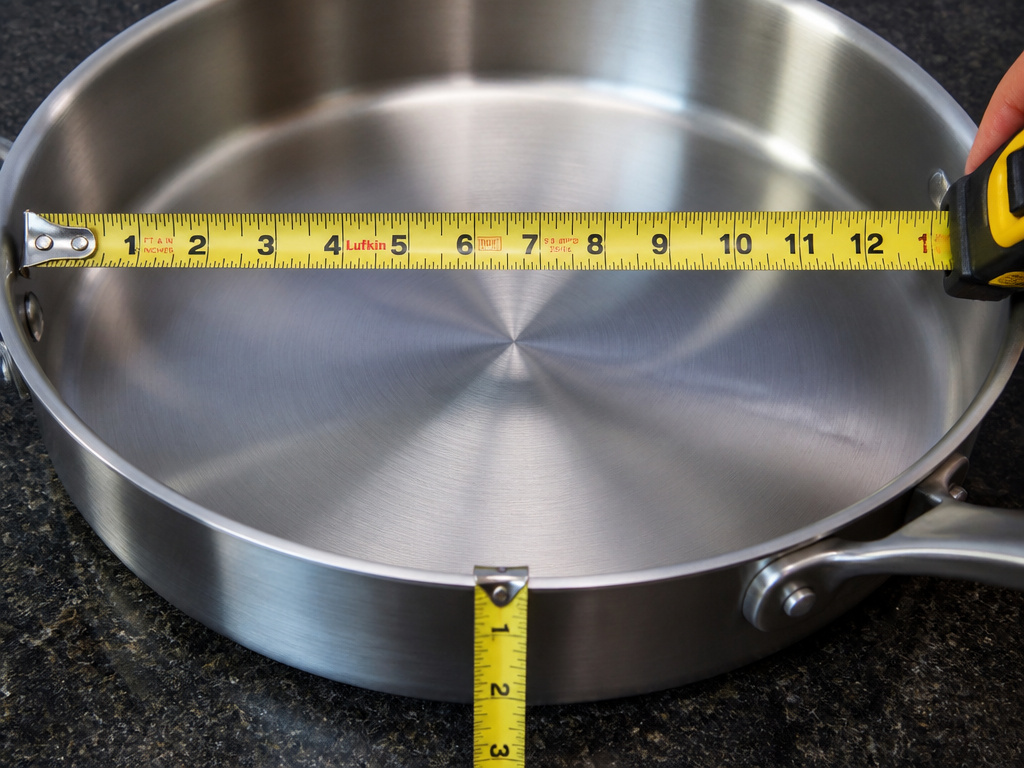 Capacity in quarts is almost useless. A manufacturer’s “5-quart” claim can mean a tall, narrow 10-inch pan or a wide, shallow 14-inch pan. They hold the same volume of water, but they cook completely differently.
You need two measurements: top diameter and height.
- Top Diameter: Use a tape measure across the very top of the pan, from inside edge to inside edge. This is your true cooking surface. For a large sauté pan, this number must be at least 12 inches. Write it down.
- Height: Measure straight down the inside of the wall. For proper braising and splatter control, look for 2.5 to 3 inches.
These two numbers tell you more than any quart rating. A pan that is 12 inches wide and 2.5 inches tall is a versatile workhorse. A pan that is 14 inches wide and 2 inches tall is a giant skillet—great for paella, not for a saucy braise.
The third, often hidden spec is bottom thickness. You can’t measure this easily, but you can find it in the manufacturer’s specs. Look for terms like “clad,” “tri-ply,” “5-ply,” or a gauge number (like 2-gauge aluminum). This tells you how resistant the pan is to warping. A warped pan is a dead pan.
The Material Showdown: Aluminum, Stainless, and Nonstick
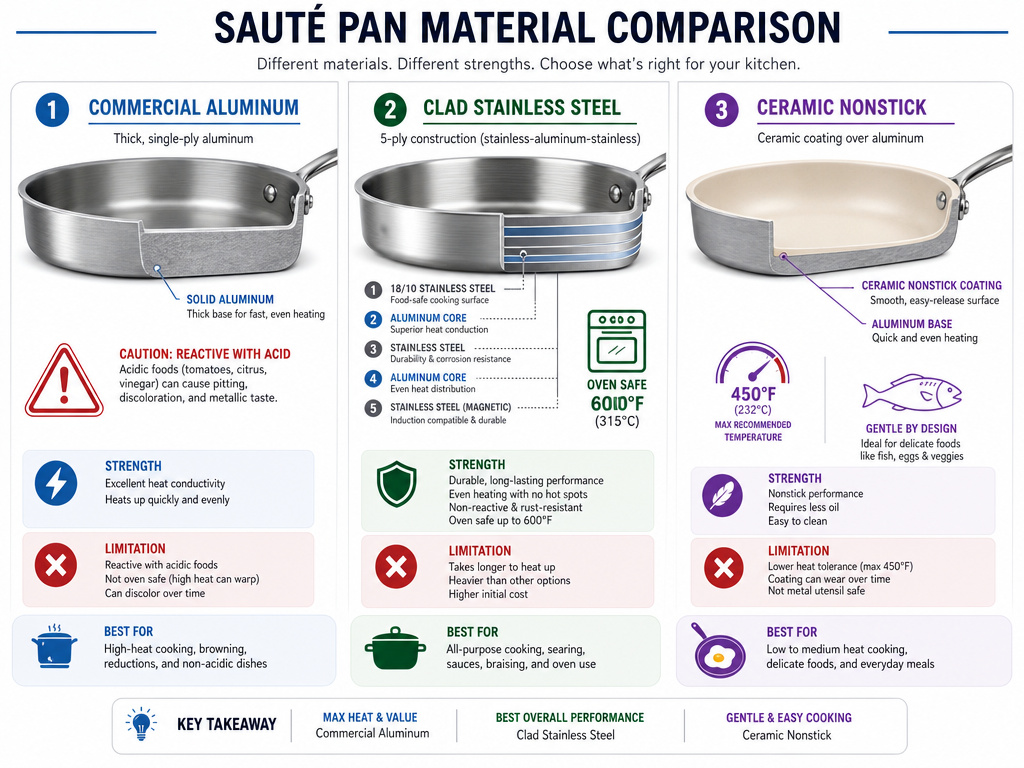 Your choice here locks in what you can cook, how you clean it, and how long it lasts. Each material has a dominant strength and a non-negotiable weakness.
Commercial Aluminum (Like Vollrath Wear-Ever)
These are the tanks of the kitchen. Pans like the Vollrath Wear-Ever Classic Select are made from 2-gauge 3004 aluminum with a double-thick bottom. They heat incredibly fast and evenly, which is why restaurants use them.
But there are three catches. First, aluminum reacts with acidic foods like tomatoes or wine, which can give a metallic taste and pit the surface over time. Second, they require hand washing. Third, and most critically, Vollrath’s warranty explicitly voids coverage for residential use. You’re buying a commercial tool with no safety net.
Common mistake: Buying a Vollrath for home tomato sauce. The acid will react with the aluminum on the first long simmer, leaving a metallic flavor in your food and dulling the pan’s interior.
They’re unmatched for high-heat, fast-cooking of neutral foods. For searing masses of vegetables or frying chicken, nothing heats faster. Just know you’re the warranty.
Clad Stainless Steel (Like Viking Professional 5-Ply)
This is the default recommendation for a reason. A pan like the Viking Professional 6.4-Quart Sauté Pan has a 5-ply construction: an aluminum core sandwiched between layers of stainless steel. The aluminum spreads heat, while the stainless steel interior is completely non-reactive.
You can sear a steak, deglaze the fond with red wine, add tomatoes, and simmer for hours. No metallic taste. No damage to the pan. Then you can put the whole thing, handle and all, into a 600°F oven to finish. You can also use metal utensils.
The trade-off? Food sticks more on initial searing. You must learn to preheat the pan properly and use enough fat. It’s also heavier and more expensive. For a tool you’ll use for decades, it’s the logical investment.
Ceramic Nonstick (Like GreenPan Rio)
Ceramic nonstick, like on the GreenPan Rio 5-Quart pan, is about ease, not performance. Its PFAS-free coating releases eggs and fish without any fat. Cleaning is trivial.
The limits are strict. The coating degrades above 450°F on the stovetop, and the pan is only oven-safe to 350°F. You cannot crank the heat to get a hard sear on a steak. You cannot finish a dish under the broiler. Metal utensils will destroy the coating.
It’s a specialist. Use it for delicate foods, low-temperature cooking, or for anyone who prioritizes easy cleanup over versatility. It won’t be your only large sauté pan.
| Material | Best For | Biggest Limitation | Oven-Safe Temp |
|---|---|---|---|
| Commercial Aluminum | Blazing-fast, even heat; high-volume neutral cooking | Reacts with acid; warranty void for home use | Varies (handle dependent) |
| Clad Stainless Steel | Versatile searing, deglazing, braising; metal utensil safe | Food sticks if not preheated/fatted properly | Up to 600°F |
| Ceramic Nonstick | Effortless release of delicate foods; easiest cleaning | Low heat tolerance; cannot sear or use high broiler | Up to 350°F |
What Size Large Saute Pan Do You Actually Need?
This decision comes down to how many mouths you feed and your stove’s power.
For 1–2 people cooking with leftovers in mind, a true 12-inch pan (often labeled as 4–5 qt) is perfect. It sears four chicken breasts or a pound of vegetables comfortably.
For 3–4 people or regular one-pan meals, aim for a 13-inch pan. This is the sweet spot for most home kitchens. It fits across two burners if needed and has enough surface area to cook a full pack of bacon or sausage for a weekend breakfast.
For 5–6 people or serious meal preppers, go for the 14-inch monster. This is the Vollrath 7.5 Qt territory. Check your burner first. A 14-inch pan on a standard 8-inch home burner will have cold edges. You need a powerful burner or the ability to straddle two burners to use it effectively. The payoff is the ability to cook an entire two-pound package of ground beef without steaming it.
Worth knowing before you start: A 14-inch pan is also a storage commitment. Make sure it fits in your cabinet or has a dedicated hanging spot.
Essential Features Beyond the Material
The pan’s body is one thing. The handles, lid, and finish decide daily comfort.
Handles: Look for riveted handles, not welded or screwed-on. Rivets are stronger and withstand oven heat. The handle should have a heat-break—a section where the metal narrows to slow heat conduction. Viking’s stainless steel handle uses this design. Silicone sleeves, like on the Vollrath, are rated for stovetop heat but check the rating (Vollrath’s is 450°F).
Lid: A tight-fitting lid is mandatory for braising. Glass lids let you monitor without releasing steam, but they have lower oven-safe temperatures. A stainless steel lid, like the one included with the Viking pan, matches the pan’s 600°F oven rating.
Finish: A satin or brushed finish (like on the Viking) hides scratches better than a mirror polish. It’s also less slippery when wet.
Frequently Asked Questions
Can you use a large sauté pan as a skillet?
You can, but it’s awkward. The straight sides make flipping food with a spatula more difficult compared to the sloped sides of a skillet. It’s better at tasks a skillet struggles with, like making a pan sauce or braising, than replacing a skillet for eggs or pancakes.
Is a 12-inch pan too big for a standard burner?
12-inch pan is designed for a standard home burner. The bottom will fully cover the heating element, providing even heat. Problems start when you jump to a 13-inch or 14-inch pan on a small 8-inch burner; the edges will be significantly cooler.
What is the difference between a sauté pan and a chef’s pan?
Chef’s pan, sometimes called a saucier, typically has rounded, sloping corners at the bottom where the side meets the base. This makes stirring and whisking sauces easier. A sauté pan has sharp, 90-degree corners. The chef’s pan is a hybrid between a saucepan and a sauté pan, while the sauté pan is designed for maximum flat cooking surface.
How do you clean a clad stainless steel sauté pan?
For everyday cleaning, use hot water, dish soap, and a non-abrasive sponge. For stuck-on fond, deglaze the pan with a little water while it’s still warm. For stubborn discoloration (rainbowing), a paste of baking soda and water or a dedicated stainless steel cleaner will restore the finish. Avoid steel wool on clad pans.
Are all large sauté pans oven-safe?
No. Oven safety depends on the materials of the handle and any knobs on the lid. Silicone handles often have a temperature limit (e.g., 450°F). Stainless steel handles with a heat-break, like on the Viking, can go to 600°F. Always check the manufacturer’s specified oven-safe temperature before putting a pan in the oven.
The Bottom Line
A large sauté pan is the most versatile pot in your kitchen when you match its geometry to your cooking. Start with the diameter—12 inches for small families, 14 inches for crowds. Choose clad stainless steel as your default for its non-reactive durability and oven safety. Remember that commercial aluminum pans heat beautifully but come with acid and warranty restrictions. Finally, treat the pan’s straight sides and flat bottom as the tools they are: for containing the mess and delivering the heat that turns a pile of ingredients into a complete meal in one shot.
