
Discover the Volume of a Large Soup Pot and Standard Sizes
This post contains affiliate links. As an Amazon Associate, we earn from qualifying purchases.
A large soup pot holds between 10 and 14 quarts (9.5 to 13.25 liters). In a commercial kitchen, the standard is 14 quarts, a size that matches the capacity of popular warmers like the Avantco S600. For home use, anything at or above 8 quarts qualifies as large, but stepping up to 10–12 quarts is better for batch cooking and feeding a crowd.
That 14-quart ceiling isn’t arbitrary. It’s the maximum capacity of the single-compartment warmers that dominate buffet lines and deli counters, designed to hold about 25 eight-ounce servings. Go larger, and you cross into stock pot territory, where the shape and intended use change.
What follows is a breakdown of the numbers: why the range is 10–14 quarts, how to convert that to real servings, and the critical differences between a soup pot, a stock pot, and a Dutch oven. You’ll also learn why wattage and wet-heat operation matter as much as the gallon number printed on the box.
Key Takeaways
- The commercial standard for a large soup pot is 14 quarts (13.25 L), as seen in models like the Avantco S600.
- For home cooks, a 10–12 quart pot is the practical large size, ideal for making 2–3 gallons of soup for leftovers.
- Always distinguish between a soup pot and a taller, narrower stock pot; the latter is for making broth, the former for serving and holding.
- Wet-heat only kettles, like some Dualit models, require a specific water buffer between liners to function and prevent damage.
- Volume alone doesn’t guarantee performance; a pot’s wattage (400W–600W) determines how well it maintains safe serving temperatures.
The 10–14 Quart Range: Why It’s the Standard
If you look at the spec sheets for commercial soup warmers, the numbers cluster tightly. The Avantco S600 holds 14 quarts. The Avantco S30SS holds 11 quarts. Maxima’s models are listed at 10 liters and 13 liters. This isn’t a coincidence.
This range solves a specific problem: holding enough soup for a lunch rush without taking up excessive counter space or requiring constant refills. A 14-quart pot, filled to a safe level, yields about 25 eight-ounce servings. That covers the peak two hours for most cafes.
Commercial soup kettle capacities are engineered around serving throughput, not arbitrary volume. The 14-quart (13.25 L) Avantco S600, with an 11-inch interior diameter and 8.25-inch depth, is designed to fit on standard buffet tables while holding a full day’s worth of a single soup offering.
The shape is part of the specification. A true soup pot is wider than it is tall. This broad surface area allows for easier ladling and better heat distribution across the entire volume. It also prevents the soup at the bottom from being crushed by the weight of the column above, which is a real concern with thicker chowders or stews.
Why 10 quarts is the home-kitchen entry point. An 8-quart pot can feel large until you try to make a broth-forward soup with lots of vegetables and protein. The ingredients displace water, leaving you with only 5 or 6 quarts of finished soup. Jumping to a 10- or 12-quart pot gives you the headroom for big batches with leftovers. It’s the difference between feeding a family for one night and feeding them for three.
How Volume Translates to Servings
You can’t just divide the pot’s volume by a bowl size. You must account for headspace (to prevent boil-overs) and ingredient displacement. This table gives you the realistic yield.
| Pot Advertised Capacity | Realistic Max Fill | Servings (8 oz / 1 cup each) | Best For |
|---|---|---|---|
| 8 Quarts | 6 Quarts | 12–14 | Small family, no leftovers |
| 10 Quarts | 8 Quarts | 16–20 | Family with planned leftovers |
| 12 Quarts | 10 Quarts | 20–25 | Meal prep, small gatherings |
| 14 Quarts | 12 Quarts | 24–28 | Large gatherings, commercial service |
The “Realistic Max Fill” is about 75–80% of the pot’s total volume. This is non-negotiable for stovetop boiling. For electric warmers, you follow the manufacturer’s maximum fill line inside the inner liner.
Soup Pot vs. Stock Pot vs. Dutch Oven: The Shape Dictates Use
Volume is just one number. The shape of the vessel tells you what it’s actually for. Confusing these is how you end up with a pot that doesn’t work for the task.
A soup pot is designed for serving. It’s wide and relatively shallow. This makes it easy to ladle from, and the large surface area helps liquid cool slightly as it’s served, preventing scorching. The Avantco S600 has an 11-inch diameter and is only 8.25 inches deep—a classic serving pot proportion.
A stock pot is designed for making. It’s tall and narrow. This shape minimizes surface area, which reduces evaporation during the long, slow simmer needed to extract flavor from bones and vegetables. A stock pot might hold the same 12 quarts as a soup pot, but it will be much taller and harder to ladle from gracefully. For making big batches of broth, you’d choose one of the best stock pots for soup.
A Dutch oven is a hybrid, but it’s not a serving pot. Its heavy construction and tight-fitting lid are for braising and slow-cooking on the stovetop or in an oven. While you can certainly make soup in one, its weight and typically smaller size (common large Dutch oven capacities are 5–7 quarts) make it impractical for buffet service. The key difference between a pot and Dutch oven is that a Dutch oven is an all-in-one cooker; a soup pot is a dedicated server.
Where this goes sideways: Using a tall stock pot as a soup server. The depth makes ladling awkward and increases the chance of burning your wrist on the steam. It also causes the soup at the bottom to be over-stirred and break down, while the top layer cools too quickly.
Electric Soup Kettles: Wattage and Wet-Heat Are Everything
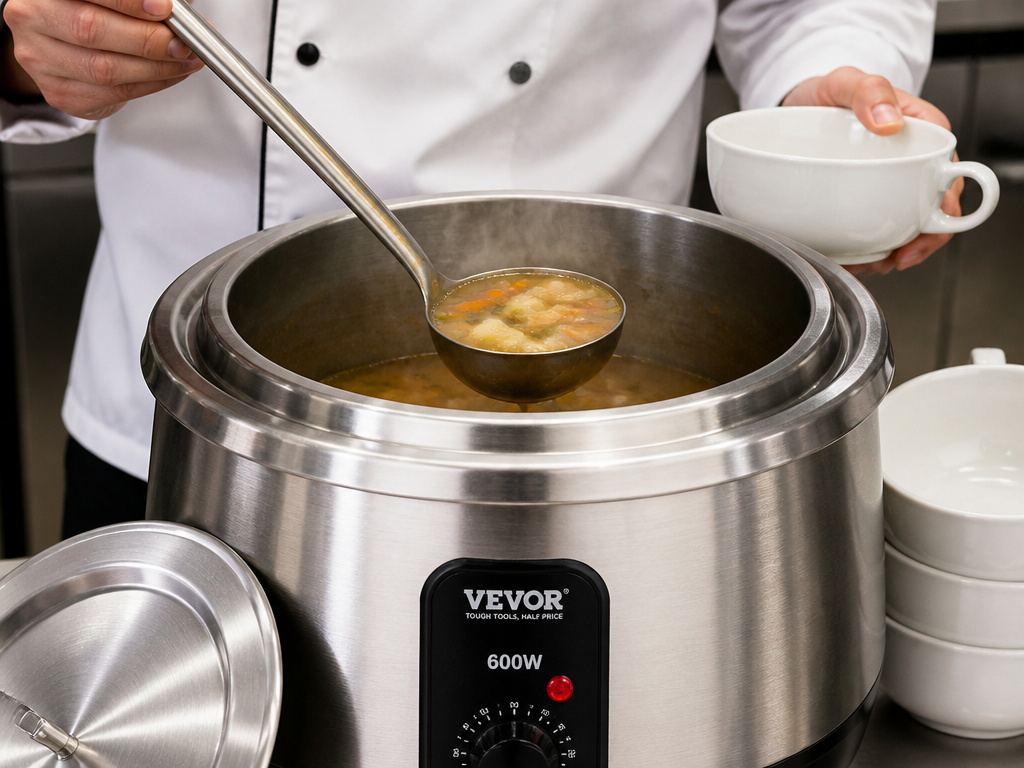 When you move from a stovetop pot to an electric soup kettle, volume becomes just one of three critical specs. The other two are wattage and heat method.
Wattage (400W–600W) is your holding power. A warmer doesn’t need to boil; it needs to maintain a safe serving temperature of at least 165°F (74°C) against the constant cooling effect of ladling and a cool room. The Avantco S600 uses 600 watts, while the S30SS uses 400 watts. The higher wattage unit will recover temperature faster after the lid is opened and is better for high-traffic areas.
Wet-heat vs. Dry-heat is a dealbreaker. Many commercial kettles, like the Dualit 10L, are wet-heat only. This means you must add a specific amount of water (300ml–600ml for the Dualit) between the stainless steel food liner and the outer aluminum container. This water bath provides gentle, even heat and prevents scorching. Let it evaporate, and you’ll damage the heating element—voiding the warranty on units like the Buffalo HT759, which requires descaling every three months to keep its guarantee valid.
Some models, like the Dualit 11L (DSKH), offer both wet and dry operation. For dry use, you must increase the temperature setting by one number to compensate for the lack of the water bath’s even heat. This is a useful feature for holding thicker, non-liquid items like mashed potatoes or gravy.
| Feature | Wet-Heat Only Kettle (e.g., Dualit 10L) | Dual-Use Kettle (e.g., Dualit 11L DSKH) | Dry-Heat Warmer (e.g., Buffet Chafer) |
|---|---|---|---|
| Required Water Buffer | Yes (300ml–600ml) | Optional (200ml for wet mode) | No |
| Best For | Soups, broths, liquid sauces | Soups, stews, mashed potatoes, gravy | Solid or semi-solid foods |
| Risk if Ignored | Element burnout, voided warranty | Inefficient heating, possible scorching in dry mode | Food drying out, scorching |
| Temperature Control | Thermostatic dial | Thermostatic dial | Manual or thermostatic |
Choosing Your Large Soup Pot: A Decision Guide
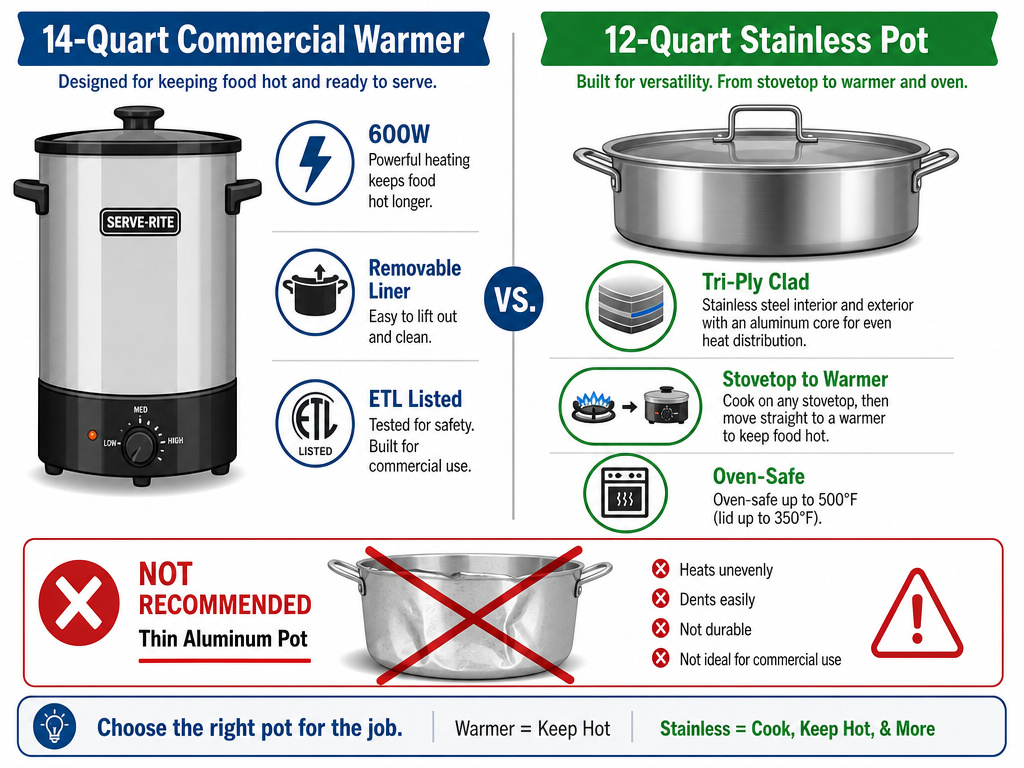 You need the right tool for your specific scenario. A busy deli has different needs than a home cook preparing Sunday dinner.
For commercial buffet service (cafes, delis, caterers):
- Capacity: Go with the 14-quart standard. The Avantco S600 is the benchmark.
- Wattage: Choose 600W for high-traffic lines; 400W is sufficient for slower service.
- Features: Removable, dishwasher-safe liner is non-negotiable. A hinged lid with ladle storage is a major convenience.
- Safety: Ensure it has a cool-touch handle and is ETL listed.
For serious home cooks and meal preppers:
- Capacity: A 10- to 12-quart heavy-bottomed stainless steel pot is ideal. This gives you the flexibility to make large batches on the stovetop and then transfer to a simpler warmer for serving.
- Material: Tri-ply or multi-ply clad stainless steel ensures even heating and prevents scorching. Avoid thin, single-ply pots for large volumes.
- Alternatives: Don’t overlook a large casserole pot for soup; their wide, oven-safe design is excellent for finishing soups under a broiler. For set-and-forget cooking, a 10-quart Instant Pot or the largest Instant Pot size can function as both cooker and warmer.
What to skip: Thin aluminum pots (they dent and scorch), pots without a thick bottom layer, and any electric warmer that doesn’t clearly state its wattage or heat method. Also, understand that a large sauté pan, while wide, is too shallow for volume soup making.
Frequently Asked Questions
Is a 6-quart pot large enough for soup?
For a single meal for four people, yes. For batch cooking or having leftovers, no. A 6-quart pot is a medium saucepan, not a large soup pot. After accounting for ingredients, you’ll get about 8 servings. If soup is a staple in your home, you’ll outgrow it quickly.
How many quarts are in a large soup pot at a restaurant?
Almost always 14 quarts. This is the standard inset size for commercial soup warmers. Some smaller operations or for secondary soup options might use 11-quart warmers like the Avantco S30SS. You’ll rarely see anything larger because the form factor becomes unwieldy for service.
Can I use my large Dutch oven as a soup pot?
You can use it to make soup, but it’s not ideal for serving soup at a buffet. A typical large Dutch oven is 7-9 quarts, heavier than a dedicated soup pot, and its enameled interior can be chipped by metal ladles. It’s a fantastic cooking tool but a clumsy serving one.
What’s the difference between a large soup pot and a large saucepan?
It’s a matter of degree. A large saucepan typically tops out at 4-5 quarts and has one long handle. A large soup pot starts at 8 quarts and has two looped handles for easier carrying when full of heavy liquid. The saucepan is for cooking; the soup pot is for cooking and serving volume.
Does a more powerful wattage (600W vs. 400W) mean the soup gets hotter?
No. Both units have thermostatic controls that cap the maximum temperature, usually around 195–212°F. The higher wattage means the unit can reheat to that set temperature faster after the lid has been open and cold soup has been added. It’s about recovery speed, not maximum heat.
Before You Go
A large soup pot isn’t defined by a single number, but by a combination of volume, shape, and function. The commercial world settled on 10–14 quarts for a reason: it’s the sweet spot between capacity and practical service. For your kitchen, let your cooking habits decide. If you love having soup for lunches all week, invest in a sturdy 12-quart stock pot for making and a simpler 8-quart warmer for serving. If you’re feeding a crowd regularly, understanding the wattage and wet-heat requirements of a commercial-style kettle will save you from a pot that can’t keep up. Remember, the best pot is the one that matches your volume needs today and has the build quality to last for thousands of servings.
