
What Is a Milk Pot & How Its Special Design Stops Scorching
This post contains affiliate links. As an Amazon Associate, we earn from qualifying purchases.
A milk pot is a double-walled cooking vessel designed to heat milk and delicate sauces gently and evenly using a water bath. This indirect heating method prevents the milk from burning, boiling over, or forming a skin, which is a common problem with direct-heat saucepans. The critical, non-negotiable rule is that you must always fill the space between the walls with water before use; operating it dry can damage the pot and defeats its entire purpose.
That water-bath mechanism is the whole point. It turns a simple pot into a precision tool for temperature-sensitive tasks. Without the water, you’re just using an oddly shaped, inefficient saucepan that will likely ruin your ingredients.
What follows is a breakdown of how this design works, the stark differences between a home kitchen model and a 50-liter professional warmer, and the specific dishes where a milk pot moves from a nice-to-have to indispensable. You’ll also see the safety warnings that manufacturers print in bold, warnings most overviews skip.
Key Takeaways
- The water bath is mandatory. Every manual states this. Running a double-walled milk pot dry risks damaging the pot and causes immediate, direct burning.
- It’s for gentle, even heat. The design is specifically for tasks where direct flame or induction contact would curdle, scorch, or boil over the contents.
- Capacity ranges wildly. Home models are typically 1–2 liters. Professional warmers, like the Kerbl MilkPot 50, hold 50 liters and are built for pasteurization.
- Safety warnings are specific. OEM manuals cite risks like tank bursting from blocked vents and scalding from overfilled water baths, not generic “be careful” notes.
- It’s a multi-tasker. Use it for chocolate, custards, béchamel, choux pastry, and even gentle defrosting.
How a Milk Pot Actually Works (The Water Bath)
Forget everything you know about heating milk in a regular saucepan. A milk pot uses a different physical principle: indirect conduction.
A double-walled milk pot creates a water bath. You pour water into the sealed space between the inner and outer walls. When you place the pot on a hob, the outer wall heats the water, which then gently transfers heat to the inner chamber holding the milk. This buffers the milk from the hob’s intense, direct heat.
The result is a slow, uniform temperature rise. Milk proteins don’t seize and stick to a hot spot. Sugars in sauces don’t caramelize and burn on the bottom. The maximum temperature is effectively capped near the boiling point of the water, preventing a runaway boil-over.
Fill the water bath every single time. This is the one step you cannot skip. The Kulina guide and every manufacturer manual treat this as an absolute. Without water, the inner wall gets direct, concentrated heat from the outer wall. Your milk will scorch in minutes, and the thermal stress can warp or damage the pot’s seams over time.
Types of Milk Pots: From 50 ml to 50 Liters
Not all milk pots serve the same kitchen. The design scales from a tiny serving pitcher to a piece of commercial dairy equipment.
| Type | Typical Capacity | Primary Use | Key Feature | Example Model |
|---|---|---|---|---|
| Home Kitchen Pot | 1.0 – 2.0 L | Gentle heating for drinks, sauces, custards | Double-walled stainless steel, often induction-compatible | WMF Perfection 1.0L |
| Professional Serving Pot | 50 – 500 ml | Frothing, pouring, and keeping milk warm for service | Single-wall stainless steel, often with a frother attachment | GGM Gastro MK-W50 (50 ml) |
| Commercial Milk Warmer | 10 – 50+ L | Pasteurizing and holding large volumes of milk or formula | Insulated tank with thermostat, water bath, and mixer port | Kerbl MilkPot 50 (50 L) |
The WMF Perfection Glas-Milchbehälter is a classic home example. It’s a 1-liter double-walled glass container designed to connect to certain coffee machines, but it works as a standalone water-bath pot. Its manual stresses two things: use up the milk before refilling to prevent spoilage, and never place the glass container on a hot surface.
On the opposite end, the Kerbl MilkPot 50 is a 32 kg, 2500-watt appliance. Its 50-liter stainless steel tank heats via a water bath with a viewing window and a stepless thermostat capable of pasteurization temperatures. The operating manual for this unit carries a stark, specific warning: never block the upper overflow opening. Blocking it prevents air equalization during heating, which can lead to the tank bursting or imploding.
Where this goes sideways: Using a home kitchen milk pot without water. The milk scorches onto the inner wall within five minutes, and cleaning it requires a long soak and scrubbing that can scratch the surface. You also risk permanent heat damage to the pot’s core structure.
Common Uses Beyond Heating Milk
A milk pot’s gentle heat makes it a versatile tool for any delicate stovetop task. If direct heat would risk curdling, separating, or burning, this is your pot.
- Scalding Milk: This is the process of heating milk to just below a boil (around 82°C/180°F) to kill bacteria and deactivate enzymes. A milk pot gives you precise control without the constant stirring and risk of boiling over you get with a standard saucepan.
- Custards & Egg-Based Sauces: Think crème anglaise or hollandaise. The water bath provides a buffer that heats eggs gradually, preventing them from scrambling.
- Melting Chocolate: Chocolate seizes with a single drop of water or burns on direct heat. A milk pot melts it slowly and evenly.
- Béchamel & White Sauces: The even heat prevents the roux from burning and allows the flour to cook out smoothly without lumps.
- Choux Pastry: The initial step of cooking flour in liquid needs consistent heat to gelatinize the starch properly.
- Keeping Foods Warm or Defrosting: The gentle, moist heat is ideal for thawing frozen purées or keeping a sauce warm without reducing it further.
Its function is complementary to, not a replacement for, a steamer pot. A steamer uses boiling water vapor to cook food, while a milk pot uses a water bath to modulate conductive heat.
Critical Safety and Maintenance Rules

The manuals aren’t filled with cautions for no reason. These are the specific, sourced warnings that keep you and the pot safe.
Before you start: The water bath can overflow if overfilled, causing scalding. Ensure handles are secure and not over a hot burner. Always use a dry potholder, a wet one transmits heat instantly.
The Judge cookware guide offers universal advice for hob-top milk pots: always heat gradually and never let the pan boil dry. Judge pans come with a 25-year guarantee, but it explicitly voids coverage for damage from overheating. Their guidance for cast iron pot sets emphasizes similar gradual heating to avoid thermal shock.
For the large Kerbl MilkPot 50, the warnings are more severe due to pressure build-up. The manual is unambiguous: the upper overflow opening must remain clear. Blocking it during heating traps expanding air or steam, creating pressure that can rupture the tank.
Easy to miss: The silicone ring on lids. The WMF Perfection lid has a removable silicone ring for cleaning. If this isn’t snapped back in place correctly, it can create a poor seal or fall into the milk.
Cleaning is straightforward but has one key rule: let the pot cool completely before dismantling it. Pour out the water from the bath. Most stainless steel pots, like the Judge frother, are dishwasher-safe, but handwashing is recommended to preserve finishes and prevent fittings from discoloring. For limescale in the water chamber, use a vinegar or citric acid solution just as you would for a kettle.
Milk Pot vs. Other Specialized Pots
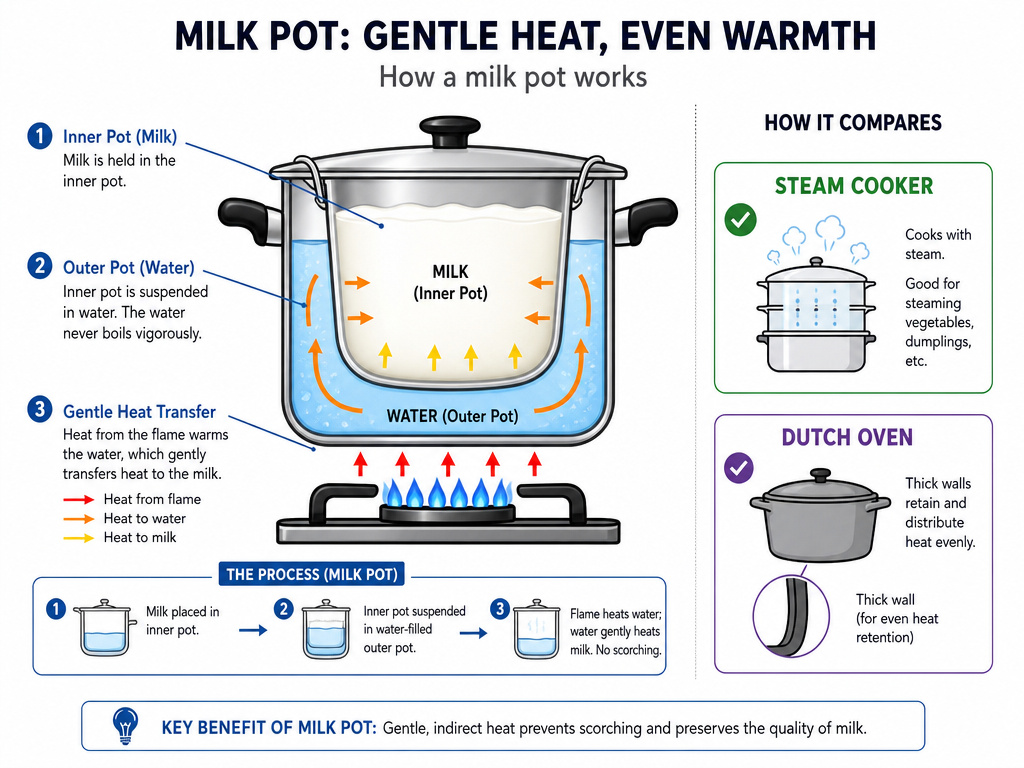
It’s easy to confuse a milk pot with other single-task items. Here’s how it fits into the broader cookware landscape.
A milk pot is not a steam cooker. A steam pot actively boils water to produce steam that cooks food above it. A milk pot uses static hot water to gently conduct heat, no boiling, no steam generation for cooking.
The comparison to a Dutch oven is about heat diffusion. Both are designed for even, steady heat. A Dutch oven achieves this with thick, heavy walls (often cast iron) that retain and radiate heat. A milk pot achieves it with a water bath that prevents high heat from reaching the food. One is for robust braising, the other for delicate warming.
It also shares no real function with a slow cooker or Crock-Pot. Those are countertop appliances for long, unattended cooking at low temperatures. A milk pot is a stovetop tool for active, precise temperature management over shorter periods.
So when do you need one?
You need a milk pot if you regularly make latte art, pastry cream, delicate sauces, or homemade yogurt. It’s for the cook who is tired of scrubbing burnt milk off the bottom of a pan. If you only heat milk for coffee once a week, a heavy-bottomed saucepan and your full attention will suffice. For everyone else, it’s a tool that solves a specific, frustrating problem perfectly.
Frequently Asked Questions
Can I use a milk pot on an induction hob?
Most modern stainless steel milk pots are induction-compatible because the outer wall is magnetic. Always check the manufacturer’s specifications. The Judge hob-top pot, for example, works on induction but requires the hob to recognize its 9cm diameter base.
Is a milk pot just for milk?
No. Its gentle, even heat is ideal for any temperature-sensitive task. This includes making custards, melting chocolate, preparing béchamel sauce, cooking choux pastry, or gently defrosting frozen foods without compromising texture.
How do I clean the space between the walls?
You don’t. The water chamber in a double-walled pot is a sealed unit. You only fill it with clean water and empty it after use. If limescale builds up inside, fill the chamber with a mixture of equal parts water and white vinegar, let it sit for an hour, then rinse thoroughly. Never use abrasive cleaners or tools inside the water space.
What’s the difference between a milk pot and a regular saucepan?
Saucepan applies direct, intense heat from the hob to its single wall. A milk pot uses a water bath between two walls to buffer and gently distribute that heat. This prevents hot spots and burning, making it superior for dairy and egg-based foods.
Are all milk pots double-walled?
No. The term “milk pot” can also refer to small, single-walled stainless steel pitchers used by baristas for frothing and pouring. For gentle heating, however, the double-walled water-bath design is the defining feature. Professional large-capacity warmers also use a double-wall or water-jacket system.
The Bottom Line
A milk pot is a purpose-built tool that replaces guesswork and constant vigilance with a simple physical principle: the water bath. It’s the answer to burnt milk, lumpy sauces, and split custards. The trade-off is an extra step, filling the chamber, and a piece of cookware that excels at a few specific tasks rather than doing everything.
For home bakers, sauce makers, or parents warming bottles, it’s a genuine problem-solver. Look for a 1.5-liter stainless steel model from a brand like Judge or WMF. Avoid the tiny sub-500ml pots unless you only froth milk for one drink at a time. And always, always remember the water. That’s the one rule that makes all the others work.
