
What Is a Pressure Cooker? Key Safety Standards Explained
This post contains affiliate links. As an Amazon Associate, we earn from qualifying purchases.
A pressure cooker is a sealed cooking vessel that uses trapped steam to raise internal pressure, which in turn raises the boiling point of water and cooks food significantly faster than conventional methods. Modern units are governed by strict safety standards like UL 136 and IS 2347, which mandate multiple fail-safes including a primary pressure regulator and a backup safety valve to prevent dangerous over-pressurization.
That definition is a list of engineering requirements tested against a 30-minute heating cycle where pressure must not exceed 0.5 psig, per recent U.S. Regulator notes.The difference between a pot and a pressure cooker is a certified safety system.
What follows: the physics that makes it fast, the three non-negotiable parts every cooker must have, and the official documents that set the rules for what you can safely buy. By the end, you’ll read a product manual and know which clauses trace directly to a government standard.
Key Takeaways
- Pressure cookers work by raising the boiling point of water, allowing food to cook at temperatures up to 121°C (250°F), which drastically cuts cooking times for tough cuts of meat, beans, and grains.
- Every legitimate model must have at least two independent safety devices: a primary pressure regulator to maintain safe pressure and a secondary safety valve that releases pressure if the first fails.
- Official standards like UL 136 (for the U.S.) and IS 2347 (for India) dictate everything from minimum metal thickness to the force required to open a lid under pressure, making modern cookers extremely safe when used correctly.
- The appliance must contain a minimum amount of liquid (often 0.25 liters) to generate steam; operating it without sufficient liquid risks overheating and damaging the pot.
- Understanding the difference between nominal pressure (the rated maximum, like 15 psi) and working pressure (the setting you cook at, like 10 psi) is key to following recipes and using the cooker properly.
The Core Definition: A Sealed Vessel for Faster Cooking
A pressure cooker is a purpose-built pressure vessel. The core pressure cooker mechanics leverage a basic law of physics: as pressure increases, the boiling point of water rises.Inside a sealed pot, steam builds and pressure climbs, allowing water to reach temperatures of 110–121°C (230–250°F) instead of boiling at 100°C (212°F) at sea level.
This elevated temperature is why food cooks food faster. Proteins denature more quickly, fibers in vegetables and legumes break down in a fraction of the time, and tough collagen in meat melts into gelatin in 90 minutes instead of 4 hours.
The general reference for pressure cookers traces this principle back to the 17th-century “steam digester” invented by Denis Papin. The modern iteration is defined not by history, but by codified safety. Standards bodies treat it as a closed domestic pressure cooking vessel intended for use over a heat source, capable of maintaining a specific nominal pressure. This is the text of the standards that manufacturers must meet.
Key Components and Their Jobs
Every pressure cooker has the same three critical systems. If one is missing or broken, stop using it.
The Sealing Lid and Gasket
The lid locks onto the pot body, creating an airtight seal via a rubber or silicone gasket. This seal is the foundation. The Indian Standard for domestic pressure cookers (IS 2347) mandates that the locking device must not release the lid unless internal pressure drops below a specific threshold, even if someone applies significant force. A worn gasket is the most common point of failure, leading to steady steam leaks that prevent pressure from building.
The Pressure Regulator
This weighted valve or spring-loaded plug sits on top of the vent pipe. It’s the primary control. As pressure builds inside, it lifts the regulator, allowing just enough steam to escape to maintain the target pressure. Most cookers offer two settings (e.g., low/0.6 bar and high/1.0 bar). The regulator is why you hear the characteristic rocking or hissing during cooking, it’s working.
The Safety Valve
This is the backup. It’s a separate, sealed mechanism designed to release pressure only if the primary regulator fails or becomes blocked. According to the IKEA 365+ manual, if steam escapes from this valve or a secondary safety pressure window, you must turn off the heat immediately, the internal pressure is too high. This redundancy is a non-negotiable requirement in all major standards.
Where this goes sideways: Replacing the annual gasket with a generic “one-size-fits-all” ring from a hardware store. The thickness and elasticity are precision specs. A mismatched gasket can fail to seal at 5 psi or, worse, blow out at 12 psi, releasing a jet of steam. Use the manufacturer’s part.
| Component | Primary Function | What Happens If It Fails |
|---|---|---|
| Lid & Gasket | Creates an airtight seal | Steam leaks constantly, pot never pressurizes, food won’t cook faster. |
| Pressure Regulator | Maintains target cooking pressure | Pressure fluctuates wildly, cooking times become unpredictable. |
| Safety Valve | Releases excess pressure as last resort | If both regulator and valve fail, over-pressurization risk increases. |
The Physics Behind the Speed
The faster cooking is the direct result of higher temperature under pressure. Water turns to steam at 100°C at sea level.In a sealed pressure cooker, that steam has nowhere to go, so pressure increases. For every additional pound per square inch (psi) of pressure, the boiling point of water rises by about 1.5°C (3°F).
Most home pressure cookers operate at a working pressure between 10-15 psi (0.7-1.0 bar). This brings the internal temperature to roughly 115–121°C (240–250°F).
At 15 psi, the boiling point is approximately 121°C (250°F). This 21-degree jump over boiling water dramatically accelerates chemical reactions like starch gelatinization and protein denaturation, which are time- and temperature-dependent.
This is why a pot of beans that simmers for 90 minutes can be done in 25 under pressure. It’s also why altitude matters less, the cooker creates its own high-pressure environment, counteracting the lower boiling point outside. The science of faster pressure cooking is a matter of consistent, elevated heat.
Safety Standards: The Rules Behind the Pot
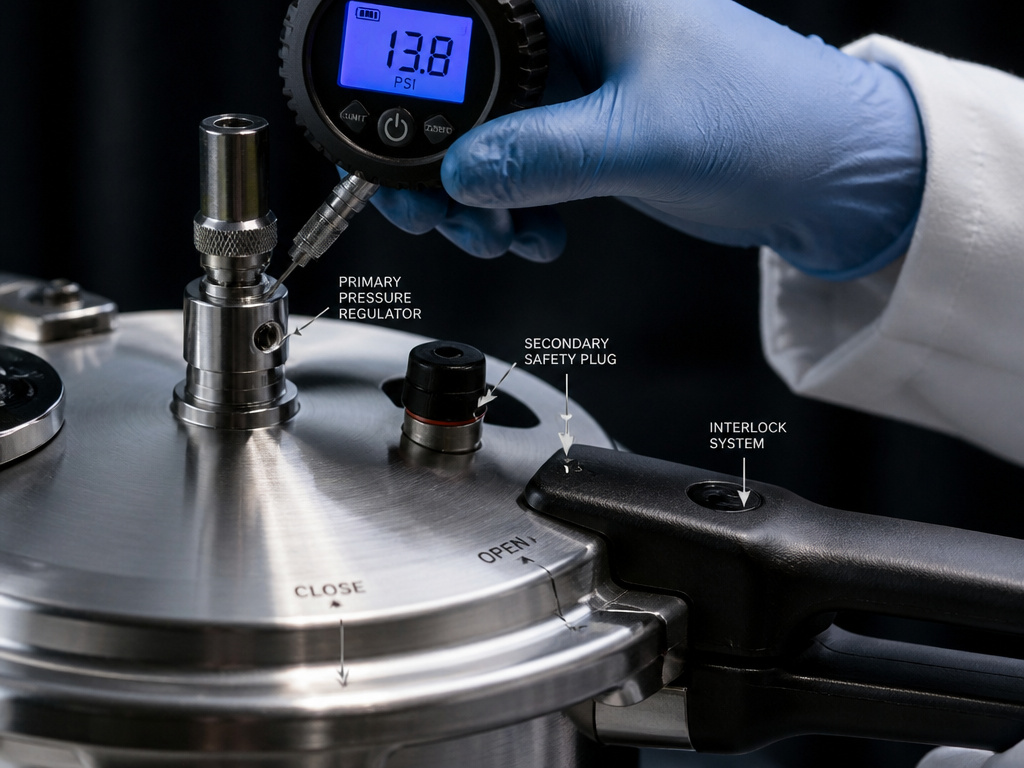 When you buy a pressure cooker, you’re buying a product shaped by decades of safety engineering and government oversight. These aren’t suggestions.
UL 136 (U.S. Standard)
This standard covers household pressure cookers operating at 15 psig (103 kPa) or less. It defines the tests for leakage, locking mechanisms, and handle strength. Recent government documentation on cooker standards from the CPSC staff recommends specific test procedures, like heating a cooker for 30 minutes and ensuring pressure does not exceed 0.5 psig during that period. This is the baseline for any cooker sold in the American market.
IS 2347 (Indian Standard)
This specification is remarkably detailed. It sets nominal capacities, mandates that the body and lid be made from specific aluminum alloys or stainless steel grades, and requires a burst pressure test of at least six times the nominal cooking pressure. Its rule that the lid must not open under pressure until it drops below 0.18 kgf/cm² is a quantifiable safety lock.
Common Safety Mandates
Both standards, and others like Europe’s EN 12778, enforce a multi-layer safety philosophy: 1. A lid that cannot be opened while pressurized. 2. A primary pressure-regulating device. 3. A secondary, independent pressure-relief safety device. 4. Clear markings for maximum capacity and minimum liquid.
These rules make the feared explosion of old-fashioned cookers extremely rare in certified modern units. The real explosion risk today almost always traces to user error, like overriding safety locks or using a damaged cooker, not spontaneous failure.
Pressure Cooker vs. Other Appliances
 It’s easy to confuse a pressure cooker with other countertop helpers. The difference is in the mechanism and result.
Pressure Cooker vs. Slow Cooker (Crock-Pot)
This is the most common mix-up. A pressure cooker vs slow cooker comparison boils down to speed and technique. A slow cooker uses low, indirect, moist heat over 6-10 hours to gently break down food. A pressure cooker uses high-pressure steam to achieve similar tenderness in 1-2 hours. The pressure cooker creates a sealed environment; the slow cooker’s lid is often vented.
Pressure Cooker vs. Multi-Cooker (like an Instant Pot)
An Instant Pot is a subset of pressure cooker, specifically, an electric multi-cooker. The core pressure cooking function is identical. The difference is the housing: a stovetop pressure cooker goes on your burner, while an electric model plugs in and has built-in programming. Many multi-cooker devices include pressure cooking as just one of several functions like sautéing, steaming, or slow cooking.
Pressure Cooker vs. Pressure Canner
This is a critical distinction for food preservation. A standard pressure cooker is designed for cooking meals. A pressure canner is larger, heavier, and designed to reach and maintain the higher pressures (often 10-15 psi) for the longer times required to safely process low-acid foods like vegetables and meat for shelf storage. Not all pressure cookers are safe for canning.
| Appliance | Core Method | Best For | Typical Time |
|---|---|---|---|
| Stovetop Pressure Cooker | High-pressure steam | Fast braises, beans, stocks | 1/3 to 1/2 conventional time |
| Electric Pressure Cooker | Programmed high-pressure steam | Set-and-forget meals, yogurt | Similar to stovetop, with automation |
| Slow Cooker (Crock-Pot) | Low, moist heat | All-day stews, pulled pork | 6-10 hours |
| Pressure Canner | Sustained high-pressure steam | Preserving low-acid foods like green beans | 20-100 minutes at pressure |
What You Can (and Should) Cook
The high-pressure, moist-heat environment is perfect for foods that are traditionally tough or long-cooking. It excels at transforming inexpensive ingredients.
Your best bets for pressure cooker recipes include: * Tough Cuts of Meat: Chuck roast, pork shoulder, and short ribs become fall-apart tender as the pressure rapidly breaks down connective tissue. * Dried Legumes: Unsoaked beans, chickpeas, and lentils cook in 25-45 minutes, with no pre-soaking needed. * Whole Grains: Brown rice, farro, and wheat berries cook evenly and quickly. * Broths and Stocks: Extract deep flavor from bones and vegetables in under two hours. * Potatoes and Root Vegetables: Cubed potatoes for mash cook in about 10 minutes.
The one universal rule: you must always include liquid. This is the non-negotiable water requirement. The IKEA manual states a minimum of 0.25 liters to generate sufficient steam and prevent the pot from boiling dry, which can cause overheating and damage. Water is the working fluid of the system.
Before You Go
A pressure cooker is a sealed vessel that uses physics to save you time. Its value lies in its strict adherence to engineering standards that prioritize safety through redundancy, a regulating valve and a backup valve. The speed comes from elevated temperature, not just steam.
For most home cooks, a 6-quart stainless steel stovetop model or a popular electric pressure cooker covers the basics perfectly. Start with a pot of beans or a beef stew to trust the process. Remember the liquid, respect the seals, and follow the manual, that document is your simplified version of the UL and BIS standards that keep the meal on your table and not on your ceiling.
Frequently Asked Questions
What is the main purpose of a pressure cooker?
Its main purpose is to cook food much faster than conventional boiling or steaming by using trapped steam to raise the pressure and temperature inside the pot. It’s especially effective for tenderizing tough meats, cooking dried beans without soaking, and making rich stocks in a fraction of the usual time.
How does a pressure cooker not explode?
Modern pressure cookers have multiple, redundant safety features mandated by law. These include a primary pressure regulator to control steam release, a backup safety valve that opens if pressure gets too high, and a locking lid that physically cannot be opened while the pot is pressurized. Standards like UL 136 require them to withstand pressures far beyond normal operating levels.
Is a pressure cooker healthy?
Pressure cooking is generally considered a healthy method because it cooks food quickly at a high temperature, which can help preserve heat-sensitive vitamins better than prolonged boiling. It also requires little to no added fat. However, the healthiness of the final dish depends more on the ingredients you choose than the cooking pot itself.
Can I use a pressure cooker for canning?
Only if it is explicitly marketed and tested as a pressure canner. Standard pressure cookers are not designed to reach or maintain the consistent, high pressures (typically a steady 10 or 15 psi) required for the extended processing times needed to safely preserve low-acid foods like vegetables and meat. Using a regular cooker for canning poses a risk of foodborne illness.
What is the difference between a pressure cooker and an Instant Pot?
An Instant Pot is a brand of electric multi-cooker that includes pressure cooking as its primary function. So, all Instant Pots are pressure cookers, but not all pressure cookers are Instant Pots. The key difference is that a stovetop pressure cooker is a single-purpose pot for your burner, while an electric model like an Instant Pot plugs in, often has built-in programs, and may include additional functions like sautéing or slow cooking.
How much water do I need in a pressure cooker?
You always need enough liquid to generate steam. Most manuals specify an absolute minimum, often around 1 cup (0.25 liters). A good rule of thumb for most recipes is to use at least 1 to 2 cups of liquid. Too little liquid risks the pot boiling dry, which can damage it and prevent pressure from building.
