
What Is in Blackstone Griddle Seasoning? Key Components
This post contains affiliate links. As an Amazon Associate, we earn from qualifying purchases.
Blackstone Griddle Seasoning is a proprietary blend of plant-based oils and waxes designed to polymerize into a durable, non-stick, and rust-resistant coating. The exact formula is a trade secret, but it’s engineered to burn off cleanly at high heat, leaving a thin, hard polymer layer that outperforms common household oils in long-term corrosion protection, especially in humid climates.
That “proprietary blend” label isn’t just marketing. It’s a promise about performance under heat and over time. Common oils like vegetable or canola work for the initial seasoning process, but they lack the additives that extend the life of the seasoning between heavy cooks.
What follows is a breakdown of what’s actually in the bottle, why the chemistry matters more than the ingredient list, and how to decide if the branded product is worth it for your climate and cooking frequency.
Key Takeaways
- Blackstone’s seasoning is a trade-secret blend of oils and conditioners, not a single oil like flax or canola.
- The critical action is polymerization, heating oil past its smoke point so it transforms into a hard, plastic-like coating bonded to the steel.
- Using too much of any oil, including Blackstone’s, creates a sticky, gummy layer that chips and attracts carbonized food.
- In humid or coastal climates, the long-term anti-corrosion additives in the branded product can prevent surface rust between uses.
- For most owners, a high-smoke-point plant oil works fine for initial coats, but the Blackstone conditioner simplifies maintenance.
What “Seasoning” Actually Means (It’s Chemistry, Not Cooking)
Seasoning isn’t about adding flavor from a bottle. It’s a chemical transformation. You apply a thin layer of oil to clean steel and heat it past its smoke point. The heat breaks down the oil’s organic compounds.
The oil doesn’t just dry. It polymerizes, forming long-chain molecules that cross-link into a hard, slick coating chemically bonded to the metal. This is the permanent, non-stick surface.
This polymer layer does two jobs. It fills the microscopic pores in the rolled steel, creating a smooth barrier. It also seals the iron in the steel from oxygen and moisture, which is the importance of seasoning for rust prevention. A thick layer can’t polymerize evenly. The top skins over while the oil underneath stays wet, leading to the sticky gunk everyone complains about.
The Core of Blackstone’s Proprietary Blend
Blackstone does not publish its ingredient percentages. The product label lists “a blend of plant-based oils and conditioners.” From material safety sheets and performance claims, we can reverse-engineer its design goals.
The blend must achieve three things: 1. A predictable, relatively high smoke point for consistent polymerization during the step-by-step seasoning guide for Blackstone. 2. Complete combustion of volatile compounds, leaving minimal carbon residue. 3. Long-term oxidation resistance to protect the steel during storage, a claim they emphasize over competitors.
This points to a base of refined, high-stability oils like soybean or canola, stripped of impurities that cause off-flavors. The “conditioners” are likely food-grade waxes or hydrogenated oils that solidify at room temperature, helping the polymerized layer resist moisture penetration. It’s this last part, the anti-corrosion additives, that separates it from a bottle of generic vegetable oil.
| Component | Likely Source Oils | Primary Function | Common Alternative |
|---|---|---|---|
| Base Oil | Refined Soybean, Canola, or Sunflower | Provides fatty acids for polymerization. High smoke point (~450°F). | Generic Vegetable Oil |
| Conditioning Agents | Food-grade waxes (Carnauba, Beeswax) or Hydrogenated Oils | Enhances moisture barrier; improves durability of polymer layer. | None in plain oil. |
| Additives | Possibly Tocopherols (Vitamin E) | Antioxidants to slow oil rancidity in the bottle. | None in plain oil. |
The takeaway? You’re paying for the conditioning agents and stability. For a griddle stored in a dry garage and used weekly, a best oil like canola works. For a griddle left on a covered patio in Florida, the extra protection has measurable value.
Why a Thin Layer Beats a Thick Coat Every Time
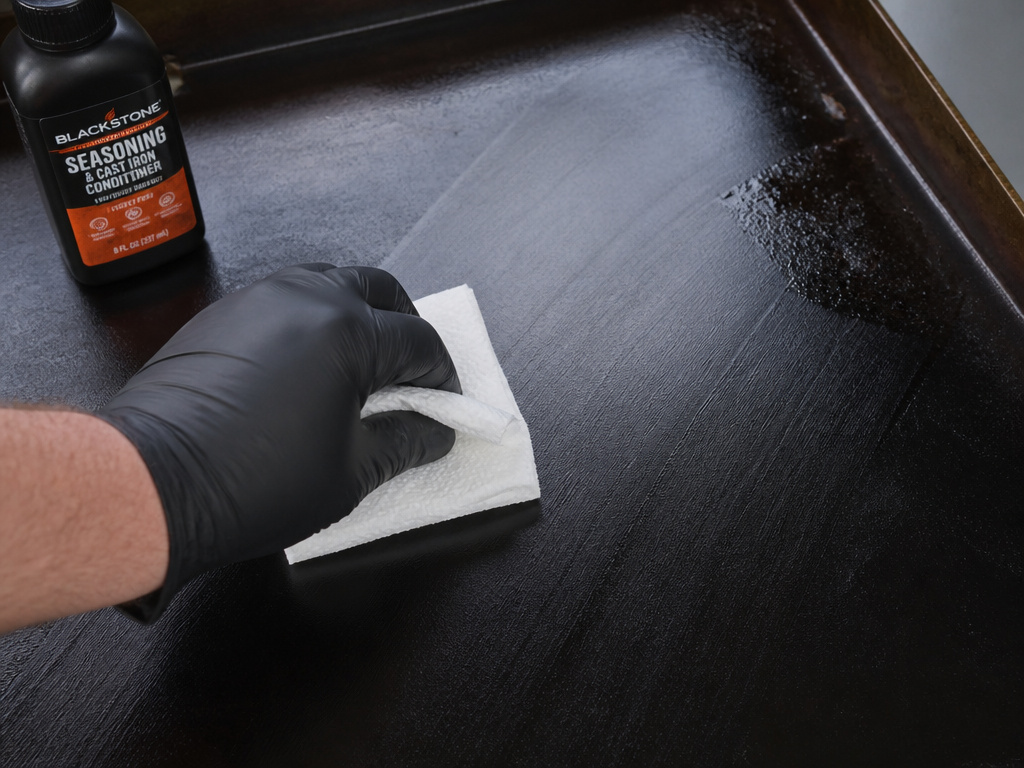
The most common mistake with any seasoning product is using too much. The manufacturer’s guides all scream “thin layer,” but few explain the mechanical consequence of ignoring them.
A thick layer of oil cannot transfer heat evenly to the steel underneath. The surface oil burns and smokes, but the oil trapped against the metal never reaches full polymerization temperature. It remains a semi-cured, sticky varnish.
Where this goes sideways: Applying a thick coat of seasoning oil. The partially polymerized layer stays tacky, attracting and bonding with food carbon on the next cook. You’ll see a brown, gummy residue that scrapes off in flakes, taking your seasoning with it.
The fix is always the same: burn it off and start over with a true thin coat. A proper layer is so thin it looks almost dry after you wipe it on. Use a paper towel and tongs to spread a tablespoon of oil across the entire surface, then use a second clean towel to buff off as much as you physically can. What’s left is the perfect amount.
How Blackstone’s Blend Compares to Common Household Oils

You can season a griddle with many oils. The choice changes the difficulty and the end result. Here’s how the branded product stacks up against pantry staples.
Flaxseed Oil
Flaxseed oil (linseed oil) is often touted for cast iron for its hard, glossy finish. It polymerizes very hard but is notoriously brittle. On a large, expanding-and-contracting griddle surface, a pure flaxseed layer can micro-crack over time, allowing moisture to reach the steel. It’s also expensive and perishable.
Canola, Vegetable, or Grapeseed Oil
These are the reliable workhorses. They have high smoke points, are cheap, and polymerize into a decent coating. This is what most oils for seasoning guides recommend. The downside? They offer no enhanced corrosion protection. The polymer layer is the only barrier.
Animal Fats (Lard, Bacon Grease)
Traditional but risky. They season beautifully and add flavor, but the non-uniform fat composition can leave spots that go rancid during storage. They also have lower smoke points and can create a less even polymer layer.
Blackstone Griddle Seasoning & Cast Iron Conditioner
The blend aims for the middle ground: as easy to use as canola oil, with a more durable and water-resistant polymer like you’d get from a wax-infused finish. It’s designed specifically for the thermal cycles of a steel griddle.
| Oil Type | Smoke Point | Polymer Hardness | Rust Protection | Best For |
|---|---|---|---|---|
| Flaxseed | ~225°F (Low) | Very Hard, Brittle | Good, but cracks | Showpiece cast iron, not daily-driver griddles. |
| Canola/Vegetable | ~400-450°F (High) | Medium-Hard | Baseline | Initial seasoning a Blackstone griddle on a budget. |
| Animal Fat | ~325-375°F (Med) | Variable | Poor; can go rancid | Flavor enthusiasts who clean and re-oil immediately. |
| Blackstone Blend | ~450°F+ (High) | Hard, Flexible | Enhanced with conditioners | Long-term maintenance, humid climates, and simplifying the process for seasoning a griddle. |
The bottom line? For your initial three to four seasoning coats, a cheap bottle of canola oil is perfectly fine. For the protective wipe-down after each cook, the step that prevents rusting between uses, the Blackstone conditioner or their Non-Stick Griddle Spray is harder to beat.
The Critical First Clean: Removing the Shipping Coating
New Blackstone griddles come with a thin layer of soy-based oil applied at the factory. This seasoning acts as a rust inhibitor for shipping and warehouse storage. It will feel slightly sticky or waxy.
You must remove this completely before you start any initial seasoning. The manual is explicit: wash the cooking surface with hot, soapy water. This is the only time soap should touch the plate.
Common mistake: Skipping the soap wash or not drying thoroughly. The shipping oil prevents the new seasoning oil from bonding directly to the steel. Any water left behind flashes to steam under high heat, disrupting the first polymer layer and leading to immediate spotting.
Dry the plate aggressively with paper towels, then immediately place it on the heat to evaporate any remaining moisture. Once it’s hot and dry, you can apply your first thin layer of seasoning oil.
When to Use the Branded Seasoning vs. Any Other Oil
Your location and routine decide this. The manufacturer’s own FAQ singles out humid and coastal climates as needing special attention.
If you live inland with low humidity, store your griddle indoors, and use it regularly, the difference between canola and the Blackstone blend might be minimal. Your cooking fats will constantly be replenishing the surface.
If your griddle lives outdoors under a cover in a damp climate, or you only use it on weekends, the added corrosion fighters in the branded product matter. That final protective wipe-down with the conditioner after cleaning creates a more resilient barrier against overnight dew or weekly humidity.
Worth knowing before you start: In humid climates, a griddle seasoned only with plain vegetable oil can show faint surface rust specks after just one week of inactivity if not covered. The Blackstone blend can extend that to several weeks.
For the post-cooking seasoning maintenance step, the convenience of the Blackstone Non-Stick Griddle Spray (a similar formula in spray form) is legit. It applies a perfectly thin, even coat without needing a towel.
Frequently Asked Questions
Can I use olive oil to season my Blackstone?
You can, but you shouldn’t. Extra virgin olive oil has a low smoke point (around 375°F) and contains many impurities that burn into a sticky, carbonized mess rather than a clean polymer. It’s one of the worst choices for selecting a seasoning oil.
Is the Blackstone seasoning blend food-safe?
Yes. It is formulated and certified as a food-safe conditioning product. Once polymerized, it is an inert coating. The “cast iron conditioner” part of its name indicates its use for maintaining seasoned surfaces, not for direct flavoring.
Why does my newly seasoned griddle look patchy or brown?
Patchy, brownish surface is the classic sign of too much oil. The thick areas polymerized into a darker, sometimes gummy residue. Don’t worry about the color during the seasoning for the first time. Focus on a thin, even coat. The color will even out to a consistent black after several cooking sessions.
How often should I re-season with the Blackstone product?
After the initial 3-4 coat seasoning, you don’t “re-season” in the full, smoke-for-30-minutes sense unless you damage the surface. Maintenance is a thin wipe-down with the conditioner or spray after every clean, while the plate is still warm. This is what maintains the properly seasoned look and prevents the consequences of not seasoning.
Can I use this on my cast iron skillets too?
Absolutely. The product is marketed as a “Griddle Seasoning & Cast Iron Conditioner.” It works on any bare or seasoned carbon steel or cast iron surface that requires a polymerized oil coating for protection.
Before You Go
Blackstone Griddle Seasoning is a tool engineered for a specific job: maximizing the lifespan of a steel griddle in real-world conditions. For your initial seasoning coats, a cheap, high-smoke-point plant oil is a financially smart choice.For the long haul, especially if you battle humidity or store your griddle outdoors, the proprietary blend’s enhanced rust protection is its legitimate selling point.
The real secret lies in the technique, that obsessively thin layer, heated until the smoke stops. Get that right with any oil, and you’ll have a surface that lasts.The Blackstone blend just gives that surface a better fighting chance against the elements.
