
Define Induction Ready Cookware: How the Magnet Test Works
This post contains affiliate links. As an Amazon Associate, we earn from qualifying purchases.
Induction ready cookware is any pot or pan with a base made of a magnetic material, like cast iron or magnetic stainless steel, that allows an induction cooktop’s electromagnetic field to generate heat directly within it. The label “induction-ready” is a marketing term, not a certified standard; the real test is whether a magnet clings firmly to the cookware’s bottom. Using incompatible or incorrectly sized cookware leads to no heat, uneven cooking, or sensor errors.
That magnetic requirement is the gate, but it’s not the whole house. What happens inside the gate, the shape of the base, the size relative to the cooking zone, even the weight of the pan, decides whether your induction cooktop performs as advertised or becomes a source of frustration. A pan that passes the magnet test can still fail in practice if its base is warped or too small for the zone’s sensor.
What follows: a breakdown of the magnetic rule, why flatness and size are non-negotiable specs, a guide to common materials, and how to decode your cooktop’s manual for the specifics your model actually demands.
Key Takeaways
- The only mandatory requirement is a magnetic base. The “induction-ready” symbol is helpful but not a guarantee.
- A flat bottom is critical. A warped pan lifts off the glass, breaking the magnetic coupling and causing inefficient heating or error codes.
- Pan diameter must match the cooking zone’s graphic. An undersized pan won’t activate the sensor; an oversized one heats slowly and unevenly.
- Not all stainless steel is magnetic. Look for grades like 18/10 or 18/0 that contain enough iron; highly austenitic grades (like some 18/8) are not magnetic.
- Pure copper, aluminum, glass, and ceramic cookware will not work on induction unless they have a bonded magnetic plate on the bottom.
The Non-Negotiable Rule: Magnetic Material
Forget the marketing. The physics are simple: induction cooking uses an electromagnetic coil under the glass to create a magnetic field. That field needs to induce a current in your cookware. The only way that happens is if the cookware base contains ferromagnetic material, iron or steel that a magnet will attract.
The magnetic cooking zone sensors located below the cooktop surface require the use of cookware made with magnetic material in order to start the heating process.
Electrolux Induction Range Use & Care Manual
If the base isn’t magnetic, the coil has nothing to “grab,” and the cooktop won’t turn on. This is why checking your existing pots and pans with a fridge magnet is the definitive first step. Don’t just check the center, run the magnet over the entire cooking surface of the base. A partial magnetic layer, common in some multi-ply or clad induction-compatible cookware, can still work, but heat distribution may be uneven.
The Magnet Test, Decoded
The test isn’t a gentle attraction; it’s a firm cling. If the magnet slides off or holds weakly, the iron content is too low. This is the most common point of confusion with stainless steel on induction. Stainless steel is an alloy, and its magnetic properties depend on its crystalline structure.
- Magnetic (Will Work): 400-series stainless (often used for knife blades), and many 300-series grades like 18/0 (containing no nickel) or specific 18/10 grades with a ferritic layer. Cast iron and carbon steel are always magnetic.
- Non-Magnetic (Won’t Work): Highly austenitic 300-series stainless steels, like some 18/8, which contain more nickel and chromium. Pure aluminum, copper, glass, and traditional ceramic are also non-magnetic.
If you’re shopping, look for the induction symbol, a coiled line symbol, stamped on the bottom. It’s a quick visual cue, but still perform the magnet test. I’ve seen pans with the symbol where the magnetic layer was so thin the magnet barely held, leading to poor performance.
Why Flatness and Pan Size Aren’t Suggestions
Passing the magnet test gets you in the door, but two physical specs determine if you’ll cook successfully: flatness and diameter. These aren’t about efficiency; they’re about basic function.
A warped bottom is a deal-breaker. Even a slight curvature means parts of the pan base aren’t in full contact with the glass. The magnetic field weakens with distance, so those lifted areas won’t heat properly. You’ll get hot spots directly over the coil and cold spots elsewhere. More critically, many cooktops have sensitive pan-detection sensors. If contact is insufficient, the zone may flash an error code and shut off entirely, thinking no pan is present.
Pan diameter is dictated by the circles on your cooktop. Each cooking zone has a minimum and maximum size indicated by concentric rings on the glass or in the manual.
| Pan Status vs. Zone | Result | Typical Cooktop Response |
|---|---|---|
| Too Small | Pan doesn’t cover the sensor. | Zone won’t activate; displays error or flashes. |
| Correct Size | Pan covers the inner ring fully. | Even, efficient heating. |
| Too Large | Pan extends beyond outer ring. | Outer edges heat slowly via conduction; center may scorch. |
Cookware that is too small for a zone may not activate the cookware detection sensor.
Electrolux Induction Cooktop Use & Care Manual
For example, an Electrolux model specifies a minimum of 4.7 inches for its smallest zone. Using a tiny butter warmer on that zone will do nothing. Always match the pan to the zone. If you only have a small pan, place it on the smallest zone available.
A Guide to Induction-Compatible Materials
Knowing which materials work helps you shop smarter and understand why your favorite pan might not make the cut.
Cast Iron & Carbon Steel: The gold standard. They’re highly magnetic, retain heat beautifully, and are often perfectly flat. Their weight is an advantage, it minimizes the slight vibration or buzz that can happen with lighter pans. A pre-seasoned cast iron skillet or a Dutch oven on induction is a powerhouse combination.
Magnetic Stainless Steel: This is the category for most modern multi-ply cookware sets. They typically have an aluminum or copper core for heat spread, sandwiched between layers of magnetic stainless steel. Brands like All-Clad, Calphalon, and Cuisinart produce lines specifically for induction. When testing stainless steel for induction, ensure the magnet sticks firmly to the entire cooking surface, not just the center.
Enameled Steel: This includes many affordable Dutch ovens and saucepans (like those from Le Creuset or Staub). The steel base is magnetic, and the porcelain enamel coating doesn’t interfere. It’s crucial these have a flat base, some cheaper, thin enameled steel can warp.
Non-Compatible Materials (Without a Plate):
- Pure Aluminum: Excellent conductor, but non-magnetic. Will not work.
- Pure Copper: Beautiful, but non-magnetic. Will not work. Some high-end copper cookware on induction has a stainless steel or magnetic plate bonded to the bottom.
- Glass, Ceramic, Clay: Non-magnetic. Unless specifically designed with a magnetic base layer, they are not suitable.
- Thin, Non-Magnetic Stainless Steel: Many cheap, single-ply restaurant supply pans fall here. The magnet won’t stick.
Where this goes sideways: Assuming “stainless steel” means induction-compatible. The alloy matters more than the name. A magnet is the only truth-teller.
Features, Noises, and the “Cookware Test”
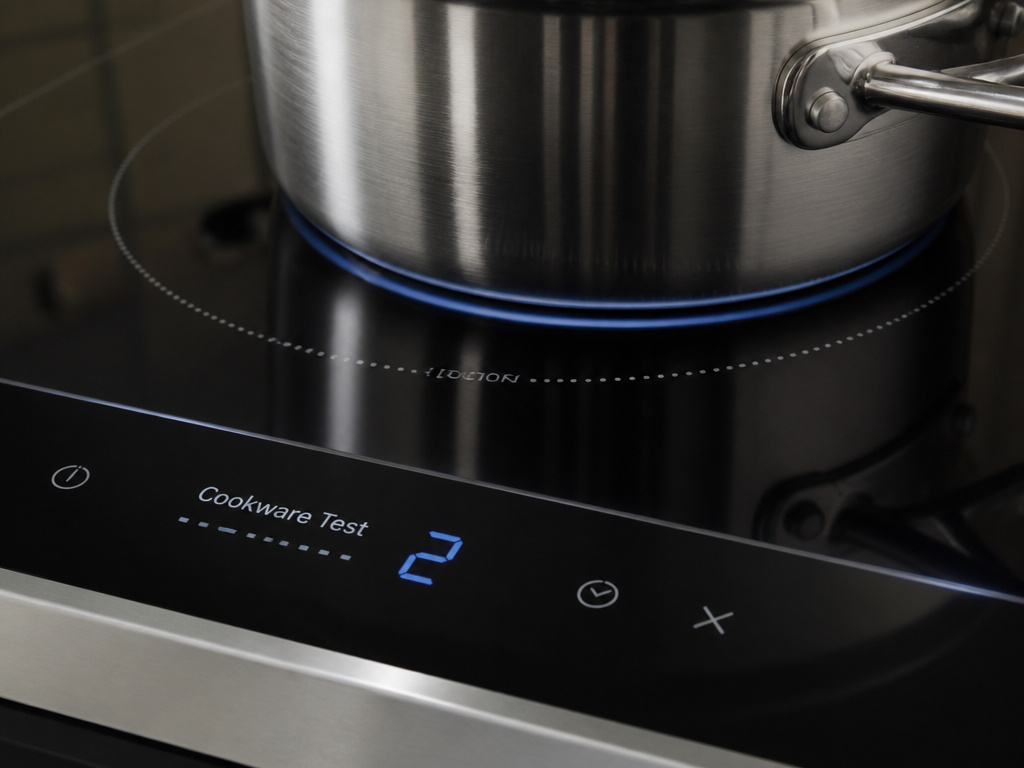
Induction introduces some quirks. The TempLock or “Bridge” functions on your cooktop rely on precise pan detection and even heating. They often work best with “heavy, sturdy, high-quality cookware,” as noted in manuals. A lightweight, warped pan can confuse these smart features.
You may also hear noises, a low hum or buzz, especially at high power. This is normal. It’s caused by the magnetic field causing the cookware to vibrate slightly. Heavier pans like cast iron buzz less. A high-pitched rattle might indicate a loose handle.
Some premium cooktops, like certain Gaggenau models, include a diagnostic “Cookware test” function. It assesses the magnetic coupling and quality of the pan, displaying a “1” for slow heating or a “2” for correct heating. If you get no display, the pan isn’t suitable. This tool highlights that compatibility isn’t binary; it’s a spectrum of performance.
Frequently Asked Questions
Does “induction ready” mean it will work perfectly?
Not necessarily. “Induction-ready” is a marketing term, not a certified performance standard. A pan can be marketed as such but still have a base that’s slightly convex or uses a thin magnetic layer. It should work, but for optimal performance, it must also be flat and of appropriate size and weight for your cooktop’s power.
Can I use my old pots and pans on induction?
You can if they pass the magnet test. Many older stainless steel or cast iron pots work perfectly. This is the first and most important step in transitioning to an induction cooktop without replacing your entire kitchen.
Why does my induction cooktop beep and not heat?
This is almost always a pan detection error. The most likely causes are: 1) The cookware is not magnetic (failed magnet test), 2) The pan is too small for the activated cooking zone, or 3) The pan’s bottom is not flat and making poor contact. Center a larger, flat, magnetic pan on the zone.
Is special cookware for induction more expensive?
It can be, but it doesn’t have to be. A basic cast iron skillet is one of the best-performing and most affordable pieces of induction-compatible cookware you can own. While high-end multi-ply sets are expensive, there are quality, budget-friendly induction-ready cookware sets from brands like Tramontina and Cooks Standard that perform exceptionally well.
The Bottom Line
Induction cooking demands a partnership between the cooktop and the cookware. The cooktop provides precise electromagnetic control, but the pan must hold up its end of the bargain: a flat, magnetic base of the right size.
Skip the jargon and start with a magnet from your fridge. Test everything. Then, lay each pot on your counter and check for rocking. Finally, match your keepers to the circles on your cooktop. This three-step check, magnetic, flat, sized, is more valuable than any “induction-ready” logo. It turns a confusing spec into a simple, physical rule you can verify with your own hands.
