
What to Look for in Stainless Steel Cookware Type of Steel
This post contains affiliate links. As an Amazon Associate, we earn from qualifying purchases.
To choose the right stainless steel cookware type of steel, match three specs: the alloy grade (304 or 316), the construction (single-ply vs. Multi-ply), and the bottom thickness (0.51mm minimum for saucepans). The alloy defines corrosion resistance, the construction controls heat spread, and the thickness prevents warping. A 304 tri-ply pan with a 2.5mm aluminum core is the default for most home kitchens.
That answer is the starting line, not the finish. The numbers 304 and 316 aren’t just marketing, they’re standardized alloy recipes printed on a mill sheet. The difference between them isn’t academic; it’s a physical barrier against pitting in your tomato sauce. The construction method decides whether your pan heats evenly or develops a permanent hot spot the size of a burner coil.
What follows: a breakdown of the three specs, the two certifications that verify them, and the one peer-tested result that reframes the “metal leaching” worry.
Key Takeaways
- The alloy grade (like 304 or 316) is the single most important spec. It’s stamped on the steel coil before the pan is formed.
- Construction, single-ply, clad, or disc-bottom, determines heat distribution. Tri-ply with an aluminum core is the performance standard.
- Thickness is a durability spec, not a weight preference. The Cookware Manufacturers Association (CMA) sets a 0.51mm minimum for saucepans.
- Metal release from new stainless steel is highest during the first few uses, then drops sharply as the surface passivates.
- For high-acid, high-salt, or long-simmering cooking, step up to 316. For everything else, 304 is more than sufficient.
The Three Specs That Actually Matter
Forget brand names and finishes for a minute. The material facts that dictate performance and longevity are the alloy grade, the construction type, and the gauge thickness. A manufacturer can’t change these after the fact. They are locked in at the mill.
If a product page doesn’t list these three, you’re buying a mystery.
What Do the Numbers 304 and 316 Actually Mean?
These are standardized designations from the ASTM A240 or EN 10088 standards. They are recipes for stainless steel. The first number you usually hear, 18/10 or 18/8, refers to the chromium and nickel content. But the grade number (304, 316) includes that plus the molybdenum.
Stainless steel 304 (18/8 or 18/10) contains 18% chromium, 8-10.5% nickel, and no added molybdenum. It forms a robust passive oxide layer that resists rust and handles everyday acids like vinegar or wine. Stainless steel 316 adds 2-3% molybdenum. That one element dramatically increases resistance to chlorides (salt) and strong acids.
The molybdenum in 316 plugs microscopic gaps in the protective oxide layer. In a Springer Nature materials evaluation study comparing kitchen equipment metals, 316 showed superior corrosion and fatigue resistance specifically in aggressive environments. For a home cook, “aggressive” means weekly batches of tomato sauce, frequent brining, or cooking near a coastal environment.
| Alloy Grade | Common Name | Key Additive | Best For | Risk If Wrong |
|---|---|---|---|---|
| 304 | 18/8 or 18/10 | None (Chromium-Nickel) | General use: searing, sautéing, boiling water, making soups. | Pitting corrosion after months of high-salt, high-acid cooking. |
| 316 | Marine Grade | 2-3% Molybdenum | High-acid canning, daily tomato sauces, cooking in coastal kitchens. | Overpaying for performance you won’t use if you cook mostly neutral foods. |
You don’t need 316 for a stockpot that only boils water. You do need it for a saucier that reduces lemon-butter sauces twice a week.
Where this goes sideways: Assuming 18/10 always means 316. It doesn’t. 18/10 describes chromium/nickel ratio only. A pan marked “18/10” could be 304 or 316. The grade number is the mandatory label.
Construction: Single-Ply, Clad, or Disc Bottom?
The alloy is the material. Construction is how you shape it into a pan that heats evenly. Stainless steel alone is a poor heat conductor. Left as a single layer, it will develop severe hot spots.
- Single-Ply (Uniform Layer): One sheet of stainless steel, formed. It’s lightweight and affordable, but heat spreads unevenly. You must preheat slowly and constantly adjust the burner. Warping is common.
- Clad (Multi-Ply): Layers of metal bonded together. The standard is tri-ply construction: an outer stainless layer, a middle core of aluminum or copper, and an inner stainless cooking surface. The aluminum core spreads heat quickly and evenly across the entire pan bottom and up the sides. This is the benchmark for performance.
- Disc Bottom: A thick slab of aluminum or copper bonded only to the pan’s bottom. It heats evenly directly over the burner but does nothing for the sides. Food sticks at the edges where the temperature gradient is steep.
For electric coil or induction cooktops, a fully clad pan is non-negotiable. The even heat distribution prevents scorching. A warped disc-bottom pan loses contact with a flat induction surface and stops working.
Thickness: The Warping Guard
Thickness is measured in millimeters (mm) or gauges. It’s a durability spec, not a feel. A pan that’s too thin will warp when heated quickly or cooled abruptly, like moving a hot pan to a wet counter.
The Cookware Manufacturers Association (CMA) Standard 10 sets minimum thicknesses for categories. For a saucepan, the floor is 0.020 inches (0.51 mm). Many quality pans start at 0.8mm for the body and 2.5mm for the clad core.
A thicker pan also has more thermal mass. It recovers temperature faster when you add cold food, which is critical for proper searing. Heft is a side effect, not the goal.
The Science Behind “Safe” and “Non-Reactive”
Stainless steel is inert. The chromium oxide layer on its surface prevents the underlying iron, nickel, and chromium from leaching into food in any significant quantity. The research is consistent on this point.
A pivotal study by the International Molybdenum Association tested seven grades of stainless steel, including 304 and 316, against the Council of Europe’s stringent food-contact protocol. The simulant was 5g/l citric acid at pH 2.4, more aggressive than most foods. The result: all grades released metals far below the safety limits. More importantly, the study noted the rate of metal release decreases significantly following initial exposure and with repeated use.
New pots release more metal ions than used ones. The first few times you cook with a stainless steel pan, the surface is “seasoning” itself, not with oil, but by stabilizing its passive layer. After that, leaching drops to negligible levels.
This is why you shouldn’t fear cooking acidic foods in stainless steel. The amounts involved are tiny. For context, a Food Protection Trends publication on food equipment characteristics notes that 3-A Sanitary Standards for commercial equipment mandate 304 or 316 for all food-contact surfaces. If it’s safe for a restaurant making 200 gallons of tomato sauce a day, it’s safe for your kitchen.
How to Verify What You’re Buying
Manufacturer claims are easy to make. Verification is harder. You need to look for specific language and, when possible, documentation.
- Demand the Grade Number. The product description must say “304 stainless steel” or “316 stainless steel.” “18/10 stainless steel” is incomplete. “High-quality stainless steel” is meaningless.
- Look for a Clad Specification. It should read “tri-ply,” “3-ply,” or “5-ply clad.” “Aluminum core” is good. “Aluminum base” or “encapsulated bottom” often means disc-bottom.
- Check for Standards. Some brands note compliance with GB/T 29601-2025 (a Chinese national standard for stainless steel ware) or ASTM A240. This indicates they are sourcing graded material.
- Read the Warranty. A lifetime warranty against warping or defects often signals confidence in material thickness and construction quality. A one-year warranty suggests thinner, lighter construction.
Brands like All-Clad and Demeyere publish their material specs openly. All-Clad’s D3 line is 304 stainless with an aluminum core. Demeyere’s Proline uses 316 with a special layer for induction. This transparency is what you’re paying for.
The 0.095 vs. 0.080 Trade-Off That Warps Pans
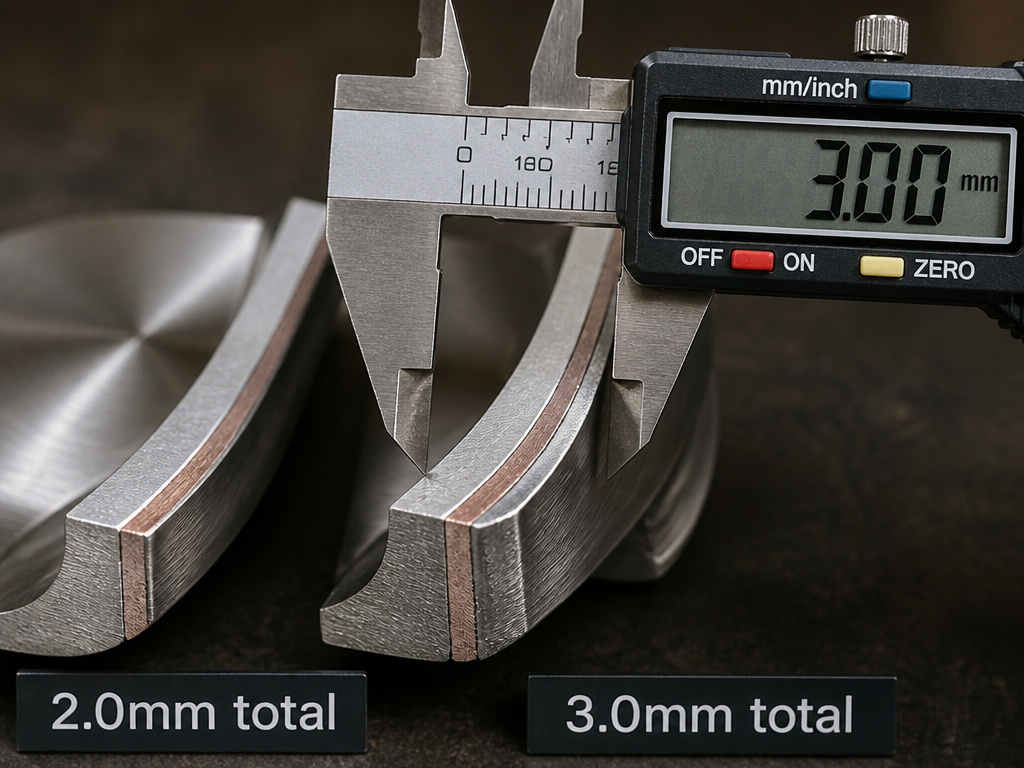 Let’s apply the thickness rule to a real decision. Imagine two 10-inch skillets. One has a total bottom thickness of 2.0mm. The other is 3.0mm. The difference seems small.
The thinner pan will heat faster. It will also cool faster when food hits it. If you try to sear a steak in the thin pan, the temperature will crash, and you’ll get steam instead of a crust. The pan might also buckle over a high-output gas burner.
The thicker pan takes longer to preheat. Once hot, it holds energy. It sears aggressively and recovers heat between batches. It lies flat on the burner year after year.
| Thickness Range | Typical Construction | Performance | Best Cooktop Match |
|---|---|---|---|
| Under 2.0mm | Single-ply or thin clad | Heats/cools quickly. Prone to warping. Requires constant burner adjustment. | Low-output electric, for gentle tasks only. |
| 2.0mm – 3.0mm | Standard tri-ply | Good heat retention. Reliable for daily tasks like sauces, eggs, sautéing. | Most gas and electric coil ranges. |
| Over 3.0mm | Heavy multi-ply or professional lines | Excellent thermal mass. Superior searing and simmering. Very resistant to warping. | High-BTU gas, induction, and for serious searing. |
The sweet spot for a versatile, durable frying pan or saucepan is that 2.5mm to 3.0mm clad range. It’s the difference between a tool that serves you and one you have to serve.
Easy to miss: The thickness listed is often for the entire clad bottom, not just the stainless layer. A “3mm thick” pan might have a 2mm aluminum core between two 0.5mm stainless sheets. That’s fine, the core does the work.
Frequently Asked Questions
Is 18/10 stainless steel the best?
It’s the most common formulation for quality cookware, but “18/10” only tells you the chromium and nickel content. It doesn’t guarantee the grade (304 or 316) or the construction. A well-made tri-ply cookware set in 18/10 (304) is an excellent choice for most. An 18/10 single-ply pan is not.
Does stainless steel leach metals into food?
All solid metals release infinitesimal amounts of ions, especially when new. Peer-reviewed studies, including one in Contact Dermatitis, show releases from 304 and 316 are far below levels that trigger allergies or health concerns. The release decreases dramatically after the first few uses. Cooking with acidic foods is safe.
How do I care for my stainless steel cookware to keep it safe?
Use stainless steel utensils or wood to avoid scratching the surface. Clean with mild soap and a non-abrasive sponge. For stuck-on food, deglaze with water or use a paste of baking soda. Avoid harsh chlorinated cleaners or steel wool, which can damage the passive oxide layer. Some cooks use a light seasoning process with oil to enhance non-stick performance, but it’s not required for safety.
What’s better: stainless steel or non-stick?
They are different tools. For the foundational work of searing, deglazing, and oven finishing, stainless steel vs non-stick wins on durability and versatility. A good stainless pan will last decades. Non-stick is for low-temperature, delicate tasks like eggs and fish, and the coating wears out in 2-5 years. Most kitchens need both.
Are brands like Cuisinart or Tramontina good?
Cuisinart stainless steel lines like the Multiclad Pro offer solid tri-ply construction at a mid-range price. They are reliable workhorses. Tramontina cookware, particularly their Tri-Ply Clad line made in Brazil, is often cited as a high-value performer comparable to more expensive brands. Both use 18/10 (304) stainless. The key is to identify their clad lines, not their disc-bottom or single-ply sets.
Before You Go
Look for the grade number first, 304 or 316. Match it to your most frequent cooking style. Then insist on multi-ply construction, and don’t settle for a bottom thickness under 2mm for a pan you’ll use daily. These three material choices matter more than any brand logo.
That’s how you buy a pan that lasts a generation, not just a season.
