
What Do You Put In a Steamer? Essential Tips for Longevity
This post contains affiliate links. As an Amazon Associate, we earn from qualifying purchases.
You put only clean, fresh water in a steamer’s water reservoir. Seasonings, broths, vinegar, or any other liquid concentrate in the reservoir, damage the heating element and internal surfaces, and will not flavor the food. All flavorings go directly on the food in the steaming basket.
That rule is absolute for electric and stove-top steamers. The physics are simple: steam is pure water vapor. Anything dissolved in the reservoir water stays behind, getting more concentrated as water boils away. This leaves a corrosive residue on the heating element and tank walls.
What follows is the breakdown of why that rule exists, the exact damage timeline from manufacturer data, and what you should actually be putting in the steaming basket—from vegetables and fish to dumplings and tamales.
Key Takeaways
- The reservoir holds only water. Adding anything else accelerates limescale buildup and can corrode the heating element, voiding the warranty.
- Descaling is not optional. The Oster manual says to descale after 7-10 uses; Russell Hobbs recommends every 3 months. Skip it and the steam stops prematurely.
- Never use water left sitting in the steamer overnight. Stale water foams, creates water droplets on food, and can clog internal parts within 30 days.
- For flavor, season the food directly or use aromatic liquids in the drip tray below the basket, not in the reservoir.
- Distilled or filtered water dramatically extends the time between descaling sessions compared to hard tap water.
The One and Only Rule for the Water Reservoir
Clean water. That is the complete list.
Manufacturer manuals are unanimous and blunt on this point. The Russell Hobbs RHSTM3 manual states it clearly: “Don’t add anything to the water. Seasonings, marinades, etc. Should be added to the food, not the steaming water. They won’t circulate with the steam, they’ll just concentrate in the reservoir, possibly damaging the surfaces of the reservoir and element.”
The steam that rises into your food is pure H2O gas. Dissolved salts, sugars, acids, and oils do not vaporize. They remain in the reservoir, increasing in concentration as water boils off. What starts as a mild brine becomes a corrosive sludge coating the heating element.
Common mistake: Adding vinegar or lemon juice to the water to “flavor the steam.” The acid stays in the reservoir, attacking the metal heating element and any aluminum parts. You’ll smell a metallic tang in the kitchen within three uses, and the element will fail within a year.
This also applies to broths, wine, or soy sauce. They will not steam into your food. They will burn onto the heating element. The resulting film acts as an insulator, forcing the element to run hotter to boil the water. That extra heat stress is what burns out the thermal fuse.
Why Distilled or Filtered Water is a Smart Default
Tap water contains dissolved minerals—calcium and magnesium carbonate. When heated, these minerals precipitate out as solid limescale. Scale coats the heating element like a jacket of chalk.
A scaled element can’t transfer heat efficiently to the water. The Oster manual notes scale accumulation will cause “the steam to turn off before food is cooked.” The element overheats, the safety thermostat trips, and your meal is half-cooked.
Using distilled or filtered water removes most of these minerals. The Jiffy Steamer manual explicitly recommends it to prevent discolored water and staining. For a high-use appliance like a clothing steamer or a dedicated food steamer, this one choice can double the time between descaling headaches.
The trade-off is cost. For occasional steaming, regular tap water is fine if you follow the descaling schedule. For weekly use, a water filter pitcher pays for itself in delayed maintenance.
What Actually Goes In the Steamer Basket
This is where your creativity runs. The basket holds the food, and you can layer flavors directly onto it. Aromatics can also go in the water below the basket or in the drip tray, where steam passes through them.
The classic approach uses a multi-tiered system. Place dense, long-cooking items like potatoes or hard squash in the bottom basket closest to the steam. Delicate items like fish fillets or leafy greens go in the top basket, where the steam is slightly cooler and less direct.
| Food Type | Preparation | Steaming Time (Guide) | Flavoring Tip |
|---|---|---|---|
| Vegetables (Broccoli, Green Beans) | Cut into uniform pieces (1-2 cm). | 13-15 minutes | Toss with olive oil, lemon zest, and salt after steaming. |
| Fish Fillets (Salmon, Cod) | Pat dry, place on lemon slice or parchment. | 8-12 minutes | Season with dill and a pinch of smoked paprika before steaming. |
| Dumplings (Pork, Shrimp) | Use a single layer, not touching, in a bamboo steamer. | 10-15 minutes | Place on cabbage leaf or parchment to prevent sticking. |
| Chicken Breast | Pound to even thickness. | 15-18 minutes | Brush with a mix of soy sauce and ginger before cooking. |
| Tamales | Stand upright in the basket. | 45-60 minutes | Add a few dried corn husks to the water below for extra aroma. |
Steaming is a moist-heat method, so it won’t create a browned crust. That’s a feature, not a bug. It preserves nutrients and natural moisture better than boiling or roasting. For a home cook, a steamer basket that fits inside your existing pots is the most versatile start.
The Aromatic Trick: Flavoring the Steam Path
You cannot flavor the reservoir water. You can flavor the steam’s path. Place citrus peels, fresh herbs, ginger slices, or spices in the drip tray below the steaming basket. As steam rises from the reservoir, it passes through these aromatics and carries their volatile oils upward.
This is a subtle effect. It won’t make your broccoli taste like lemon sauce. It will impart a faint, pleasant background note. It also keeps the aromatics away from direct contact with the heating element, so they can’t burn or gunk it up.
For a dedicated steamer with a separate water chamber, this trick works perfectly. For a simple basket insert, tuck herbs between the basket and the pot wall.
Descaling: The Non-Negotiable Maintenance
If you use water, you get scale. The only variable is how fast.
Manufacturer descaling schedules are your baseline, not a suggestion. They are based on average water hardness and use frequency. The Oster manual for models 5709, 5711, and 5713 says to descale “after 7-10 uses.” The Russell Hobbs 26530 manual recommends “every 3 months.” The Jiffy Steamer manual advises cleaning every 3-6 months “depending on your water supply.”
Ignore these intervals and the steamer will ignore your cooking time. Scale insulates the heating element. The water takes longer to boil. Eventually, the overworked safety thermostat shuts the unit off early, leaving your food raw.
Where this goes sideways: Using vinegar as a descaler without rinsing thoroughly. Residual acid in the reservoir corrodes the element on the next heat cycle. You’ll see pitting on the metal within two descaling cycles.
Follow the manual’s procedure exactly. Most involve running a descaling solution (citric acid or a branded cleaner) through a steaming cycle, then multiple rinse cycles with plain water. For the Jiffy Steamer, their liquid cleaner must sit in the unit for 3 hours without steaming to avoid damage.
| Symptom | Likely Cause | Fix |
|---|---|---|
| Steam production weakens or stops mid-cook. | Heavy limescale buildup. | Descale immediately. May require multiple cycles if severe. |
| Unit turns off before timer ends. | Overheating from scaled element. | Descale. Allow to cool completely. Reset by unplugging for 10 minutes. |
| Water spits or droplets come out with steam. | Stale water or partial clog. | Empty, flush with fresh water. Descale if problem continues. |
| Metallic or chemical smell from steam. | Incorrect cleaner residue or corrosion. | Run 3-4 rinse cycles with fresh water. Inspect element for damage. |
What Never Goes In Any Part of Your Steamer
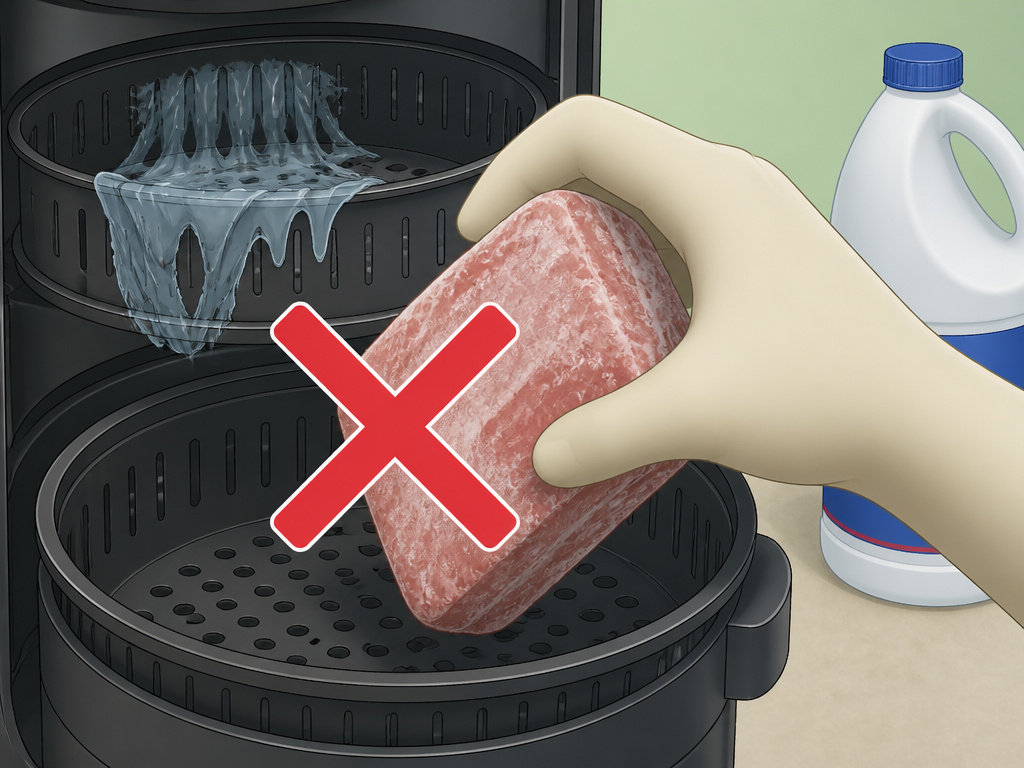
Some items will break your appliance or ruin your food. These bans come from direct failure modes documented in service manuals.
- Frozen Meat or Poultry. The Russell Hobbs manual explicitly says “Don’t put frozen meat or poultry in the steamer – defrost fully before use.” Steam cannot penetrate a solid frozen block evenly. The exterior will overcook while the interior remains frozen, creating a food safety hazard.
- Overnight Water. The Jiffy Steamer manual warns that water left for extended periods (30 days or more) goes stale. Stale water promotes bacterial growth, can foam during heating, and will clog internal parts. Always empty the reservoir after use.
- Plastic or Non-Heat-Resistant Liners. If you line a steamer, use parchment, cabbage leaves, or cheesecloth. A plastic bag will melt onto the basket and element, releasing toxic fumes and creating a permanent, foul-smelling mess.
- Cleaning Chemicals (except designated descaler). Never run bleach, all-purpose cleaner, or dish soap through the steaming cycle. The Groen SmartSteam Pro manual bans cleaners containing sulfamic acid, chlorides, or more than 30% phosphoric acid. These corrode seals and boilers.
Before you start: Steam is hotter than boiling water and under pressure. Never open a steamer mid-cycle or reach over it. The Wagner Power Steamer 715 manual notes temperatures exceed 212°F (100°C) and can cause instant scalds. Always unplug and let the unit cool before refilling or cleaning.
Choosing Your Water: Tap, Filtered, or Distilled?
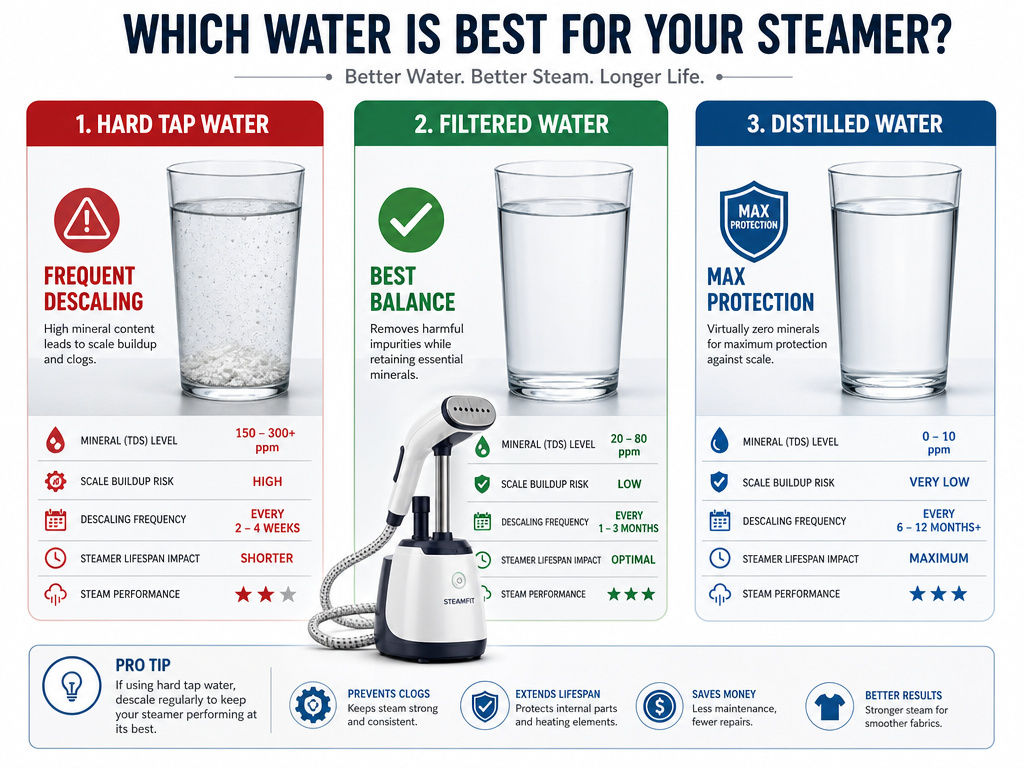
Your water quality dictates your maintenance life. This is the single biggest factor in how often you’ll need to descale.
- Hard Tap Water: High in calcium and magnesium. Will require descaling on the short end of the manufacturer’s schedule (closer to 7 uses for Oster, every 3 months for Russell Hobbs). You may see white mineral deposits on the basket and tray.
- Filtered Water (Pitcher or Faucet): Removes a significant portion of hardness minerals. Stretches the descaling interval by 30-50%. The best balance of cost and convenience for regular home use.
- Distilled or Demineralized Water: Contains virtually no minerals. Maximizes time between descaling. Ideal for garment steamers like the Jiffy to prevent staining, or if you have extremely hard water and steam multiple times a week.
There’s no “best” choice for everyone. Match the water to your usage. Steam rice once a month? Tap water is fine. Run a clothing steamer daily before work? Use distilled.
The goal is to prevent the failure mode the Kärcher steam cleaner manual describes: “Long heating-up time” and “No steam” due to a decalcified boiler. That’s repair-shop territory.
Frequently Asked Questions
Can I use broth instead of water in my steamer?
No. Do not put broth in the water reservoir. The proteins and salts in broth will burn onto the heating element, creating a foul smell and damaging the unit. They will not flavor the food. To add flavor, place a small amount of broth or aromatics in the drip tray below the food basket.
How often should I clean my steamer?
Clean the baskets and trays after every use with warm soapy water. Descale the internal water reservoir and heating element according to your manual’s schedule—typically after 7-10 uses (Oster) or every 3 months (Russell Hobbs). For a bamboo steamer, simply rinse and air-dry completely to prevent mold.
Why does my steamer smell like plastic or chemicals?
New steamer may have a slight odor from manufacturing oils on the heating element. Run it with water only for a full cycle and ventilate the kitchen. A persistent chemical smell after use usually means a non-food substance was added to the water or an incorrect cleaner was used. Run multiple rinse cycles. If it continues, the element may be corroded.
What can I use if I don’t have a steamer basket?
You can improvise a steamer with a heatproof plate elevated on mason jar rings or balls of aluminum foil in a pot. The key is to keep the food above the boiling water and to cover the steamer with a tight-fitting lid to trap the steam.
Before You Go
The steamer’s rule is simple: water in the tank, everything else on the food. This isn’t about limiting flavor—it’s about protecting the machine that makes the flavor possible. Adding anything but water to the reservoir is a direct trade: a hypothetical hint of taste for a guaranteed repair bill.
Stick to the schedule for descaling. Empty the water after you cook. Use a basket that fits your pot or a dedicated unit like a Russell Hobbs. Your reward is perfectly cooked vegetables, succulent fish, and dim sum that doesn’t stick, year after year. The tool is reliable only if you follow its one non-negotiable law.
