
Why Is Food Sticking to My Cast Iron Skillet? Heat & Oil Guide
This post contains affiliate links. As an Amazon Associate, we earn from qualifying purchases.
Food sticks to a cast iron skillet for two mechanical reasons: the pan is too hot, or the oil is too cold. Cast iron holds heat intensely, so a medium setting is often your high. Preheating for 4-5 minutes establishes even heat. Oil must be shimmering—not smoking—before food hits the pan. Cold oil soaks into food instead of creating a sear.
That heat-and-oil answer is the whole game. Get either one wrong and your eggs weld themselves to the surface. The rest is just the details of why that happens and how to undo it.
What follows: the manufacturer-specified preheat times most guides miss, the visual cue for oil temperature nobody mentions, and the one-hour oven fix for a skillet that’s already sticky. We’ll also cover why your brand-new Lodge still sticks and what to do when “just cook with it” isn’t enough.
Key Takeaways
- Preheat for 4–5 minutes on medium-low. Cast iron heats unevenly at first; this wait lets the entire cooking surface reach temperature.
- Oil must shimmer before adding food. If the oil smokes, the pan is too hot. If the oil just sits there, it’s too cold and food will absorb it and stick.
- A sticky skillet means too much oil. Fix it by baking the skillet upside down in a 450–500°F oven for one hour to polymerize the excess.
- Acidic foods damage new seasoning. Avoid tomatoes, vinegar, or wine sauces until the skillet has a dark, established patina.
- Soap is safe for seasoned cast iron. Modern dish soap won’t strip seasoning; it cleans off the food grease that turns sticky and rancid.
Why Does Food Stick to Cast Iron?
The question isn’t why cast iron sticks. It’s why you’re overriding its natural non-stick system. That system is a properly seasoned skillet, which is just a thin, hard layer of polymerized oil. Your job is to protect that layer with the right heat and a hot fat barrier.
Common mistake: Cranking the burner to high. Cast iron’s heat retention means a medium setting delivers the same searing power as high heat on thin stainless steel. On an electric coil, high heat creates a small, nuclear-hot spot directly over the element while the rest of the pan lags behind. Food hits that spot and bonds.
Lodge’s own troubleshooting guide states the two reasons plainly: “the pan is simply too hot” or “it’s not being cooked with enough oil.” Their recommended preheating time is 4 to 5 minutes on medium-low. That’s not a suggestion—it’s the time needed for the iron’s crystalline structure to distribute heat evenly. Skip it, and you’re cooking on a map of hot and cold zones.
Why-Layer: Cold food hitting a pan that’s only hot in the center undergoes a violent temperature change. Proteins like eggs or chicken instantly contract and fuse to the microscopic pores in the iron. A properly preheated skillet has fewer and smaller temperature differentials, so the food sears instead of seizing.
The Two Culprits: Heat & Oil
These aren’t separate issues. They work together, and failing one usually means failing both.
Heat: You’re likely using too much. On gas, a visible flame licking up the sides is too much for anything but a hard sear. On electric or induction, the setting labeled “medium” is often your new “high.” The Victoria Cookware manual advises “mostly low to medium heat,” noting that high heat causes smoke and sticking.
Oil: Its temperature is a visual science. According to Lodge, the oil should be “shimmering” before food goes in. Shimmer means the oil’s surface is moving with tiny, rapid currents. No shimmer means the oil is too cold; food will drink it up and glue itself down. If the oil is smoking, it’s breaking down—remove the pan from heat for a minute.
| Symptom | Cause | Immediate Fix | Long-Term Fix |
|---|---|---|---|
| Food sticks instantly | Pan not preheated | Let pan cool, restart with 5-min preheat | Build preheating into your routine |
| Food sticks & smokes | Heat too high | Remove from heat, reduce burner | Re-season if surface looks dull or gray |
| Food absorbs oil | Oil too cold | Remove food, reheat oil until shimmering | Wait for the visual cue before adding food |
| Sticky residue after cooking | Excess oil in seasoning | Bake skillet at 450-500°F for 1 hour | Apply thinner oil coats after cleaning |
Your Skillet Is New (Or Not Seasoned Enough)
A seasoned skillet straight from the factory is not the same as one with a year of weekly use. Lodge’s pre-seasoning is a good base layer, but it’s thin. Their own care sheet says, “Some foods may stick to new cookware (especially eggs). Use a little extra oil or butter until you’ve built up the seasoning.”
This is the “just cook with it” phase. But “just cook” doesn’t mean struggle. It means cook forgiving foods.
- Start with fats: Bacon, sausages, pan-fried potatoes, cornbread. These release fats as they cook, which bakes onto the skillet and thickens the seasoning layer.
- Avoid eggs and fish initially. Eggs are the ultimate test of a mature non-stick surface. Fish is delicate and prone to tearing.
- Absolutely avoid acidic foods. Both Lodge and Victoria manuals warn against tomatoes, vinegar, citrus, and wine-based sauces on new seasoning. The acid breaks down the polymerized oil layer.
Where this goes sideways: Adding multiple layers of flaxseed oil before first use. The Victoria guide explicitly warns: “We do not suggest doing more than 3-4 layers of flaxseed oil seasoning… As too many layers may cause peeling due to the slickness and hardness of the layers.” A brittle, thick coating will flake off the first time you sear a steak.
You’re Damaging the Seasoning
Seasoning isn’t permanent. You can remove it through abuse, neglect, or simple chemistry. Recognizing the damage is the first step to fixing it.
Acid Attack: Cooking a long-simmered tomato sauce or a vinegar-based braise in a young skillet will strip seasoning. You’ll see the metal underneath turn lighter, and food will stick aggressively the next time you use it.
Abrasive Cleaning: Steel wool or harsh scrub pads scour off seasoning. So does using the skillet as a cutting board. Stick to nylon brushes, chainmail scrubbers (like the Victoria Chainmail Scrubber), or plastic scrapers for cleaning a skillet.
Thermal Shock: This is a quick killer. Putting a hot skillet under cold water, or heating a fridge-cold pan on high, can cause microscopic cracks in the seasoning. Victoria’s manual calls for all temperature changes to be “slow and steady.”
If your pan looks dull, gray, or patchy, the seasoning is compromised. Food will stick. This is when you need to cure cast iron again.
How to Fix a Sticky, Gummy Skillet
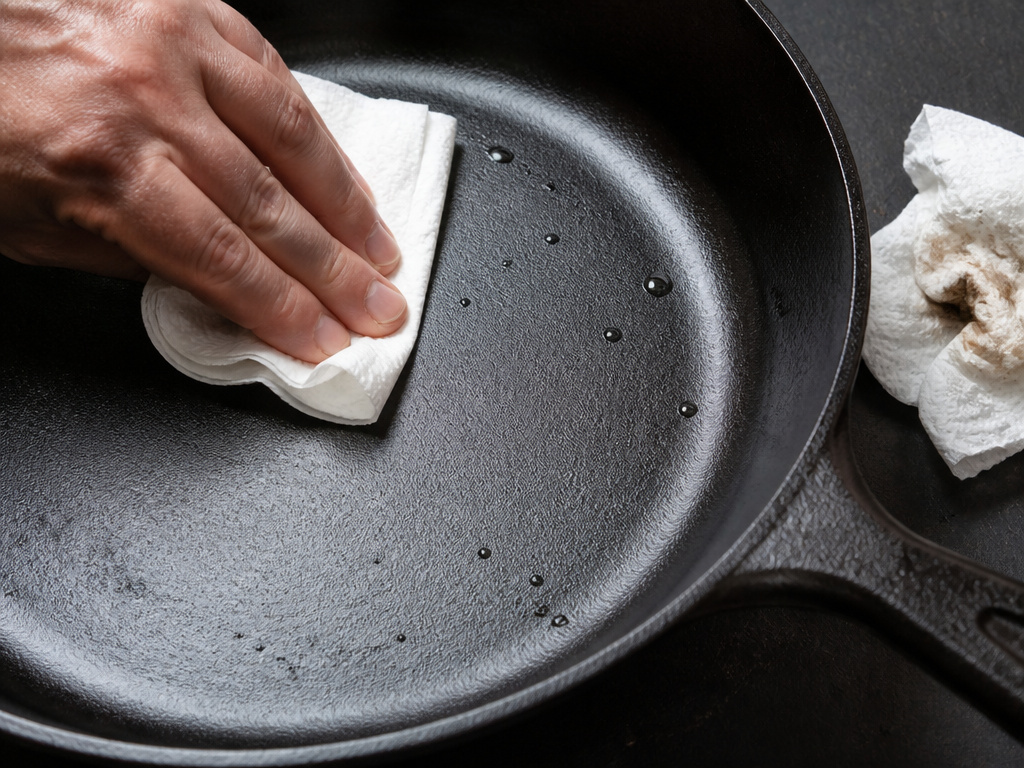
A tacky feeling when you rub your hand over the surface means one thing: too much oil was left on the skillet after cleaning. This is the most common user error in skillet maintenance. The fix is straightforward and comes straight from Lodge’s troubleshooting page.
Place your skillet upside down on the top rack of the oven to bake for one hour at 450-500°F.
This isn’t just drying it. The high heat polymerizes the excess oil, baking it from a sticky liquid into a hard, smooth part of the seasoning layer. Put foil on the rack below to catch drips. Let the skillet cool in the oven. When it comes out, the surface should be dry and smooth.
Why this works: Seasoning is a chemical process, not a coating process. Oil must be heated past its smoke point to break down and reform as a plastic-like polymer. A thin layer does this perfectly. A thick layer only partially polymerizes, leaving behind gummy residue. The oven finish drives the reaction to completion.
The Right Way to Apply Oil After Cleaning
This step prevents stickiness from returning. After washing and drying your skillet: 1. Pour a few drops of a neutral oil for seasoning (canola, vegetable, grapeseed) onto a paper towel. 2. Wipe the entire interior and rim. 3. Take a clean paper towel and buff the surface aggressively. Your goal is to remove almost all the oil you just applied. 4. The skillet should look barely moist, not glossy. If it looks wet, you used too much.
This “thin coat” mantra is in every manufacturer guide for a reason. A visible oil layer will turn sticky every time.
Step-by-Step Guide to a Stick-Free Cooking Session
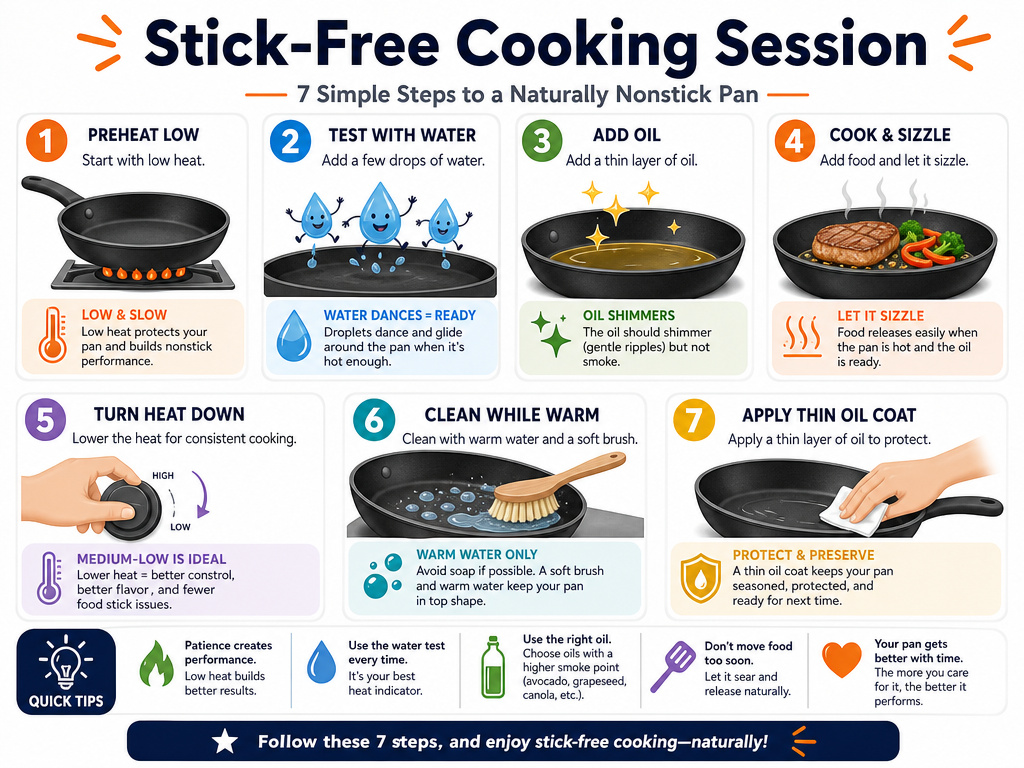
Follow this sequence exactly. It turns the theory into a repeatable ritual.
- Preheat on medium-low for 5 minutes. No oil yet. Place your dry skillet on the burner and set a timer. This is non-negotiable.
- Check the heat with water. After 5 minutes, flick a few drops of water into the pan. They should dance and evaporate quickly, not sizzle violently or just sit there.
- Add your oil and wait. Pour in enough oil to coat the bottom thinly. Swirl it. Now wait 60 seconds. Watch for the shimmer.
- Add your food. Gently place the food in the pan. It should sizzle immediately. Do not move it for at least a minute to allow a sear to form.
- Reduce heat if needed. Cast iron holds heat. You may need to nudge the burner down to medium-low after the food is in to prevent burning.
- Clean while warm. Once done, let the skillet cool slightly but clean it while it’s warm. Use hot water, a drop of soap, and a brush. Stuck bits? Simmer an inch of water for 2 minutes (per Victoria’s manual), then scrape with a wooden spatula.
- Dry, oil, store. Dry thoroughly, apply the whisper-thin oil coat, and put it away.
The part nobody mentions: If you mess up and food sticks badly, don’t force it. Fill the skillet with an inch of water, bring it to a simmer, and turn off the heat. Let it sit for 10-15 minutes. The steam will loosen almost anything, making scraping cast iron safe and easy.
Frequently Asked Questions
Can I use soap on my cast iron skillet?
Yes. Modern dish soaps are detergent-based, not lye-based. They cut grease but do not break down the polymerized oil that is your seasoning. Soap is essential for removing food grease that can turn rancid and sticky.
Why do my eggs always stick?
Eggs are the final exam. If they stick, your heat is too high, your pan isn’t preheated enough, your oil isn’t hot enough, or your seasoning is too young. For new skillets, use more butter and lower heat. For mature skillets, ensure a proper 5-minute preheat and wait for the butter to foam before adding eggs.
How do I know if my seasoning is ruined?
Look for light gray or silver metal showing through, a rough or patchy surface, or persistent rust spots. If food sticks uniformly and the pan looks dull, the seasoning is thin or gone. Time to clean a burnt pan of carbon buildup and re-season.
Is a sticky skillet ruined?
No. A sticky skillet is the easiest problem to fix. It means you used too much oil during maintenance. Bake it upside down at 450-500°F for one hour. It will come out smooth and ready to use.
What’s the best oil for seasoning?
High smoke point, neutral oils work best for building layers. Canola oil, vegetable shortening, and grapeseed oil are reliable. Flaxseed oil creates a hard finish but can be brittle and peel. For daily maintenance after cooking, any oil you have is fine—just use a tiny amount.
Before You Go
Sticking is a signal, not a defect. Your skillet is telling you the heat, the oil, or the seasoning is off. Listen to it.
Remember the numbers: 5 minutes to preheat, shimmering oil, 450-500°F for one hour to fix stickiness. This isn’t folk wisdom; it’s the spec from the companies that make the pans. Your cast iron isn’t fragile. It’s a thermal mass that rewards patience and punishes haste. Lower your heat, watch your oil, and keep cooking. The slidey eggs will come.
