
What Is Aluminized Steel Bakeware? Heat Limits & Durability
This post contains affiliate links. As an Amazon Associate, we earn from qualifying purchases.
Aluminized steel bakeware is a sheet of base steel hot-dipped in a bath of molten aluminum-silicon alloy. This creates a three-layer material: a strong steel core, a bonded alloy interlayer, and a protective aluminum oxide surface. It conducts heat efficiently, resists rust, and meets ASTM A463 specifications, but its safe continuous oven temperature is typically 450°F (232°C), not the material’s extreme 1292°F (700°C) short-term limit.
That 450°F rating isn’t arbitrary. It’s the ceiling where the bonded layers stay stable through hundreds of baking cycles without the slow degradation that starts around 400°C. This gap between a material’s ultimate failure point and its practical, repeated-use limit is where most bakeware warranties are written.
What follows is a breakdown of the alloy’s composition, the exact temperatures where performance shifts, and the care rules that prevent the 10-11% strength loss documented in reuse studies. You’ll know what you’re buying, how to keep it working, and where it fits against stainless steel and raw aluminum.
Key Takeaways
- The safe, continuous-use temperature for most aluminized bakeware like KitchenAid’s line is 450°F (232°C). Exceeding this regularly risks warping and accelerates coating degradation.
- Thermal cycling, repeated heating and cooling, weakens the material. A peer-reviewed study found two high-temperature cycles reduced the aluminized steel’s hardness and tensile strength by 10-11%.
- Never shock hot pans with cold water. The different expansion rates of the steel core and aluminum coating can cause immediate warping or cracking.
- For high-heat roasting (above 450°F) or acidic recipes, stainless steel bakeware is a more durable and non-reactive choice.
- Hand wash with mild detergent. Dishwasher detergents and abrasive pads will slowly erode the protective oxide layer, leading to dullness and reduced corrosion resistance.
How Aluminized Steel Bakeware Is Made
The process is called hot-dip aluminizing. A sheet of low-carbon steel is cleaned and then immersed in a molten bath of aluminum alloyed with 8–11% silicon. The silicon is critical, it promotes adhesion between the steel and the aluminum, preventing the coating from flaking off.
The steel workpiece is immersed in molten aluminum to produce a tight metallic bond between the steel and coating. The product has a unique combination of properties possessed by neither steel alone nor aluminium alone.
As the steel is withdrawn, it cools, forming a permanent metallurgical bond. The resulting sandwich has three distinct layers you can see under a microscope: 1. Steel Core: Provides the structural strength and rigidity. 2. Al-Si Alloy Interlayer: A brittle intermetallic layer where the steel and aluminum have diffused together. This is the glue. 3. Aluminum Oxide Surface: The top layer instantly oxidizes in air, forming a thin, hard shell that resists corrosion and provides the base for non-stick coatings.
This structure is why it’s superior to plain steel for baking. The aluminum surface transfers heat quickly and evenly, while the steel core prevents the pan from flexing like a thin aluminum sheet would. An example of a specific grade used in food industry sheets is DX51D AS120 B per the European UNE-EN 10346 standard.
Temperature Limits: Oven-Safe vs. Maximum Heat
This is the most misunderstood spec. There are three critical temperature thresholds, and only one is your guide for daily baking.
| Temperature | Significance | Consequence for Bakeware |
|---|---|---|
| 450°F (232°C) | Manufacturer’s Oven-Safe Limit (e.g., KitchenAid) | The recommended maximum for continuous baking. Ensures long-term durability of the coating and bond. |
| 752°F (400°C) | Creep Becomes a Concern | The steel core can begin to slowly deform under its own weight over prolonged periods. The Al-Si layer also softens. |
| 1292°F (700°C) | Maximum Intermittent Service Temperature | Short-term survival temperature for industrial applications. Not for kitchen use—the coating will degrade rapidly. |
The 550°C (1022°F) figure often cited is the point where the base steel itself undergoes almost no structural change. It’s a material science fact, not a baking recommendation. Your bakeware’s polymer handles, any non-stick coating, and the metal’s own oxidation rate fail long before this.
Where this goes sideways: Assuming the “maximum” temperature is for baking. Using aluminized steel for a 500°F pizza weekly will eventually cause the pan to bow in the center. The bond between layers fatigues, and the steel core creeps.
For high-heat roasting, you need a different material. This is where knowing your oven-safe stainless steel options matters, as high-grade stainless can handle 500-600°F without issue.
Performance and Durability Over Time
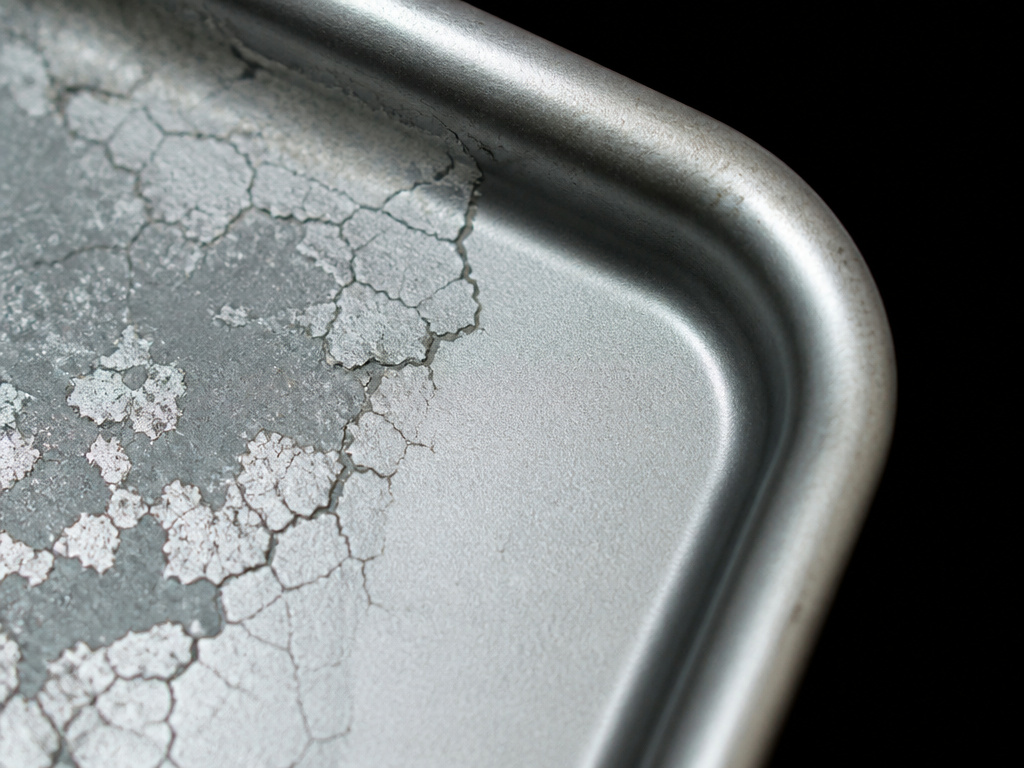 Aluminized steel excels at even heating and rust resistance, but it isn’t indestructible. Its performance changes with use, and a specific study quantifies why.
The key advantage is thermal conductivity. The aluminum surface heats up faster than stainless steel and distributes that heat more evenly than plain carbon steel, reducing hot spots. This is why it’s a favorite for cookie sheets and jelly roll pans, consistent browning across the entire surface.
Its corrosion resistance is excellent for a kitchen environment. The aluminum oxide layer protects the steel core from moisture and oxidation, so it won’t rust like an uncoated steel pan. However, this layer can be compromised.
A 2018 study published in Materials journal is the non-commodity proof point. Researchers subjected aluminized steel substrates to thermal cycles simulating coating removal (500°C) and re-coating (400°C). After just two cycles, they measured a 10-11% decrease in hardness and tensile strength.
The takeaway for your kitchen: Every time you run an empty pan under the broiler, forget a pan in a self-cleaning oven, or wash a scorching hot pan, you’re applying a micro-stress cycle. The drop in performance is gradual, but it’s measurable. This is the physical reason hand-washing and avoiding thermal shock aren’t just suggestions, they’re what preserve the material’s bonded layers.
For a pan that maintains its strength over a wider temperature range, many cooks prefer the inherent safety of stainless steel cookware, which doesn’t rely on a coated bond.
Care and Maintenance Instructions
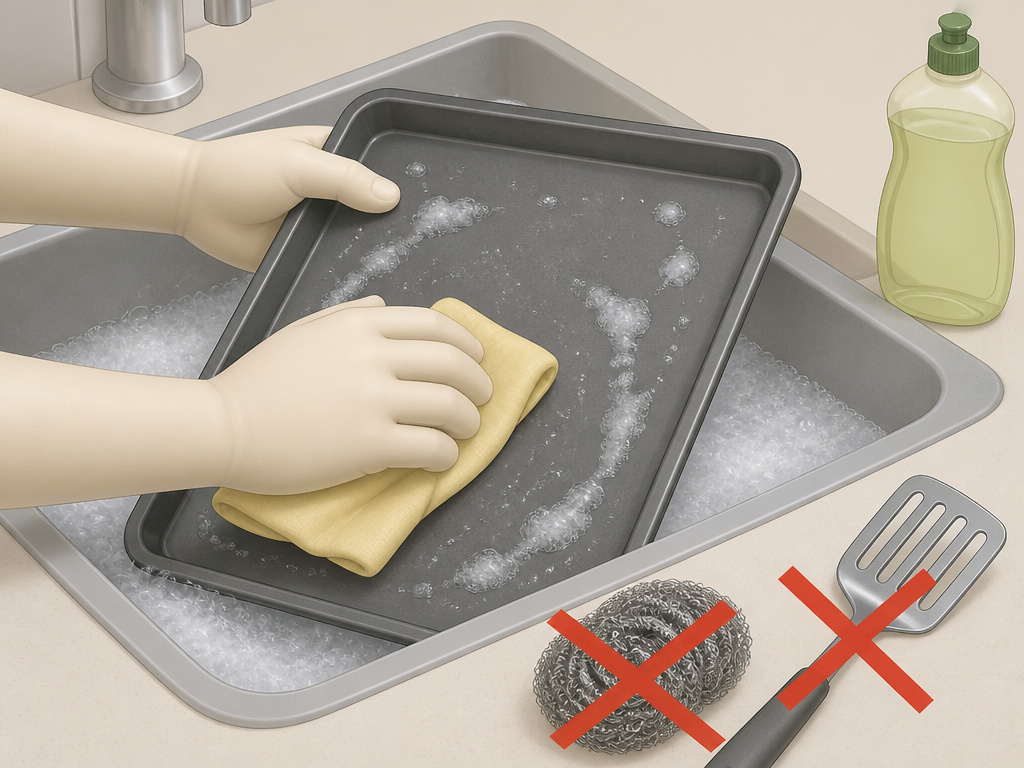 Treat aluminized steel like a coated car finish, gentle cleaning preserves it. The OEM care guide from KitchenAid is the primary source here, and its warnings are specific.
- First Use: Wash with hot, soapy water. No seasoning is needed or beneficial.
- Cleaning: Hand wash with warm, soapy water and a soft cloth. While often labeled dishwasher-safe, the alkaline detergents and high heat can dull the surface over time.
- Drying: Dry immediately with a soft towel to prevent water spotting.
Never hold hot bakeware under cold water. The steel core contracts much slower than the aluminum coating. This differential can cause immediate warping or, in the worst case, crack the coating.
The list of what not to use is explicit: – Oven cleaners – Harsh detergents or chlorine bleach – Steel wool or abrasive nylon scrubbing pads – Metal utensils (use wood, silicone, or nylon)
Scratches aren’t just cosmetic. They expose the underlying steel to moisture, which can lead to rust spots in that specific area. This same gentle philosophy applies to other specialty materials; for instance, knowing how to clean glass bakeware also avoids abrasives that cause micro-scratches.
Storage: Nest pans with a paper towel between them. Storing them with metal utensils like whisks or measuring cups is a sure way to get scratches. The care required is less than for cast iron but more than for non-toxic stainless steel.
Aluminized Steel vs. Stainless Steel vs. Aluminum
Choosing bakeware is about matching the material to the task. Here’s how these three common metals stack up.
Aluminized Steel is the hybrid. It borrows even heating from aluminum and structure from steel. It’s the go-to for manufacturers of affordable, mass-market baking sheets. Best for: everyday cookies, sheet-pan dinners at or below 450°F, and anyone who wants a lightweight, rust-resistant pan. Its weakness is the bonded interface, which fails under extreme thermal stress.
Stainless Steel is the tank. It’s stronger, fully non-reactive (safe for long-term acidic food contact), and has a much higher heat tolerance, often 600°F or more. It’s the choice for professional kitchens and high-heat roasting. The trade-off is poorer heat distribution (it can have hot spots) and a higher price. For understanding its full oven temperature limits, check the specific grade.
Aluminum (Bare or Anodized) is the heat champion. Bare aluminum conducts heat fastest and most evenly, perfect for delicate pastries. But it reacts with acidic foods (tomatoes, citrus) and can warp easily. Anodized aluminum solves the reactivity issue by electrochemically hardening the surface, making it more durable and non-stick. It’s often considered a top performer, but it’s also more expensive and can be damaged by dishwasher salts.
Bottom line: For most home bakers making cookies and cakes, aluminized steel works well. For frequent high-heat use or acidic recipes, step up to stainless. For precision pastry work, anodized aluminum is worth the investment.
Safety and Health Considerations
The primary health question is about aluminum leaching. The science is clear on aluminized steel: the aluminum is locked in a metallurgical bond and topped with an inert oxide layer. It is not the same as cooking with pure, uncoated aluminum pots.
Under normal baking conditions (below 450°F), the amount of aluminum that could potentially migrate into food from an intact aluminized surface is negligible and considered safe by food safety agencies. The risk is vastly lower than with aluminum bakeware that lacks this protective oxide layer.
The real safety focus should be on physical condition and use: 1. Damaged Coating: If the surface is deeply scratched, gouged, or the coating is flaking, the steel core is exposed. This spot can rust, and the pan’s performance is compromised. It’s time to replace it. 2. Temperature Misuse: Exceeding the recommended temperature doesn’t just risk warping. At extremely high, sustained heats, the integrity of the Al-Si bond could degrade, which is a failure mode not present in solid metals.
For those prioritizing absolute inertness, especially for acidic long-cooking recipes, exploring the safest bakeware materials leads you to glass, high-quality ceramic, or 300-series stainless steel. These are the benchmarks for non-toxic cookware with zero leaching potential.
Frequently Asked Questions
Is aluminized steel bakeware safe for the oven?
Yes, within its stated limit. Most brands, like KitchenAid, rate their aluminized bakeware safe for continuous use up to 450°F (232°C). This is well within the range for most baking and roasting. Do not confuse this with the material’s absolute maximum temperature, which is for industrial, short-term exposure.
Can aluminized steel bakeware go in the dishwasher?
Technically, yes, many manufacturers say it’s dishwasher-safe. However, they uniformly encourage hand washing. Dishwasher detergents are abrasive and the high-heat dry cycle can accelerate oxidation, leaving pans looking dull and reducing the coating’s lifespan.
How does aluminized steel compare to non-stick bakeware?
They are different layers. Aluminized steel is the base metal. Most aluminized steel bakeware is then coated with a non-stick polymer (like the Americoat systems mentioned in manufacturer specs). So you often get both: the even heating of the metal and the easy release of a non-stick surface. Care for the non-stick coating (no metal tools, moderate heat) is an additional rule on top of caring for the metal itself.
Does aluminized steel bakeware rust?
It is highly rust-resistant due to the aluminum oxide barrier. However, if the coating is scratched through to the steel core and that spot is exposed to moisture, it can develop surface rust. This is why avoiding abrasive cleaners and metal utensils is important for long-term durability.
Can you use aluminized steel bakeware on the stovetop?
No. Aluminized steel bakeware is designed for oven use only. The direct, concentrated heat of a stovetop burner can cause extreme localized heating, leading to warping, damage to any non-stick coating, and potentially breaking the bond between the aluminum and steel layers.
Before You Go
Aluminized steel bakeware is a practical, cost-effective workhorse for the home kitchen. Its strength is delivering even, consistent heat for cookies, sheet cakes, and roasted vegetables without the price tag of premium metals. Respect its 450°F boundary, hand-wash it, and never shock it with cold water, and it will perform reliably for years.
Its limitations are its guide. When your recipes regularly call for 500°F roasting, or you’re simmering a tomato-based dish for hours, that’s your signal to reach for a different tool, like a stainless steel roasting pan or a glass casserole dish. Understanding the material means knowing both what it’s for and when to use something else. For specific tasks like using silicone bakeware for delicate molds or knowing how to place it in the oven, you match the material to the job. This one handles the daily bake.
