
Why Would Food Cook Faster in a Pressure Cooker? The Science
This post contains affiliate links. As an Amazon Associate, we earn from qualifying purchases.
Food cooks faster in a pressure cooker because it is a sealed system that traps steam. This trapped steam increases the internal pressure, which raises the boiling point of water from 212°F at sea level to about 250°F. Cooking at this higher temperature dramatically accelerates the chemical and physical processes that tenderize food.
That 38-degree jump is the whole game. It’s not just about keeping heat in; it’s about fundamentally changing the environment inside the pot. In an open pot, boiling water caps the temperature. No matter how high you turn the burner, that water, and the food in it, will not get hotter than 212°F. A pressure cooker breaks that ceiling.
What follows is a breakdown of the physics, the real-world specs that matter (not all cookers hit the same pressure), and the practical consequences for everything from a pot roast to your safety. By the end, you’ll know exactly why that pot of beans finished in 45 minutes instead of two hours.
Key Takeaways
- The sealed pot traps steam, raising internal pressure to about 15 psi above atmospheric pressure.
- This pressure elevates the boiling point of water to approximately 250°F, cooking food at a significantly higher temperature.
- Most electric models cook at 9–12 psi, slightly lower than traditional stovetop units, which can affect cooking times.
- You cannot use a standard pressure cooker for pressure canning; it cannot safely maintain the consistent 240°F required to prevent botulism.
- At high altitudes, you must increase cooking time by 5% for every 1,000 feet above 2,000 feet to compensate for lower atmospheric pressure.
The Core Scientific Principle: Trapped Steam and Pressure
Forget the lid for a second. The real mechanism is the water inside. When you heat water in any pot, the molecules move faster, eventually turning to steam. In an open pot, that steam escapes, carrying energy with it. The temperature of the liquid water stabilizes at its boiling point, 212°F at sea level, and won’t go higher.
A pressure cooker changes the rules by sealing the steam in. As more water vaporizes, the number of gas molecules in the fixed space increases. These molecules collide with the walls of the pot and the surface of the liquid, creating pressure.
In a sealed pressure cooker, the pressure can increase by an additional 15 psi, to almost 30 psi. At that pressure, water boils at 121°C (250°F). That means food can cook at a much higher temperature than it ever could at atmospheric pressure.
This relationship between pressure and boiling point is a fixed law of physics, not a manufacturer claim. The Exploratorium food science page illustrates it clearly: higher pressure directly equals a higher boiling temperature. Your food isn’t just cooking in hotter water; it’s cooking in water that is physically incapable of existing at that temperature under normal conditions.
Why does this higher temperature speed things up so much? Cooking is largely a process of breaking down structures. Heat denatures proteins, gelatinizes starches, and softens fibrous cell walls. These reactions aren’t linear; they accelerate exponentially with temperature. A jump from 212°F to 250°F can reduce cooking times by 50 to 70 percent. A tough cut of meat that would braise for four hours can become tender in one.
Stovetop vs. Electric: A Pressure Difference
Not all pressure is created equal. This is the single most overlooked detail when recipes go wrong. The classic stovetop pressure cooker, with a weighted jiggler valve, is designed to reach and maintain about 15 psi (pounds per square inch) above atmospheric pressure. That’s where the 250°F figure comes from.
Electric programmable pressure cookers (EPPCs), like the Instant Pot, often operate differently. As noted in a University of Idaho guide, most EPPCs cook at a high pressure of 9–12 psi. They achieve this lower pressure through an internal spring-loaded valve and electronic controls that cycle the heat to maintain a steady, safe pressure without constant steam venting.
| Cooker Type | Typical High Pressure (psi) | Approx. Boiling Point | Best For |
|---|---|---|---|
| Stovetop (Weighted Valve) | 15 psi | 250°F (121°C) | Fastest possible times, canning (with a pressure canner), full control over heat. |
| Electric (e.g., Instant Pot) | 9–12 psi | 242–248°F (117–120°C) | Set-and-forget convenience, safety features, multi-cooking functions. |
| Low Pressure Setting | ~8 psi | ~235°F (113°C) | Delicate vegetables, seafood, keeping foods from overcooking. |
The takeaway? An electric model might need a few extra minutes compared to a stovetop recipe written for 15 psi. It’s a small difference, but it matters for precision. This is also why understanding pressure cooker settings is crucial, you need to know what “high” actually means on your machine.
What You’re Really Cooking In: Superheated Steam and Liquid
The environment inside a pressurized pot is a mix of superheated steam and intensely hot liquid. This combination is uniquely effective.
The steam, which can be well above 250°F, surrounds the food, transferring heat rapidly. Meanwhile, the liquid water, also at 250°F, conducts heat into submerged ingredients. Because the system is sealed, very little moisture evaporates. This is why pressure-cooked meals taste intensely of themselves, the flavorful compounds that usually escape as steam are trapped and re-absorbed.
Common mistake: Using too little liquid. You need a minimum of ½ to 1 cup of water or broth to generate enough steam to reach pressure. Without it, the cooker can’t pressurize, and the heating element may damage the empty pot.
This requirement for water in a pressure cooker is non-negotiable. The water isn’t just there to boil the food; it’s the working fluid that creates the pressurized environment. The NMSU Extension pressure cooking booklet emphasizes that timing doesn’t start until the pot reaches pressure, which can’t happen without adequate steam generation.
The Safety Mechanisms That Make It All Possible
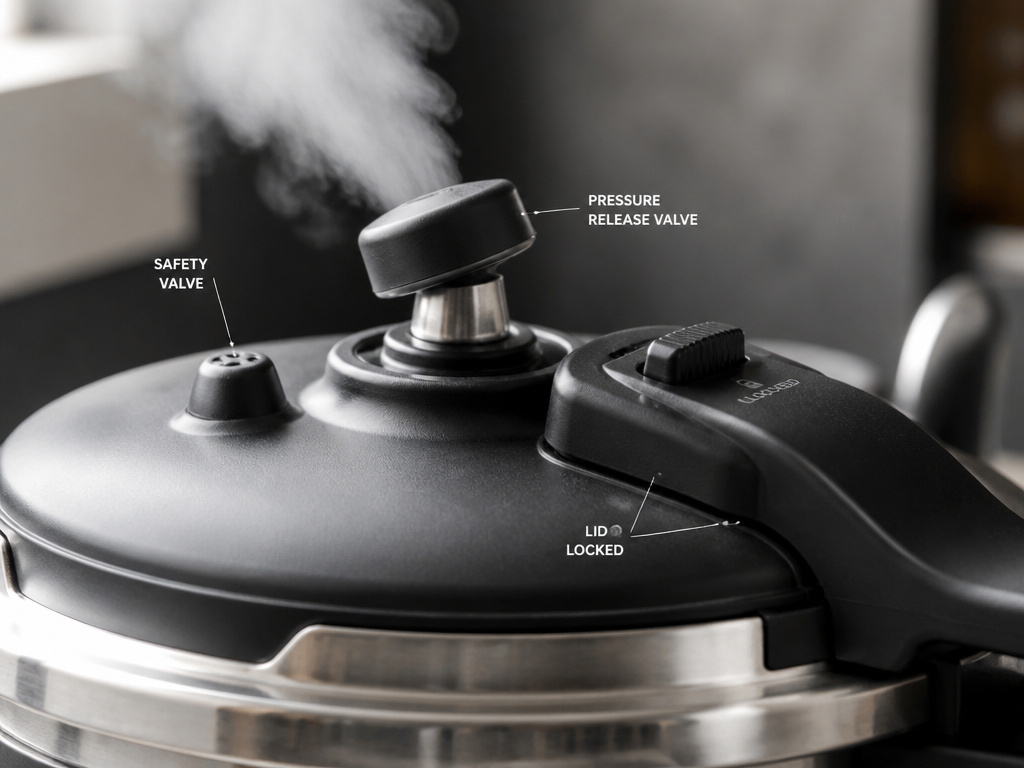 Modern pressure cookers are not the explosive devices of kitchen lore. They have multiple, redundant safety features that make them remarkably safe when used correctly.
- Primary Pressure Release Valve: This is the weighted jiggler or spring-loaded valve. It regulates pressure by allowing small amounts of steam to escape once the target pressure is reached, maintaining a steady internal environment.
- Backup Pressure Release Valve: A secondary valve that will open if the primary valve becomes clogged, preventing pressure from rising to dangerous levels.
- Lid Locking Mechanism: The lid cannot be opened while the pot is pressurized. This prevents accidental steam burns.
- Gasket (Sealing Ring): This rubber ring creates the initial seal. It’s a wear item and should be checked for cracks or stiffness regularly.
These features mean the explosion risk with a modern cooker is extremely low. The safety systems are designed to fail open, releasing pressure safely. The real risk isn’t explosion; it is steam burns from improper release. Always follow the manufacturer’s guide for the natural release method or quick-release to avoid injury.
Critical Limitations and What a Pressure Cooker Can’t Do
 Understanding the limits is as important as understanding the capabilities. A pressure cooker is a specialized tool, not a magic box.
You Cannot Pressure Can in a Standard Pressure Cooker.
This is a major point of confusion. According to food safety researchers at NC State, pressure canners must reach and maintain a consistent 240°F to destroy botulism spores. Most pressure cookers, especially electric ones that cycle on and off, cannot guarantee this. The NC State University explainer article states this rule plainly: you can use a canner as a cooker, but not a cooker as a canner.
Altitude Dramatically Affects Performance.
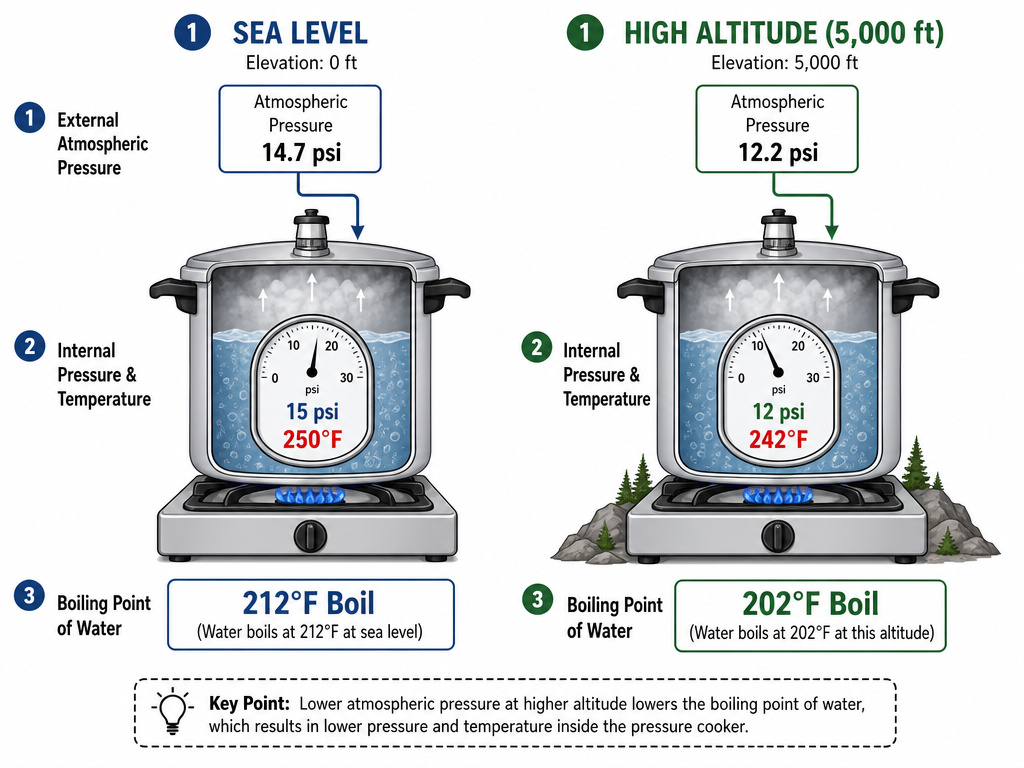
Air pressure decreases as you go up a mountain. At 5,000 feet, water boils at 202°F, not 212°F. Since a pressure cooker increases pressure relative to the outside atmosphere, starting from a lower baseline means you’ll achieve a lower maximum temperature inside.
The universal fix is to increase cooking time. The rule from extension services is to add 5% more time for every 1,000 feet above 2,000 feet in elevation. If a recipe takes 20 minutes at sea level, it needs 21 minutes at 3,000 feet and 22 minutes at 5,000 feet. Ignoring this is why beans stay hard in Denver.
Choosing and Using Your Cooker
If you’re sold on the science of pressure cooking, the next step is picking the right type. Your choice hinges on control versus convenience.
For total control and the highest possible temperature, a stovetop pressure cooker like a Presto or Fagor is the choice. You manage the heat directly to bring it to pressure quickly and adjust it to maintain a gentle rock of the valve. These are workhorses for bulk cooking.
For convenience and built-in safety, an electric pressure cooker like the Instant Pot is the default for most homes. It’s a sealed, programmable unit. You sacrifice a few degrees of temperature for the ability to walk away. It also functions as a slow cooker, yogurt maker, and rice cooker, justifying its space. When looking at best electric pressure cookers, focus on the inner pot material (non-stick vs. Stainless steel) and the clarity of the control panel.
Where this goes sideways: Following a stovetop recipe verbatim in an electric model. Since electric units often run at lower pressure, you may need to add 5-10% more time to achieve the same tenderness, especially for meats and legumes.
Once you have your cooker, start with forgiving, dishes for pressure cooking like bean soups, pot roast, or stock. The process is simple: add food and liquid, seal the lid, select the pressure setting and time, and let the cooker do its work. Always release pressure according to the recipe, quick-release for vegetables to stop cooking, or natural release for meats to allow fibers to relax gradually.
Frequently Asked Questions
Does more pressure mean faster cooking?
Yes, but with diminishing returns and practical limits. Higher pressure equals a higher boiling point, which speeds reactions. However, most consumer cookers max out at 15 psi for safety. The difference between 12 psi and 15 psi is a matter of a few minutes for most recipes, not a halving of time.
Can I open the pressure cooker to check the food?
No. Opening the cooker releases all pressure and steam, dropping the temperature instantly. You must restart the entire pressurization process, adding significant time. It’s better to estimate timing, use a quick-release to check, and then return to pressure for a few more minutes if needed.
Why is my pressure cooker not getting up to pressure?
Three likely causes: 1) The sealing ring is damaged, dirty, or not seated correctly. 2) There isn’t enough liquid inside to generate sufficient steam. 3) The release valve is stuck in the open position or is clogged with food debris. Check these three points before anything else.
Is an Instant Pot the same as a pressure cooker?
An Instant Pot as a pressure cooker is one of its core functions. It is a brand of electric multi-cooker that includes pressure cooking. The term “pressure cooker” is the category; Instant Pot is a specific product within that category that also bakes, sautés, and slow cooks.
How do I clean the pressure cooker lid?
The lid, especially the sealing ring and release valves, requires careful cleaning. Remove the rubber gasket and wash it separately with warm soapy water. Check the primary and secondary valve openings for blockages. Let all parts dry completely before reassembling to prevent mold and ensure a proper seal.
The Bottom Line
A pressure cooker speeds cooking by brute-force physics: a sealed pot traps steam, raising pressure, which forces water to a higher boiling point. Food cooks at 250°F instead of 212°F, and reactions that take hours collapse into minutes. The tool’s true value lies in knowing the specifics, that electric models often run at lower psi, that altitude requires a time adjustment, and that it is categorically not a substitute for a pressure canner.
For weeknight dinners, the convenience of an electric model is hard to beat. For purists who want the fastest possible times and don’t mind tending the stove, a traditional pressure cooker remains a champion. Whichever you choose, you’re not just saving time. You’re harnessing a simple, profound principle to transform tough ingredients into tender meals.
