
What If You Don’t Season a Blackstone Griddle? The Results
This post contains affiliate links. As an Amazon Associate, we earn from qualifying purchases.
If you don’t season your Blackstone griddle, two things happen: rust forms on the bare steel within weeks, and every piece of food will stick and tear. Seasoning is the essential process that bonds a protective, non-stick polymer layer to the raw metal. Without it, you’re cooking on a surface designed to corrode.
That polymer layer is the whole game. The manual for the Blackstone 28″ Griddle Model #1517 defines it as a “hard protective layer bonded to the steel surface.” Skipping seasoning means that bond never forms. The steel stays exposed to oxygen, moisture, and food acids.
What follows is the exact sequence of failure, the specific warranty line you cross, and the restoration drill that pulls a neglected griddle back from the brink. This isn’t about keeping it shiny; it’s about stopping the metal from eating itself.
Key Takeaways
- Rust starts as surface discoloration within 2–3 weeks in average humidity, but can appear in days in coastal climates.
- Food sticks catastrophically because there’s no polymerized oil layer to act as a release agent, eggs and pancakes will weld themselves to the steel.
- Neglect that leads to rust voids the standard 12-month warranty on the griddle part for defects.
- The fix requires abrasive removal (steel wool or 80-grit sandpaper) back to bare metal, followed by 3–4 full seasoning cycles.
- In humid areas, the manuals explicitly warn that heavier oils and more frequent seasoning are non-negotiable.
The Two Guaranteed Outcomes of Skipping Seasoning
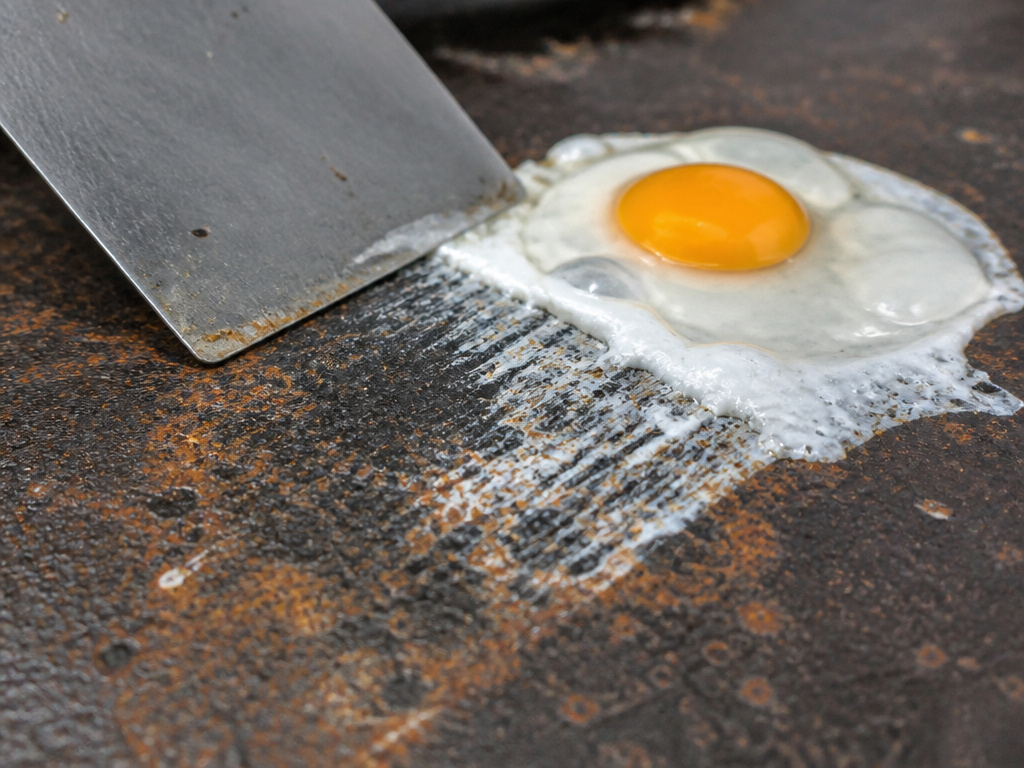
You bought a steel plate. Without seasoning, that’s all you have. The outcomes aren’t possibilities; they are mechanical certainties.
First, the metal will rust. Steel contains iron, and iron oxidizes when exposed to air and moisture, it’s chemistry, not conjecture. The timeline depends on your environment. In a dry garage, you might see the first orange speckles in a month. In Florida or anywhere with salt air, that clock speeds up to a week or less.
Where this goes sideways: Storing a wet, unseasoned griddle overnight. Surface rust can bloom by morning, and that rust is abrasive. It will scratch and pit the steel as you try to cook on it.
Second, everything will stick. A seasoned surface works because the heat transforms a thin layer of oil into a slick, polymerized coating. No coating means direct metal-to-food contact. Proteins denature and fuse to the microscopic pores in the steel. You aren’t making pancakes; you’re creating a biological weld. Cleaning this requires scraping so aggressive it can gouge the metal.
The difference isn’t subtle. A properly seasoned Blackstone releases food with a gentle nudge. A bare one holds it hostage.
Why Seasoning Actually Works (The Polymer Layer)
Most guides tell you to oil and heat the griddle. Few explain what you’re actually building.
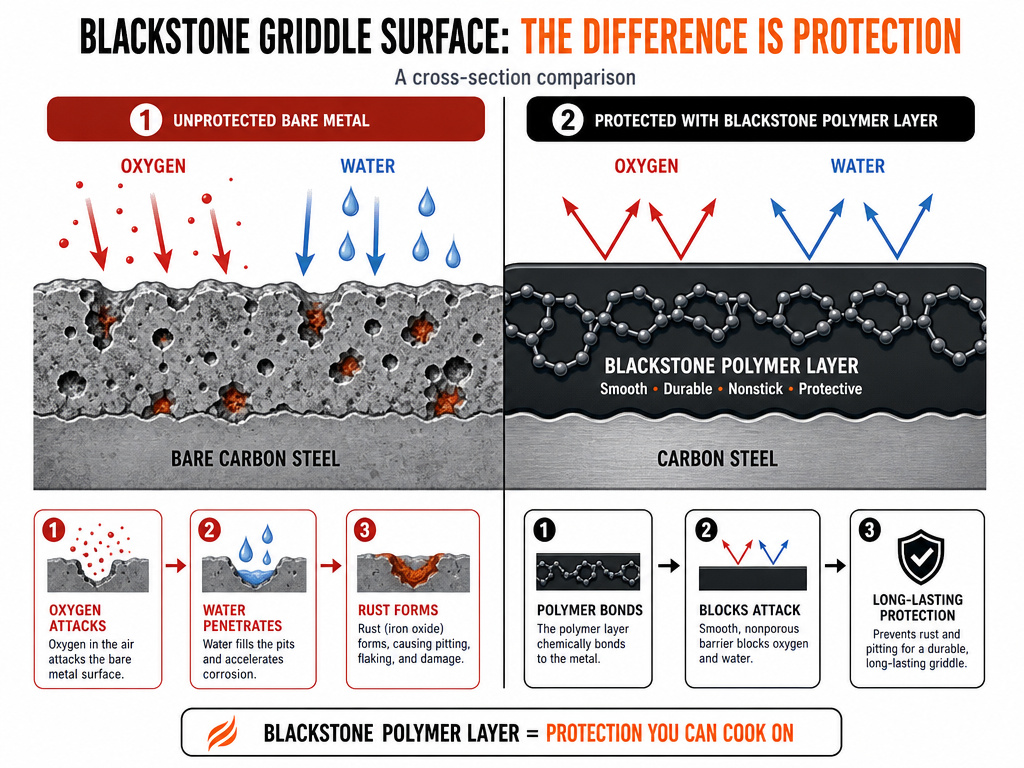
Seasoning creates a “hard protective layer bonded to the steel surface” and forms a “new polymer that acts as a stick resistant and protective layer over the griddle.”
Blackstone 28″ Griddle Model #1517 Manual
When you heat oil past its smoke point on the steel, you’re initiating polymerization. The fat molecules break down and re-form into long-chain polymers that cross-link and bond directly to the metal. This isn’t a coating that sits on top; it becomes part of the surface itself. This polymer layer is inert, slick, and blocks oxygen and water from reaching the raw steel underneath.
Each round of seasoning adds to this matrix. That’s why the seasoning process isn’t a one-time event. The first 3–4 cycles build the foundation. Subsequent cooking and light post-cook seasoning maintain and thicken it.
If you skip this, you have no barrier. Water from washing or ambient humidity reaches the iron. Oxidation begins. Food acids attack the metal directly. The result is a surface that fails at its only two jobs: not rusting, and not sticking.
The Humid Climate Multiplier
The manuals don’t mince words on this. For models like the #1650, #2230, and #1517, a specific warning is printed in the FAQ section.
CUSTOMERS IN HUMID OR COASTAL CLIMATES MAY REQUIRE MORE FREQUENT SEASONINGS AND THE USE OF HEAVIER COOKING OILS TO AVOID RUSTING AND CORROSION.
This is a non-commodity, manufacturer-verified fact. Humidity doesn’t just speed up rust; it changes the protocol.
| Climate Factor | Standard Procedure | Humid/Coastal Adjustment |
|---|---|---|
| Seasoning Frequency | After initial build, maintain with cooking. | Season between uses, even if you cook weekly. |
| Oil Type | Any high-smoke-point oil (vegetable, canola). | Use heavier, more saturated fats like flaxseed oil or coconut oil for a harder polymer. |
| Storage | Cool, dry place with a cover. | Mandatory heavy-duty cover; consider a dehumidifier in the storage area. |
| Rust Inspection | Check every few months. | Check weekly for early spotting. |
In these environments, [rust prevention](https://CookwareCanvaas.Preventing rust is the primary reason you pick up the oil bottle. The salt in coastal air is especially aggressive, acting as an electrolyte to accelerate corrosion.
How to Fix a Griddle You Didn’t Season
So you have a rusty, sticky mess. The process is straightforward but physical. You are essentially starting over from factory condition, which means stripping everything back to bare, clean steel.
Before you start: You will create metal dust and debris. Wear safety glasses and a dust mask. Work in a well-ventilated area, away from open flames.
- Strip the Surface. You must remove all rust and any failed, gunked-up oil. The official manuals for multiple Blackstone models (including #1650, #1832, and #1866) specify using steel wool, low-grit sandpaper, or a Blackstone Pumice Stone. Start with 80-grit sandpaper or a coarse scrubbing pad. Scrub in a circular motion until the surface is uniformly gray, metallic steel. No black spots, no orange dust.
- Clean Thoroughly. Wash the griddle with hot, soapy water. This is the only time soap is recommended, as per the Model #1517 manual. You need to remove all abrasive dust and oil residue. Rinse completely and dry immediately with paper towels. Let it air-dry for an hour to be certain no moisture remains.
- Apply Thin Oil. Choose your best seasoning oil. Flaxseed, vegetable, canola, or the Blackstone-branded conditioner all work. The critical word is thin. Apply a few drops and wipe it across the entire surface with a paper towel. Then, take a clean towel and try to wipe it all off. The microscopic layer that remains is what you want.
- Heat to Polymerize. Turn all burners to medium-high. Heat the griddle until the oil smokes, then keep heating until the smoke completely stops. This takes 15–25 minutes. The surface will darken. Turn off the heat and let it cool completely.
- Repeat 3–4 Times. This is the mandated step from the Model #1517 manual. One round is not enough. The polymer matrix needs multiple layers to become durable. Repeat steps 3 and 4 three to four times total.
After this, you should have a dark, semi-matte, properly seasoned surface. It may not be jet black yet, that comes with cooking. But it will be protected and non-stick.
The Warranty and Long-Term Cost
Neglect has a price tag. The Blackstone 36″ Griddle Cooking Station Model #1554 carries a 12-month full warranty on the griddle part for defects in material or workmanship.
Rust from failure to season is a maintenance failure, not a material or workmanship defect. The warranty won’t cover a replacement.You are now paying for the fix with your time, sandpaper, and oil.
The long-term cost is more cycles of abrasive sanding the griddle. Each time you strip it down, you remove a tiny amount of steel. Over a decade, this can actually wear down the cooking surface, making it slightly uneven. Consistent seasoning after cooking prevents this cycle entirely.
Maintenance vs. Crisis Management
Once restored, shift from crisis mode to a maintenance rhythm. This is what makes a griddle last 20 years.
After each cook, while the griddle is still warm (not scorching hot), scrape the griddle clean with a flat metal spatula. Wipe it down with a paper towel. Then, apply a micro-thin layer of oil, the same “wipe it on, then try to wipe it off” technique. The residual heat will help it bond. This is the five-minute habit that builds the legendary black patina.
If you see a dull, dry patch after a high-heat sear, that’s a spot where the polymer layer has burned off. Don’t wait. Spot-season it immediately. Apply a drop of oil, spread it thin, and heat that section until it smokes and stops.
This routine is simpler, faster, and cheaper than the weekend-long restoration project that follows neglect.
Frequently Asked Questions
Can I just cook on it to season it?
No. Cooking deposits food carbon, not a uniform polymer layer. It creates a spotty, fragile coating that leads to a sticky surface. Proper seasoning requires the dedicated, empty-heat process to build an even, bonded base.
What’s the fastest rust will appear?
If you wash an unseasoned griddle and leave it damp overnight in a humid climate, you can see light surface rust by morning. It starts as a faint yellow hue, not deep orange.
I used soap on my unseasoned griddle. Is it ruined?
Soap isn’t the problem, the lack of seasoning is. Washing with soap is actually the first step in the manual’s initial seasoning instructions. The damage comes from leaving the bare steel wet. Dry it immediately and completely, then begin the seasoning process.
Can I use any oil to fix it?
For the repair seasoning, use an oil with a high smoke point: flaxseed, vegetable, canola, or grapeseed. Avoid butter, olive oil, or bacon grease for the initial layers, they have lower smoke points and can leave a gummy residue.
How do I know when all the rust is gone?
When sanding, you must go past the visible rust to clean, silver metal. Rust is porous. If you stop at the first sign of gray, the pores still hold oxidants and rust will reappear under the new oil layer. Keep sanding until the entire area is uniform.
The Bottom Line
A Blackstone griddle is a tool, not a appliance. It requires a simple, initial investment of time to convert raw steel into a cooking surface. Skip that investment, and the tool will break itself.
The sequence is predictable: stick, rust, regret. The fix is documented, physical work. The choice is between building a protective layer molecule by molecule, or fighting corrosion and food weldment every time you cook.
Get the sandpaper grit right, follow the 3–4 cycle rule, and never let water sit on the bare metal. That’s the entire manual. Everything else is just cooking.
