
Does Caraway Cookware Work on Induction? Definitive Answer
This post contains affiliate links. As an Amazon Associate, we earn from qualifying purchases.
Caraway cookware is induction compatible. Each piece has a magnetized stainless steel base plate that allows the electromagnetic field of an induction cooktop to generate heat. However, Caraway itself notes that not all induction stovetops are compatible, and some users report uneven heating or slower performance despite the magnetic base.
That manufacturer caveat is the whole game. A basic magnet test confirms the physics will work, but your actual experience hinges on two specifics: the flatness and design of your pan’s base, and the electronics of your particular induction hob. A pan with a slightly warped bottom or a ‘decorative’ partial magnetic base can pass the magnet test but heat poorly.
What follows: the exact science, a fail-proof test, the common complaints you won’t find in the marketing, and how Caraway stacks up against other induction-ready brands like HexClad and Calphalon when the rubber meets the road.
Key Takeaways
- Caraway pans have a magnetized stainless steel base plate and will pass the standard magnet test for induction compatibility.
- The company explicitly warns that not all induction stovetops are compatible, advising you to check with your cooktop manufacturer.
- Some users report slower, uneven heating on induction, which experts attribute to base flatness and the specific magnetic field design.
- The one-year limited warranty excludes damage from excessive heat, which is easier to reach on a powerful induction burner.
- For reliable induction performance, brands like Made In and All-Clad use fully magnetic, multi-ply bases as a standard.
The Science of Induction Cooking (And Where Caraway Fits)
Induction cooktops don’t heat the glass surface. They create a variable electromagnetic field that induces currents directly in the magnetic base plate of the cookware. The pan itself becomes the heat source. This requires a ferromagnetic material, something a magnet will stick to, in the bottom layer of the pan.
Caraway’s construction places it in the “compatible” category. The body is aluminum for even heating, but the critical bottom layer is a magnetized stainless steel base plate. This is the component that interacts with the induction hob’s field.
Induction cooking is the only method that directly uses the cookware as part of the cooking system. To create the magnetic field, the bottom of the cookware must have some iron content. The key test is that a magnet must stick and hold to the bottom of the pan. GE Appliances Support Guide
That’s the primary-source rule. Your Caraway pan passes it. But the GE guide and others list a second requirement: a flat bottom. This is where the first potential gap between “compatible” and “works well” appears.
How to Test Your Caraway Pans for Induction
You need a standard refrigerator magnet. A weak promotional magnet isn’t good enough.
- Turn the pan upside down on a stable surface.
- Place the magnet on the center of the pan’s base.
- Apply slight pressure and try to slide it off.
If the magnet grips firmly and resists sliding, the pan is induction compatible. The stainless steel base plate is doing its job.
If the magnet slides easily or falls off, the base isn’t sufficiently magnetic. This is rare with Caraway but could indicate a manufacturing defect.
Common mistake: Testing only the very center of the base. The magnetic layer needs to cover enough surface area to couple effectively with the induction coil. Test the outer edges too.
This test confirms the fundamental physics. It doesn’t guarantee perfect performance. For that, you need to understand your pan’s base design.
The “Decorative” Base Caveat
Some cookware has a ferromagnetic disk attached to an otherwise non-magnetic bottom. A 2023 Caple induction guide calls this a ‘decorative’ ferromagnetic base and includes a specific warning.
| Base Type | Magnet Test Result | Likely Induction Performance |
|---|---|---|
| Fully Magnetic Base | Magnet sticks firmly everywhere | Excellent, even heating |
| ‘Decorative’ Partial Base | Magnet sticks only in specific areas (e.g., a ring) | May heat unevenly, slower response |
The guide states such a pan “may perform differently to a fully compatible pan base.” While Caraway doesn’t advertise a partial base, some user complaints of slow heating suggest similar magnetic field coverage issues. If the magnetic material doesn’t align well with your hob’s coil pattern, performance suffers.
Why Some Users Report Problems on Induction
Caraway’s own FAQ includes this line: “not all induction stovetops are compatible with us! We suggest reaching out to your manufacturer to confirm.” This isn’t legalese. It’s a direct acknowledgment that induction hob electronics vary.
Professional reviews pinpoint the mechanical reason. One notes that “as the bottoms are not absolutely perfectly flat, you may get less than optimal results” on induction. A warped or uneven base creates a tiny air gap between the pan and the glass cooktop. On induction, this gap disrupts the magnetic coupling, reducing efficiency and causing uneven hot spots.
The other common complaint is simply that the pans don’t get hot enough fast enough on induction compared to traditional stainless steel or cast iron. This often traces back to the base plate’s thickness and specific alloy. A thinner or less conductive magnetic layer transfers the induced energy less effectively.
Where this goes sideways: Assuming “compatible” means “optimal.” A pan that heats 30% slower on your induction hob than your old cast iron skillet is technically compatible, but it will frustrate you every time you cook.
Caraway vs. Other Induction-Compatible Brands
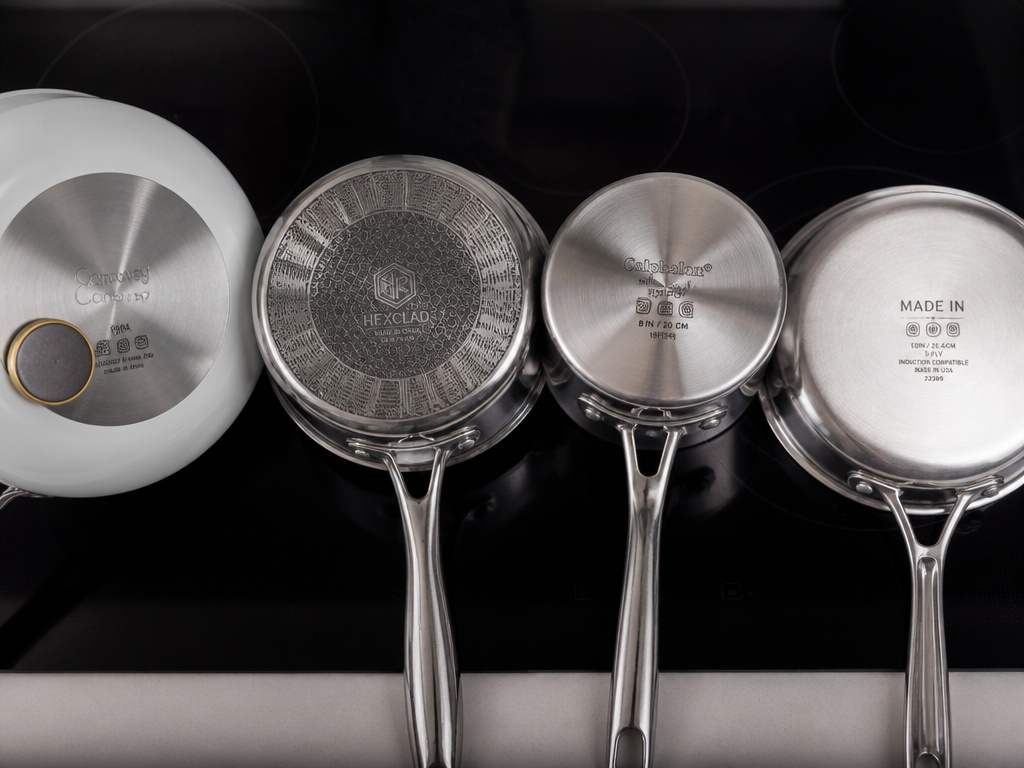
If induction performance is your top priority, Caraway sits in a specific tier. It’s a ceramic non-stick option with a magnetic base. For searing and all-metal-utensil use, you’d look at fully clad stainless steel. For non-stick, other brands engineer specifically for induction.
| Brand | Best For | Induction Construction | Performance Note |
|---|---|---|---|
| Caraway | Everyday, low-to-medium heat cooking; aesthetic kitchens | Aluminum body with bonded stainless steel base plate | Can be slower; watch base flatness. |
| HexClad | High-heat searing with non-stick convenience | Hybrid stainless steel surface with magnetic core | Excellent magnetic contact, heats rapidly. |
| Calphalon (Premium lines) | Even heating and durability | Tri-ply or hard-anodized with magnetic stainless base | Consistent performer; check specific product line. |
| Made In | Professional-grade heating and longevity | Fully clad 5-ply magnetic stainless steel throughout | No base plate—entire vessel is induction-ready. |
For a non-stick induction cookware set that prioritizes speed, many dedicated kitchen guides point to brands like GreenPan or Ninja Foodi. If you want the best induction ready cookware for brute-force performance and don’t need non-stick, a fully clad Made In saucepan or All-Clad D3 skillet is the benchmark.
What the Warranty Says (And Doesn’t Say)
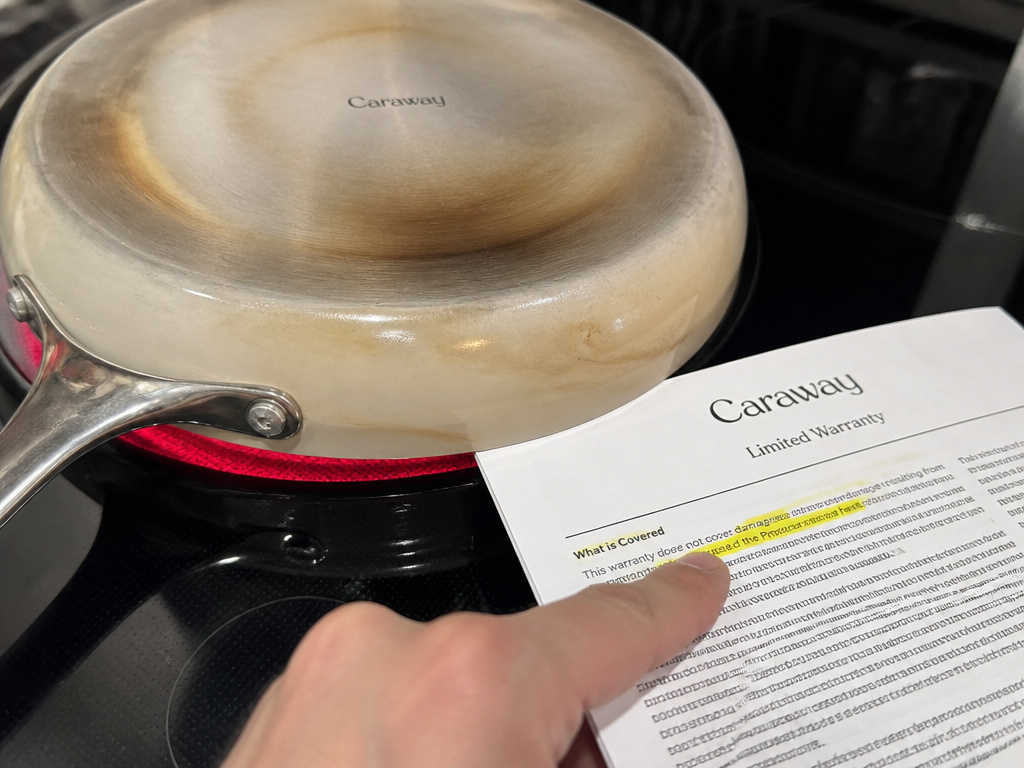
Caraway offers a one-year limited warranty. It’s crucial to read the exclusions, especially for induction use. The warranty does not cover damage from “excessive heat” or “prolonged heat exposure,” which can cause non-stick deterioration, warping, or metal separation.
Induction burners can deliver intense, focused heat very quickly. It’s easier to accidentally overheat a pan on an induction cooktop than on a conventional electric coil. If you warp a Caraway pan by leaving it on a high-power induction burner empty, that repair likely won’t be covered.
The warranty also excludes cosmetic damage like scratches, scuffs, and staining, all of which can happen during normal use, especially if you’re not meticulously careful with utensils and cleaning.
Caring for Caraway on Induction
The rules are stricter than for gas or electric.
- Never preheat empty. On high power, an empty pan can reach damaging temperatures in under a minute. Add a little oil or food first.
- Use medium heat. Induction excels at rapid boiling, but you don’t need the “High” setting for sautéing. Medium provides plenty of power and protects the ceramic coating.
- Lift, don’t slide. Dragging a pan across the glass induction surface can scratch both the cooktop and the pan’s base, worsening future contact.
- Let it cool completely before washing. Thermal shock from plunging a hot pan into water is a top cause of warping, which ruins induction performance.
Hand wash with a soft sponge. The dishwasher’s harsh detergent and high heat accelerate the wear on the non-stick coating and can degrade the exterior enamel over time.
Frequently Asked Questions
Does the magnet test guarantee my Caraway will work on my induction stove?
No. The magnet test guarantees the pan is physically capable of working with induction technology. It does not guarantee optimal performance with your specific brand and model of induction cooktop. Always refer to your stove’s manual for cookware recommendations.
Why does my Caraway pan take so long to boil water on induction?
This usually points to a poor magnetic coupling. Check that the pan’s base is perfectly flat and clean. Ensure you’re using a burner zone that matches the pan’s base diameter. If the base is smaller than the induction coil, much of the energy is wasted.
Can I use my Caraway cookware in the oven if it has an induction base?
Yes. The stainless steel base plate does not affect oven safety. Caraway pans are oven-safe up to 550°F, including their lids. This makes them good for recipes that start on the stovetop and finish in the oven.
Is Caraway’s ceramic coating safe for induction cooking?
Yes. The ceramic non-stick coating itself is inert and does not interfere with the magnetic field. The safety concern with induction is the intense heat, which can degrade any non-stick coating if overheated. Stay under medium-high heat.
What should I do if my induction hob displays an error code with my Caraway pan?
First, turn off the burner and remove the pan. Error codes like “E0” or “U” often mean the hob cannot detect the pan. Clean the bottom of the pan and the glass cooktop surface thoroughly. Ensure the pan’s base diameter is at least 5 inches, as most hobs have a minimum size requirement. If the error persists, the pan may not be compatible with that hob’s sensor system.
Before You Go
Caraway cookware is induction compatible by design. It will pass the magnet test. Whether it performs brilliantly on your specific induction cooktop is a separate question, influenced by base flatness, magnetic field design, and your stove’s electronics.
If you already own Caraway and are moving to an induction kitchen, it will work. Start on medium heat and manage your expectations on boiling speed. If you’re buying new induction cookware sets and performance is the priority, consider brands that build induction readiness into their core design, like Made In or dedicated induction non-stick cookware lines. For most everyday cooking, Caraway’s combination of style, non-stick convenience, and oven safety works, as long as you understand the limits of that stainless steel base plate.
