
The Truth About Boiling Water on a Griddle & Its Time Limit
This post contains affiliate links. As an Amazon Associate, we earn from qualifying purchases.
You can boil water on a griddle. Use a small pot or pan, place it on a preheated section, and keep the flame or element medium-high. The flat surface transfers heat, but efficiency drops because a griddle spreads heat over a larger area than a pot’s base. For more than a cup or two, use your stove’s burners.
The catch is the griddle itself. That large, flat plate isn’t designed as a primary boiling vessel. Its job is consistent, even heat for pancakes or burgers. Pouring water directly onto it invites rust on cast iron, can warp thin aluminum, and strips the seasoning you worked for. The real question isn’t about possibility, it’s about consequence and the manufacturer’s fine print.
What follows is a breakdown of the physics, the material limits from OEM manuals, and the one scenario where using your griddle for boiling actually makes sense.
Key Takeaways
- Check your manual first. Smeg explicitly limits griddle use to 40 minutes for aluminum models with non-stick coatings to prevent damage.
- Never pour water directly onto the cooking surface. Always use a pot, pan, or kettle to contain the water and protect the griddle’s seasoning or coating.
- Cast iron handles boiling best due to its mass and heat retention, while thin aluminum griddles risk warping under rapid, localized heat.
- Induction hobs require specific cookware. Your griddle must be magnetic (cast iron, carbon steel) to work on an induction zone.
- This is a low-volume, high-speed task. Boiling a cup for tea or a small amount for pasta water is fine; boiling a liter for potatoes is inefficient and risks exceeding time limits.
The Physics of Boiling on a Flat Surface
A griddle is a heat exchanger. Whether gas flames lick its underside or an induction coil energizes its molecules, its purpose is to absorb energy and distribute it evenly across its surface. When you place a pot of water on it, you’re asking that large plate to concentrate its stored heat into the small footprint of the pot’s base.
This creates a thermal bottleneck. The griddle heats the pot’s bottom, the pot heats the water. Because the griddle’s heat source is often larger than the pot, energy bleeds out around the sides. You’ll see this as the griddle surface around the pot getting dangerously hot. Miele’s manual warns that leaving a rangetop unattended on high power can cause spilled food to smoke and ignite, a warning that directly applies to an over-hot griddle surrounding your boiling pot.
Water boils very quickly on an induction zone set to the highest heat setting, provided you use suitable cookware. Cookware is suitable if it meets this test. This is stated in the Electrolux induction hob manual as the functional check for compatible pans.
The shape is wrong for efficiency. A burner directs flames or energy upward into the curved bottom of a pot, creating a convective column that heats quickly. A griddle is a flat intermediary. For a small amount of water, the penalty is minor. For a large volume, you waste time and fuel.
Why does this matter for your griddle’s health? Prolonged, high-heat focus on one spot is what warps metal. Thin aluminum griddles are especially vulnerable. The Smeg hob manual includes a specific warning for aluminum griddles with Teflon non-stick coating: pre-heating empty should not exceed 5 minutes, and total use should not exceed 40 minutes. Boiling a large pot of water could eat half that time limit in one go.
Griddle Materials: Which Can Handle the Heat?
Not all griddles are built the same. Your approach to boiling water depends entirely on what’s sitting on your burner.
| Griddle Material | Best For Boiling? | Key Risk | OEM Time/Heat Limit |
|---|---|---|---|
| Cast Iron | Yes – best option. | Rust if water is spilled directly on surface. | No specific limit, but requires seasoning a griddle to maintain. |
| Enameled Cast Iron | Yes – with caution. | Thermal shock can crack enamel if cold water hits a hot surface. | Avoid extreme temperature swings. |
| Bare Aluminum | Not recommended. | High risk of warping under concentrated high heat. | Smeg: max 40 minutes total use. |
| Aluminum with Non-Stick Coat | Avoid. | Coating degrades under prolonged high heat; warping risk. | Smeg: 5-min max empty pre-heat, 40-min total use. |
| Carbon Steel | Yes – good option. | Similar rust risk to cast iron; requires seasoning. | Similar care to cast iron. |
Cast iron is the default pick. Its thermal mass smooths out hot spots, and its seasoned surface, if maintained, shrugs off minor spills. If you own a cast iron skillet, you already know the drill: dry it thoroughly after any contact with water. The same rule applies to a cast iron griddle. A quick boil won’t hurt it, but letting water sit or splashing it outside the pot can break down the seasoning and cause a sticky griddle or make the griddle turn black with rust.
Where this goes sideways: Using a thin, non-stick aluminum griddle for extended boiling. The coating breaks down above 260°C (500°F), and a high burner under a small pot can easily create a hotspot that exceeds that. The result is a damaged coating within a few uses.
Aluminum is the problem child. It conducts heat beautifully but has low mass and a low melting point. Concentrate a 15,000 BTU burner under a small saucepan on an aluminum griddle, and the metal under the pan can get significantly hotter than the rest. That differential stress is what causes the permanent warp, a bulge or dip that ruins even cooking forever. The 40-minute rule in the Smeg manual is a direct guard against this cumulative heat stress.
Step-by-Step: How to Boil Water on a Griddle Safely
This is a method for when you need a quick cup of boiling water and the stove is occupied, or you’re using a standalone griddle unit.
- Place your pot or kettle. Never place it empty. Have at least a cup of water in it before the griddle heats up. This protects the griddle surface and the pot from thermal shock.
- Preheat the griddle on medium. Don’t blast it on high immediately. Let the entire plate come up to temperature evenly for 3-5 minutes. For proper griddle preheating, you want to see a drop of water skitter across the surface, not instantly vaporize.
- Increase heat to medium-high. Once the pot is hot to the touch, turn up the heat to bring the water to a boil. Watch for vigorous simmering.
- Reduce heat once boiling. As soon as you get a rolling boil, turn the heat down to a level that maintains it. The Thermador Pro Rangetop guide lists HIGH specifically for “boiling water quickly,” but advises reducing power once boiling is achieved.
- Remove the pot immediately after use. Don’t let the griddle sit scorching hot under an empty pot. Turn off the heat.
- Cool and inspect. Let the griddle cool completely. Wipe any moisture or mineral deposits left by steam. If you spilled, you may need to lightly re-oil a cast iron surface to prevent rust.
The entire process should take under 10 minutes for a few cups of water. If it’s taking much longer, your griddle is not the right tool for this volume.
Gas vs. Electric vs. Induction: Does Cooktop Type Matter?
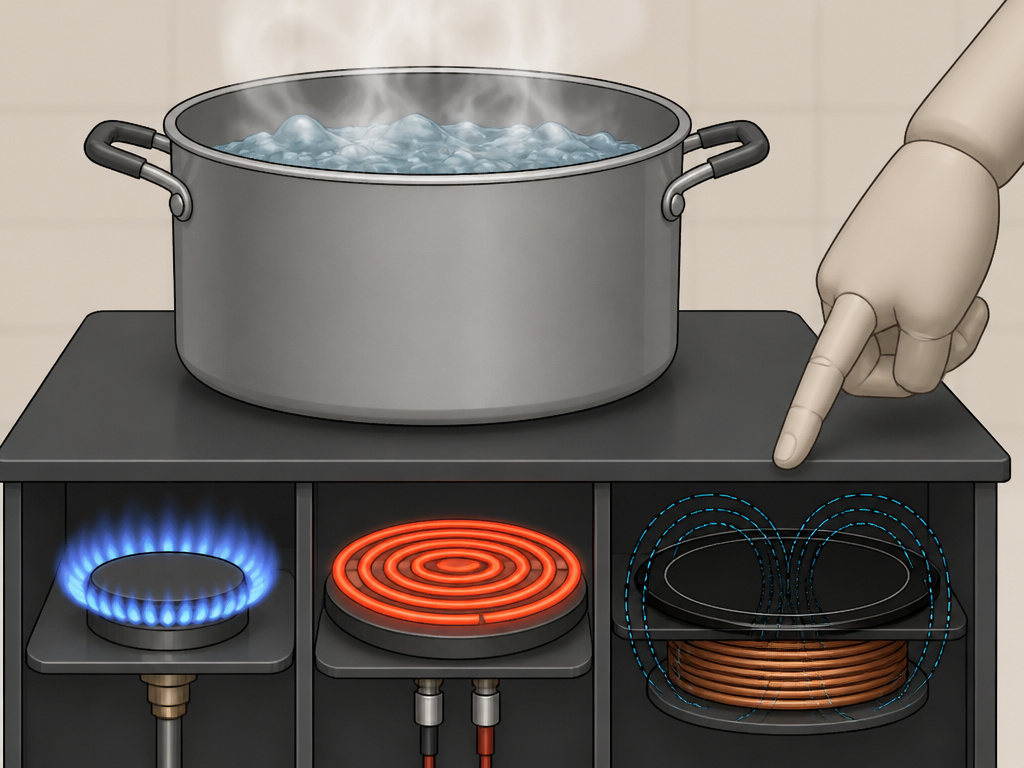
The heat source changes the rules, especially for induction.
Gas Cooktops are the most forgiving. The flames spread under the griddle, providing relatively even heating. The GE Appliances manual for its PowerBoil™ burner specifies it’s for bringing “large amounts of liquid in pots 11 inches or larger in diameter to a boil.” While this refers to a burner, not a griddle, the principle is the same: use a pot that matches the heat source’s size. A tiny pot on a huge gas flame under a griddle wastes energy and overheats the local area.
Electric Coil or Smoothtop elements cycle on and off. This can lead to slower, less consistent heating for boiling. The key is to ensure your pot has a perfectly flat bottom that makes full contact with the griddle. Any gap cripples efficiency.
The part nobody mentions: On an electric smoothtop, a boiling pot can cause violent bubbling that spills water over the side. That water hits the hot griddle surface, flashes to steam, and leaves behind a hard, baked-on mineral ring that’s a chore to clean off a griddle.
Induction Hobs are a special case. They only work with ferromagnetic cookware. If your griddle is cast iron or carbon steel, it will work. If it’s aluminum, it won’t heat at all unless it has an induction-compatible base layer. The Electrolux manual states its induction zones deliver 2300W to 3300W with PowerBoost, more than enough power to boil quickly. But it also warns that cookware bottoms must be “as thick and flat as possible.” A warped griddle will make poor contact and boil water slowly, if at all.
When You Should Never Boil Water on a Griddle
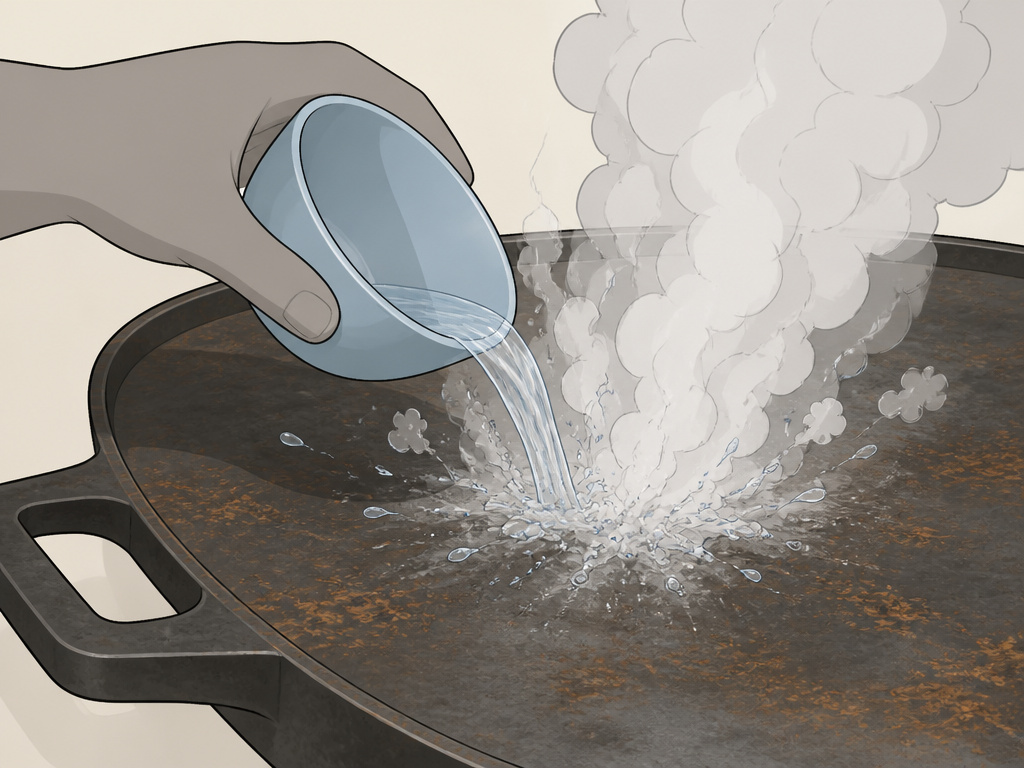
Some scenarios turn a minor convenience into a repair bill.
- On a brand-new, unseasoned cast iron griddle. Water will immediately begin the rusting process. Always complete the initial griddle seasoning process before any use involving moisture.
- To “clean” it by deglazing. Pouring water onto a hot griddle to loosen stuck-on food works on a restaurant flat-top with a scraper and a grease trap. At home, it creates a huge, dangerous steam blast and can warp the metal. It also strips seasoning.
- For canning or large-batch cooking. The prolonged, high-heat requirement will almost certainly exceed safe time limits for non-stick surfaces and puts tremendous stress on any griddle.
- If your griddle is already warped. The uneven contact will make boiling inefficient and further stress the metal. Fix the warp or stop using it.
- On a griddle with a damaged non-stick coating. Boiling will force steam and water into the cracks, accelerating the coating’s failure.
If your goal is to cook foods that need a simmering liquid, like poached eggs or dumplings, you’re better off using a dedicated griddle recipes designed for dry or shallow-fry heat. Boiling is not this tool’s strength.
Frequently Asked Questions
Can you put water directly on a Blackstone griddle?
No. Outdoor propane griddles like Blackstones have a seasoned carbon steel surface. Pouring water directly on it while hot can cause thermal shock, warp the metal, and strip the seasoning. It also creates a massive, dangerous steam cloud. Always use a pot or kettle.
What is the best pot to use for boiling on a griddle?
Use a heavy-bottomed saucepan or kettle with a flat base. Stainless steel with an aluminum or copper core is ideal, it won’t scratch the griddle and distributes heat well. Avoid glass or ceramic; they can crack from the direct griddle heat.
Does boiling water ruin griddle seasoning?
Quick boil in a pot won’t ruin it. However, if water splashes or spills over the pot’s side and sits on the hot seasoned surface, it can break down the polymerized oil layer. This leads to a spot that requires re-seasoning your griddle.
Can you boil water on an electric griddle?
Yes, the same rules apply. Most standalone electric griddles have a non-stick coating and a thermostat. Use a pot, and avoid running it at its highest setting for more than a few minutes to prevent coating damage and potential thermostat issues from constant high heat.
Before You Go
Boiling water on a griddle is a functional shortcut, not a recommended practice. It works in a pinch for a small volume, provided you use a pot and respect the material limits of your specific griddle. The 40-minute rule from Smeg isn’t arbitrary, it’s the engineering limit before heat stress causes permanent damage.
Your griddle’s primary job is delivering even, consistent heat for searing and frying. For boiling, your standard burners and a good pot are faster, safer, and more energy-efficient. Keep the griddle for what it does best, and you’ll avoid the warps, coating failures, and griddle curing headaches that come from pushing a tool past its design.
