
Can You Put a Cast Iron Skillet in the Oven? Limits & Tips
This post contains affiliate links. As an Amazon Associate, we earn from qualifying purchases.
Yes, you can put a cast iron skillet in the oven, but the safe limit is almost never the iron itself. The ceiling is set by the weakest component: an enamel coating (500°F for brands like Lava), a plastic knob (often 350°F), or a wooden handle. A one-piece bare cast iron skillet can handle a standard oven’s maximum heat; anything attached to it cannot.
That distinction is where pans get damaged. You aren’t just heating iron. You’re testing a glued joint, a coated surface, or a synthetic material against sustained dry heat. Skip the check and the knob melts, the enamel crazes, or the handle loosens within a single use.
What follows is the breakdown most guides skip: the three specs you must match before the oven preheats, the physical reason enamel fails before iron, and the step-by-step move from stovetop to oven that prevents thermal shock. By the end, you’ll read any skillet’s rating in ten seconds and know exactly how hot it can go.
Key Takeaways
- The iron is almost never the limit. The safe temperature is set by the weakest attached part, enamel coating, handle material, or lid knob.
- Enameled cast iron (like Lava Cookware) has a hard ceiling of 500°F (260°C) per its manual. Exceed this for broiling and you risk cracking the glass-like surface.
- Bare, one-piece cast iron with no coatings or attached handles can withstand any standard oven temperature, including broiling.
- Never place any cast iron cookware in a self-cleaning oven cycle (often over 875°F). This will warp the metal and destroy coatings.
- Thermal shock, moving a hot skillet to a cold wet surface or adding cold liquid, is the leading cause of enamel chips and hairline cracks in bare iron.
The Real Limit Isn’t the Iron. It’s Everything Else
A solid block of cast iron doesn’t care about your oven’s 550°F broiler setting. It’s the other stuff that fails first. This is the core mistake: assuming “cast iron skillet” means one material from handle to cooking surface. It rarely does.
The practical temperature limit is a chain, and it breaks at the weakest link. That link is almost always a non-iron component. A plastic side handle rated for 400°F, a phenolic knob glued to a lid, a wooden handle secured with screws, or the glass-like enamel coating fused to the surface. These materials have maximum service temperatures far below what the iron body can tolerate.
For oven broiling, oven temperatures should never exceed 500°F. Lava Cookware User Manual
That 500°F limit from Lava is the temperature at which the differential expansion between the iron and the enamel coating can cause stress fractures. Go over it, and you’re betting against physics.The same principle applies to any attached part. Heat a glued wooden handle to 450°F, and the adhesive softens. The handle wobbles by the time your casserole is done.
Check Your Skillet’s Three Specs Before Heating
You need three pieces of information, and only one is usually stamped on the pan.
- Coating Type: Is it bare cast iron or enameled? Bare iron has a dark, sometimes blotchy, matte or semi-gloss surface from seasoning your skillet. Enameled iron has a hard, shiny, often colored coating. Enamel limits are strict, 500°F for Lava, 570°F for the Vermicular Oven-Safe Skillet.
- Handle & Knob Material: Are they one-piece cast iron, stainless steel, plastic, phenolic resin, or wood? One-piece metal handles share the skillet’s high limit. Anything attached has its own, lower rating.
- Manufacturer’s Stated Maximum: This is the law for your specific pan. It’s in the manual or on the product webpage. If you can’t find it, assume the conservative limit for enameled (500°F) or the limit of the lowest-rated component (often 350°F-400°F for plastic).
Bare Cast Iron vs. Enameled: The 150-Degree Gap
This is a functional divide that changes how you use the oven. A bare seasoned skillet and an enameled skillet live in different heat worlds.
| Feature | Bare Cast Iron | Enameled Cast Iron |
|---|---|---|
| Max Oven Temp | Withstands standard oven max (~550°F+) | Typically 500°F (260°C) – e.g., Lava Cookware |
| Broiler-Safe? | Yes, if handle is one-piece metal | No, unless specified (broiling often exceeds 500°F) |
| Primary Risk | Overheating damage to seasoning | Thermal shock cracking the enamel coating |
| Main Advantage | No upper bound for dry-heat cooking | Non-reactive, no seasoning process required |
Bare cast iron’s strength is its monolithic nature. A well-maintained oven-safe skillet with a one-piece handle is the most oven-forgiving tool you own. You can sear on the stovetop at high heat and slide it directly under a broiler to finish. The polymerized coating of seasoning protects the iron from rust and improves with use.
Enameled cast iron trades that extreme heat tolerance for convenience and chemical inertness. The porcelain enamel coating won’t react with acidic foods like tomatoes or wine. But it’s essentially a glass layer fused to metal. Glass and metal expand at different rates when heated. The manufacturer’s limit (500°F, 570°F) is the point where that differential stress can surpass the enamel’s bond strength, leading to hairline cracks or chips. Once chipped, the exposed iron will rust, and the pan’s utility plummets.
Where this goes sideways: Assuming “oven-safe” means broiler-safe for enameled pans. Broiler elements can exceed 550°F locally, even if your oven dial is set lower. That extra 50+ degrees is the difference between a fine finish and a network of tiny cracks.
The Two Instant-Damage Scenarios (Self-Clean & Thermal Shock)
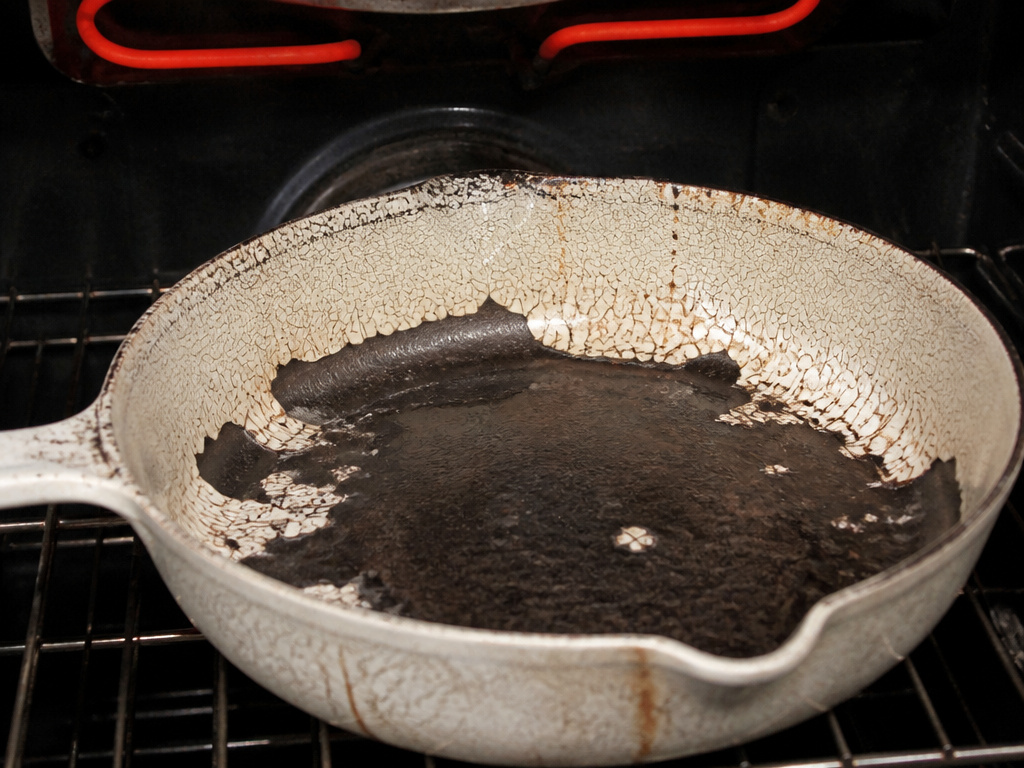
Some mistakes don’t cause wear. They cause immediate, irreparable failure. These two scenarios void warranties and ruin pans in one cycle.
1. The Self-Cleaning Oven Cycle
A self-cleaning cycle incinerates food residue at temperatures exceeding 875°F (470°C). This is catastrophic for any cast iron. * Bare Iron: The extreme, sustained heat can warp the metal permanently, creating a wobble. It also burns off the protective seasoning layer, leaving bare metal to oxidize. * Enameled Iron: The coating will craze, discolor, or blister. The iron underneath can also warp. The rule is absolute: never, under any circumstances, leave cast iron in an oven during a self-clean cycle.
2. Thermal Shock
This is the rapid, uneven cooling of hot metal. It’s why manuals explicitly warn against adding cold water to a hot pan or placing a hot pan on a cold, wet counter. * Mechanism: When one part of the metal cools and contracts rapidly while the rest remains hot and expanded, it creates internal shear stress. In brittle materials like enamel or even in thick iron, this stress exceeds the material’s tensile strength. * Consequence: For enamel, it’s chips and cracks. For bare iron, it can be a hairline fracture that starts at the rim or handle. This is a primary cause of cast iron rust in enameled pans, as moisture invades the crack.
The 7-Step Safe Transfer From Stovetop to Oven

This sequence is about managing thermal mass and stress gradients. The goal is to make temperature changes gradual for every component of the pan.
- Confirm Oven-Safety: Check the handle/knob material and recall the max temp. If using enamel, ensure the oven setting is at or below 500°F.
- Preheat the Oven: Start this first. Your goal is to have the oven at target temperature before the skillet needs to go in.
- Preheat the Skillet on the Stovetop: Use medium, never high, heat. Let it warm gradually for 3-5 minutes. This brings the entire mass up evenly.
- Cook on the Stovetop: Perform your sear or sauté. The pan is now evenly hot.
- Turn Off the Burner: Before moving the pan.
- Transfer to the Oven: Use dry potholders. Open the oven and place the skillet squarely on the rack or a preheated baking sheet. Do not slam the door.
- Final Transfer Out: When done, place the hot skillet on a wire cooling rack or a trivet, never on a cold stone countertop, a wet cloth, or in the sink.
Following these steps minimizes the risk of damage from excessive oven heat and thermal shock. It treats the cookware as a system, not just a piece of iron.
What About Lids, Knobs, and Non-Stick Coatings?
The skillet body is often the most robust part. The accessories are the failure points.
Lids: Glass lids often have a much lower heat limit (around 400°F). If a recipe calls for a covered finish in the oven, verify the lid’s rating. A stainless steel lid is safer.
Knobs: The knob on a Dutch oven lid is frequently the weakest link. Standard phenolic knobs melt around 390°F. Most manufacturers sell metal replacement knobs for high-heat baking. Swap it. “Non-Stick” Cast Iron: Some modern skillets have a factory-applied non-stick coating over cast iron. These have very strict temperature limits, usually between 400°F and 450°F. Treat them like enamel with a lower ceiling, never broil, and stay at the lower end of oven cooking.
This is why essential cast iron skillet maintenance starts with knowing what you actually own. A pre-seasoned skillet from the store isn’t the same as a vintage bare iron pan, and neither is the same as an enameled showpiece.
Frequently Asked Questions
Can you put a cast iron skillet in a 450°F oven?
Yes, 450°F is safe for virtually all cast iron skillets, including enameled models like Lava (rated to 500°F). It is a standard baking and roasting temperature that falls well within the limits of the iron and most attached components. Always double-check if your specific pan has a plastic or wooden handle, as those may have lower limits.
What temperature is too high for a cast iron skillet?
For enameled cast iron, any temperature above the manufacturer’s stated maximum (commonly 500°F or 570°F) is too high. For bare cast iron with one-piece metal handles, no standard home oven temperature is too high. The “too high” threshold is defined by non-iron parts: plastic knobs melt around 390°F, wooden handles can char and loosen, and non-stick coatings degrade above 450°F-500°F.
Can you put a cast iron skillet in the oven while preheating?
It is generally safe but not always ideal. For bare iron, placing it in a cold oven and heating together is fine and prevents thermal shock. For enameled iron, it’s also acceptable as the gradual ramp-up is gentle. However, if you need a searing-hot surface for something like a steak, preheating the skillet in the oven alone won’t get it as hot as preheating on a stovetop burner first.
How long can a cast iron skillet stay in the oven?
Indefinitely, from a material integrity perspective. The iron does not degrade with prolonged exposure to oven temperatures. The limiting factor is the food you’re cooking, not the pan. A cast iron Dutch oven regularly stays in the oven for 4+ hours for braises. Just ensure the continuous temperature does not exceed the limits of any coatings or attached handles.
Can you put a cast iron skillet from the oven into the sink?
No. This is a classic thermal shock event. Placing a 400°F+ metal pan into a sink (a cold, often damp environment) causes extreme localized cooling and contraction. This can crack enamel instantly and promote warping or cracking in bare iron over time. Always let the skillet cool on a rack or trivet before cleaning a skillet.
The Bottom Line
You can put a cast iron skillet in the oven, but the permission comes with fine print. The iron is willing, but the enamel, the glue, and the plastic knob are not. The rule is 500°F for the glass coating on your Lava pot, 390°F for the phenolic knob on your Dutch oven, and 350°F for the silicone sleeve on a handle.
So the answer is always conditional. Find your skillet’s weakest point, respect its limit, and avoid the two instant killers, the self-clean cycle and the cold sink. Do that, and your oven-safe skillet will move from stovetop to oven for years without a wobble, a chip, or a melted grip. That’s the difference between using a tool and understanding it.
