
How Do You Clean a Steamer | The 3-Month Rule That Prevents Jams
This post contains affiliate links. As an Amazon Associate, we earn from qualifying purchases.
To clean a steamer, follow a two-part routine: wipe the exterior and wash removable parts after every use, and descale the internal boiler every 3 months or per your manual’s specific interval using a manufacturer-approved cleaner or a vinegar-water solution. This prevents mineral clogs that kill steam output and can void warranties.
The 3-month descaling interval isn’t a suggestion, it’s the average hard-water failure point for boilers. Miss it, and limescale binds to the heating element, forcing the thermostat to cycle on and off. Your steamer sputters, takes forever to heat, and eventually stops producing steam entirely. The repair cost often exceeds replacement.
What follows: the exact daily wipe-down, the descaling steps that change based on your steamer type (food, garment, or power cleaner), and the one storage mistake that guarantees sediment buildup.
Key Takeaways
- Descale on schedule, not when it fails. The Russell Hobbs RHSTM3 food steamer manual mandates descaling every 3 months; the Tefal IS7850 garment steamer uses a 100-hour runtime rule. Waiting for weak steam means damage has already started.
- Use the right cleaner. Jiffy Steamer requires its proprietary Jiffy® Liquid Cleaner to avoid tank damage. Many other brands approve a 1:1 white vinegar and water solution. Check your manual, using the wrong agent can void warranties.
- Never store water in the tank. The Wagner 915e Power Steamer manual explicitly states to drain all water after use. Standing water accelerates mineral deposit formation and promotes bacterial growth.
- Clean the exterior after every use. Wipe down with a damp cloth to remove dust, fabric lint, or food residue. For garment steamers, run the head over an old cloth to clear condensation from the steam holes before putting it away.
The 4-Step Daily & Weekly Cleaning Routine
This isn’t deep cleaning. It’s the five-minute habit that keeps grime from hardening and lint from entering the system.
Step 1: Unplug and Cool Completely
Never touch a warm steamer. The housing and steam head hold heat for 20 minutes after you turn it off. Scalding risk is real. Unplug the unit and walk away until the body feels cool to the touch.
Step 2: Wipe the Exterior
Use a soft, damp cloth, microfiber works best. For a garment steamer, pay attention to the water tank exterior and the handle, which collects hand oils. For a food steamer like the Russell Hobbs RHSTM3, wipe the base unit inside and out. Never use abrasive scrubbers or harsh chemicals; they degrade plastics and finishes.
Step 3: Clean Removable Parts
Most food steamer baskets, drip trays, and lids are dishwasher-safe on the top rack. Hand-washing in warm, soapy water is gentler and preserves non-stick coatings. For garment steamers, detach any lint brushes or fabric attachments and wash them separately. A clogged lint brush just redeposits debris.
Step 4: Clear the Steam Head
This is the step everyone skips. For garment steamers, after the unit is cool, plug it back in, let it heat for 30 seconds, and hold the steam trigger over an old towel for 5 seconds. This purges any residual water from the internal pathways, preventing the first sputter of your next use from being a brown, mineral-flecked mess.
Common mistake: Putting a garment steamer away without purging the head. The stagnant water in the tiny steam holes evaporates, leaving concentrated minerals that will clog those same holes within a month. The steamer then leaks or spits instead of producing a fine mist.
Descaling Your Steamer: A Step-by-Step Guide
Descaling removes limescale, the chalky, hard mineral deposits from tap water that cement themselves to your boiler and heating element. The process varies by steamer type. This table matches your appliance to the right method.
| Steamer Type | Primary Descaling Agent | Key Manufacturer Warning |
|---|---|---|
| Food Steamer | Commercial descaling solution | Never use vinegar if the manual prohibits it; it can damage certain plastics. |
| Garment Steamer (Jiffy) | Jiffy® Liquid Cleaner | Using other cleaners voids the warranty on Jiffy models. |
| Garment Steamer (General) | White vinegar & water (1:1) | Run clear water through twice after to eliminate vinegar smell. |
| Power Steam Cleaner | Vinegar or manufacturer solution | Never descale while unit is hot; always drain boiler first. |
For Food Steamers (Like Russell Hobbs, Tefal)
Food steamer manuals are strict because flavor transfer is a risk. The Russell Hobbs RHSTM3 process is the standard.
- Make the solution. Mix about 1 litre of descaling solution per the bottle’s instructions. If your manual approves vinegar, use a 1:1 mix with water.
- Fill and steam. Pour the solution into the empty water reservoir. Assemble the steamer with its baskets and lid. Turn it on and let it steam for 25 minutes. This circulates the descaler through the entire system.
- Cool, drain, and rinse. Unplug the unit and let it cool completely, this takes time. Pour out the spent solution. Refill the reservoir with clean water only, steam for another 25 minutes, and drain again. Repeat this rinse cycle until no descaler smell remains.
- Wash all parts. Give the baskets and lid a final wash in warm, soapy water.
If your steamer has an automatic water-fill function, the process may differ. The Evolution Steamer manual, for models without this feature, requires manually adding about 2.5 gallons of water for a 15-minute cleaning cycle in Cook Mode.
For Garment Steamers (Like Jiffy, Conair, Rowenta)
Garment steamer descaling is about protecting the boiler and hose. The Jiffy Steamer manual is particularly specific.
- Drain the old water. Always start with an empty tank. Tilt the unit over a sink to remove any standing water.
- Introduce the cleaner. For a Jiffy, use 4 ounces of Jiffy® Liquid Cleaner mixed with 4 ounces of water in the bottle, then invert it into the unit. For other brands using vinegar, fill the tank with the 1:1 solution.
- Run and soak. Turn the steamer on and let it produce steam for 1-2 minutes. Then, turn it off and let it sit for 30 minutes. This soaking time is when the acid breaks down the mineral bonds.
- Empty and rinse thoroughly. Drain the cleaning solution completely. Refill the tank with fresh water, steam for a minute, and drain again. Do this 2-3 times until the drained water runs clear and odorless.
For Power Steam Cleaners (Like Kärcher, Wagner)
These units have larger boilers and different drainage points. Safety is paramount.
- Cool and drain. Ensure the unit is off, unplugged, and cold. Locate the drain plug (often on the bottom), place the unit over a bucket, and open it to empty the boiler completely. The Kärcher manual stresses removing all existing water first.
- Add descaling solution. Fill the boiler with your cleaning solution, either a manufacturer-specific descaler or a vinegar-water mix. Do not overfill.
- Soak and drain. Let the solution sit in the sealed boiler for 30-60 minutes. Do not turn the unit on. Open the drain plug again and let it empty fully.
- Flush with clean water. Refill the boiler with fresh water, slosh it around, and drain. Repeat until the effluent is clear.
How Often Should You Descale? It’s Not Guesswork
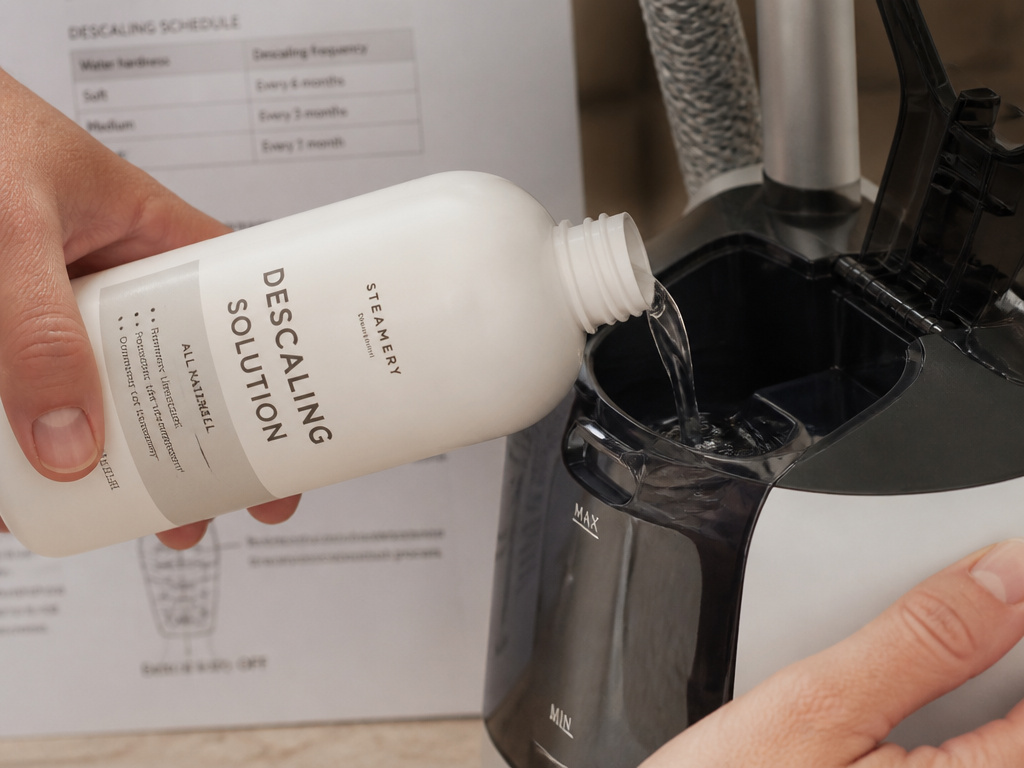
Forget generic advice. Your manual holds the correct number, and it’s based on two factors: time and water hardness.
The Russell Hobbs RHSTM3 rule is straightforward: every 3 months. The Tefal IS7850 uses a hybrid rule: at least once a year or every 100 hours of use, whichever comes first. A professional cleaner using it daily would hit 100 hours in under two months.
Where this goes sideways: Using distilled water and thinking you can skip descaling. The Kärcher manual notes distilled water makes descaling “not necessary,” but that’s for pure distillation. Most bottled “distilled” water still contains some minerals. If you use it, you might stretch the interval to 6 months, but don’t cancel the task.
Here’s how to diagnose your need:
| Symptom | Likely Cause | Timeline to Failure |
|---|---|---|
| Steamer takes 2x longer to heat | Light scale on the element | Will progress to symptom 2 in 1-2 weeks. |
| Steam output is weak or intermittent | Scale restricting flow | Heating element burnout within a month of continuous use. |
| Steamer spits brown or gritty water | Scale chunks breaking loose | Immediate clogging of steam head orifices. |
| Unit cycles on/off repeatedly | Thermostat struggling | Complete thermostat failure, requiring professional repair. |
If you see any of these, descale immediately. It might reverse early symptoms.
The Tools and Cleaners You Actually Need
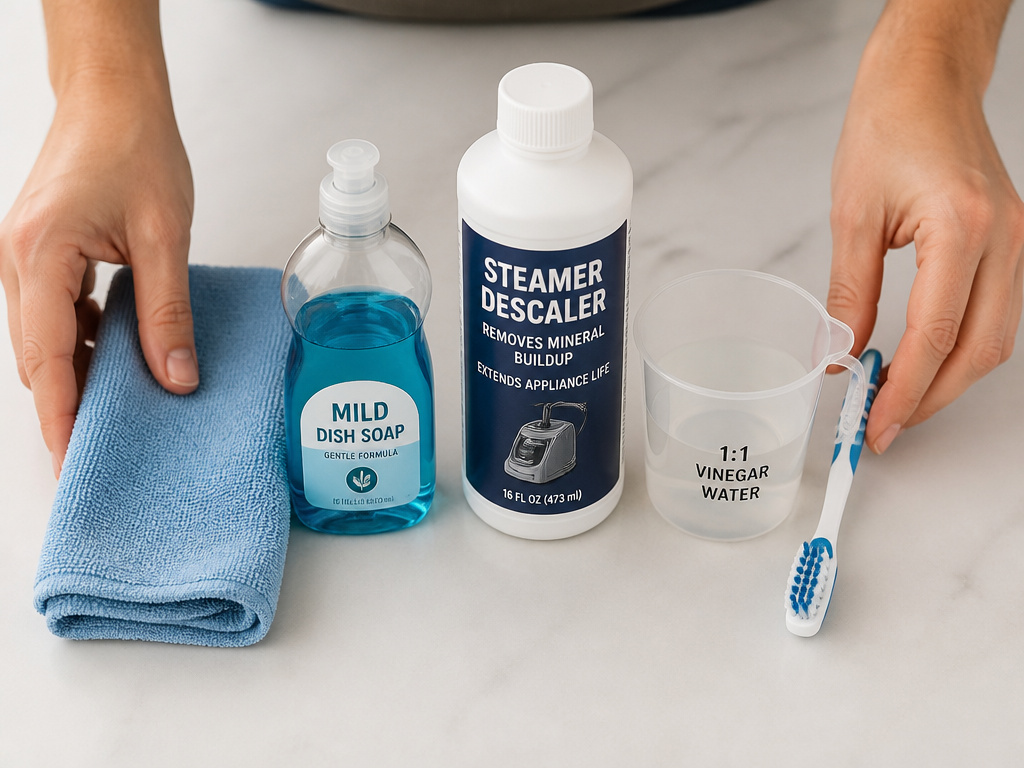
You don’t need a specialty kit. You need the right agent for your tank material and a few basic tools.
- Soft microfiber cloths: For exterior wiping. Avoid paper towels that can scratch.
- Mild dish soap: For washing removable parts.
- Descaling agent: This is the critical choice.
- Jiffy® Liquid Cleaner: Non-negotiable for Jiffy Steamer owners. A 10-ounce bottle treats multiple cleans.
- Commercial descaler (e.g., Dezcal, Urnex): Food-safe and effective for most food steamers. Follow bottle dilution rates.
- White distilled vinegar: The universal household option. Use a 1:1 mix with water. Avoid for aluminum components unless the manual explicitly says it’s safe.
- A small brush or toothpick: For clearing debris from steam head holes on garment steamers.
- A measuring cup or jug: For accurate solution mixing.
Easy to miss: The brush for the steam head. Lint and fabric fibers get baked onto the head plate. A dry, soft-bristled brush (an old toothbrush works) scrubs this off after the unit is cool. This restores even steam distribution.
Why does the cleaner matter so much? Proprietary cleaners like Jiffy’s are formulated for their specific boiler metallurgy. Vinegar is acidic enough to descale but can be too harsh for some plastics or thin metal coatings over time. When in doubt, the manual is law.
Troubleshooting Common Steamer Cleaning Problems
You followed the steps, but something’s still off. Here are the fixes.
Problem: Steamer still has a vinegar smell after rinsing.
Solution: You didn’t rinse enough. The smell lingers in the hose and internal chambers. Fill the tank with fresh water, steam it until the tank is half empty, drain, and repeat. Do this 3-4 times. The steam must carry clean water through the entire system to purge the scent.
Problem: White powder reappears inside the tank within a week.
Solution: Your water is very hard. You’re removing scale, but new minerals are depositing instantly. For food steamers, use filtered or distilled water for cooking. For garment steamers, make distilled water your standard fill. It’s the only way to break the cycle.
Problem: The steamer leaks from the seam between the tank and base after descaling.
Solution: You may have damaged or dislodged an O-ring or gasket during disassembly or aggressive handling. Consult your manual for the location of seals. For a garment steamer, this is often a warranty service issue. For a food steamer, check if the water reservoir is seated perfectly.
Problem: No steam comes out after a descaling cycle.
Solution: A chunk of dislodged scale has likely lodged in the steam pathway or the pump inlet. For garment steamers, try the needle-cleanout method on the steam head. For food steamers, you may need to repeat the descaling cycle to dissolve the blockage. If that fails, the unit likely requires disassembly, a task for a professional or, if out of warranty, a sign it’s time for a new one.
This is where knowing your appliance pays off. A traditional bamboo steamer has none of these mechanical issues; its care is about drying and mold prevention, covered in our guide on proper bamboo steamer care.
Frequently Asked Questions
Can I use lemon juice instead of vinegar to descale?
Yes, but it’s less reliable. The citric acid in lemon juice works, but it’s often less concentrated than acetic acid in vinegar. You may need a longer soak time or more repetitions. It does leave a fresher scent. Always rinse thoroughly regardless.
How do I clean a severely clogged steamer?
The Jiffy Steamer manual states that severe clogs may require disassembly for proper cleaning. This is a last resort and often voids warranties if not done by an authorized service center. Before going there, try a “double-strength” descaling soak: use a 2:1 vinegar-to-water solution and let it sit for 2 hours. Then run and rinse.
Is it safe to use tap water in my steamer?
It’s safe but not ideal. Tap water contains minerals that cause scale. Using it means you must descale more rigorously on the 3-month schedule. For longer intervals and peak performance, use distilled or demineralized water. Some manufacturers, like those for certain ceramic cookware-adjacent appliances, are very strict about water purity.
My steamer has a self-clean function. Is that enough?
Usually, no. A self-clean cycle typically just heats the boiler to a high temperature to burn off light organic residues. It does not dissolve mineral scale. You still need to perform a chemical descaling cycle on the recommended schedule.
Can I store my steamer with water in it?
Never. The Wagner 915e Power Steamer manual capitalizes “NEVER store the unit with water in the tank.” Standing water accelerates scaling and can lead to bacterial or mold growth inside the tank, which you’ll then aerosolize next time you steam. Always drain after use and before storage.
Before You Go
Cleaning a steamer isn’t about making it look new. It’s a maintenance procedure to ensure it actually works when you need it. The spine of the job is the descaling schedule, mark your calendar for every 3 months or 100 hours of runtime. Use the cleaner your manufacturer specifies, and never put the unit away wet.
For the exterior, a simple wipe-down after each use takes 30 seconds and prevents bigger messes. If you also use a steamer basket for vegetables, its care is simpler but follows the same logic: clean it immediately to prevent stains and odors. That separate tool has its own best practices, which we detail in our review of the best vegetable steamer baskets.
Your steamer, whether it’s for shirts or dumplings, is a simple appliance. Give it clean water and a regular descale, and it will last for years. Neglect that, and you’ll be shopping for a replacement right when you have a wrinkled suit or a hungry family to deal with.
