
Can You Wok on Induction? | The Flat-Bottom & Magnet Test
This post contains affiliate links. As an Amazon Associate, we earn from qualifying purchases.
You can wok on an induction cooktop or hob, but only if your wok has a perfectly flat, magnetic base. Round-bottom carbon steel woks will not work. You need a flat-bottomed wok made of magnetic stainless steel, enameled cast iron, or carbon steel with an induction plate welded to its base. Test your current wok by seeing if a refrigerator magnet sticks firmly to its center.
That flat, magnetic contact is the whole game. Induction works by creating a magnetic field that heats the pan directly. No magnetic pull, no heat. A curved base lifts the center away from the glass, breaking that essential contact.
What follows is a breakdown of the two real paths: modifying your home induction cooktop with the right flat-bottom wok, or stepping up to a dedicated commercial-style countertop induction wok burner. We’ll cover the magnet test, the specs that matter, and the mistakes that burn out motors or crack glass.
Key Takeaways
- The magnet test is non-negotiable. If a standard fridge magnet doesn’t grip strongly to the center of your wok’s base, it will not work on induction.
- Flat-bottom is mandatory. Even a slightly warped or curved base will cause inefficient heating, error codes, and can damage the cooktop over time.
- Avoid induction adapter plates for wok cooking. They overheat, scorch food, and can damage the induction generator in your cooktop.
- Dedicated countertop induction woks like the Vollrath or Avantco models solve the problem with a recessed bowl, delivering true high-heat wok cooking at 3500W.
- Never pre-heat an empty wok on induction. The technology heats so fast that a bare pan can reach damaging temperatures in under a minute.
The Core Rule: A Magnet and a Flat Bottom
Induction doesn’t care about the shape of your wok’s walls. It only cares about the few square inches of metal directly touching the glass. The cooktop generates an oscillating magnetic field. When a magnetic metal, like iron or certain steels, is within that field, electrical currents (called eddy currents) form inside the pan, generating heat.
The minimum pan diameter for most induction hobs is 12 centimeters (about 5 inches). If the magnetic area on your wok’s base is smaller than this, the hob may not activate or will flash an error code.
This is a physical limit, not a suggestion. The GE manual states its elements require a minimum pan size to function, and will shut off if a pan is removed for more than 25 seconds.
The Magnet Test
Get a standard refrigerator magnet. Place it on the very center of your wok’s exterior base. If it sticks with a firm, unpullable grip, the wok is induction-compatible. If it slides off or holds weakly, the material is not sufficiently ferromagnetic. This rules out pure aluminum, copper, glass, and most non-magnetic stainless steel woks.
The Flatness Test
Place your wok upside down on a perfectly flat countertop. Look for light under the base. Rock it gently. Any gap or wobble means the base is warped. On induction, that warp creates an air gap. The magnetic field weakens over distance, so even a millimeter of lift can cut heating efficiency by half or trigger a “bad pan” error.
Common mistake: Assuming a “flat-bottom” wok from a gas stove is flat enough for induction. The tolerance for induction is far tighter. A base that seems fine on a metal grate can still be too uneven for glass.
The consequence is immediate. You’ll hear a persistent buzzing or clicking as the hob struggles to maintain coupling, food will cook in a lopsided ring, and the glass can develop thermal stress cracks over months of uneven heating.
Wok Materials That Work (and One That Doesn’t)
Not all “induction-ready” labels are equal. The material dictates heat retention, responsiveness, and seasoning ability.
Magnetic Stainless Steel (Good)
This is often a multi-ply clad construction with an aluminum or copper core sandwiched between magnetic stainless steel layers. It provides even heating and is virtually indestructible. The downside is lower heat retention than carbon steel, so it cools faster when you add food. Brands like All-Clad and Demeyere make woks in this category. They are a set-and-forget option, but they lack the traditional character.
Carbon Steel with Induction Base (Best for Most)
Many modern carbon steel woks solve the induction problem by having a thicker, flat disk of magnetic steel welded to the round carbon steel body. This gives you the fantastic heat retention and seasoning potential of carbon steel where it counts, the cooking surface, with a dedicated induction-ready base. This is the hybrid that most closely replicates traditional wok performance.
Enameled Cast Iron (Heavy Duty)
Cast iron is inherently magnetic. Enameled versions like those from Le Creuset offer a flat, durable base and superb heat retention. The weight is the trade-off; tossing ingredients in a 10-pound cast iron wok is a workout. It’s excellent for braising and deep-frying, less ideal for the quick-toss stir-fry technique.
The One That Doesn’t Work: Round-Bottom Carbon Steel
The classic, hand-hammered carbon steel wok with a fully rounded bottom is incompatible with a flat induction hob. There is no magnetic contact over a sufficient area. This is the fundamental clash of technologies.
| Wok Material | Induction Compatible? | Best For | The Catch |
|---|---|---|---|
| Round-Bottom Carbon Steel | No | Traditional gas-fired wok hei | Requires a dedicated ring or wok burner. |
| Flat-Bottom Carbon Steel (with disk) | Yes | High-heat stir-frying, seasoning | The welded disk can create a hot spot. |
| Magnetic Stainless Steel | Yes | Even heating, durability, easy cleaning | Less heat retention; can feel “slippery” for tossing. |
| Enameled Cast Iron | Yes | Braising, deep-frying, slow cooking | Extremely heavy; not for quick tossing. |
For a deep dive on specific models that pass these tests, our guide to the best induction woks breaks down the top performers by material and design.
Why Adapter Plates Are a Dead End for Woks
An induction adapter plate is a flat, magnetic steel disk you place on the hob, then set your round-bottom wok on top. It seems like a clever fix. It is not.
The plate acts as a middleman. The induction hob heats the plate, and the plate then conducts heat to your wok. This adds two critical points of failure: thermal lag and massive inefficiency.
The Physics Problem
The plate heats unevenly, hottest in the ring directly over the induction coil, cooler at the edges. Your round wok only touches the plate at a single point in the center. Heat transfer from a small, hot spot to a large, curved pan is terrible. You lose the intense, responsive heat that defines wok cooking.
The Damage Risk
Manufacturers like Miele explicitly warn against them. The manual for their induction hobs states: “The induction generators could be damaged or even destroyed if you use an induction adapter plate for cookware.” The adapter can confuse the hob’s sensors, causing it to overdrive or malfunction.
The Practical Result
You wait three times as long for mediocre heat. Oil pools and scorches on the hot spot of the adapter. The wok itself never gets properly hot up the sides. You end up stewing vegetables instead of stir-frying them. If you’re committed to a round-bottom wok, you need a different heat source, not an adapter.
For understanding the underlying technology you’re trying to adapt, our article on how induction works explains the magnetic principles that make adapter plates so problematic.
Countertop Induction Woks: The Dedicated 3500W Solution
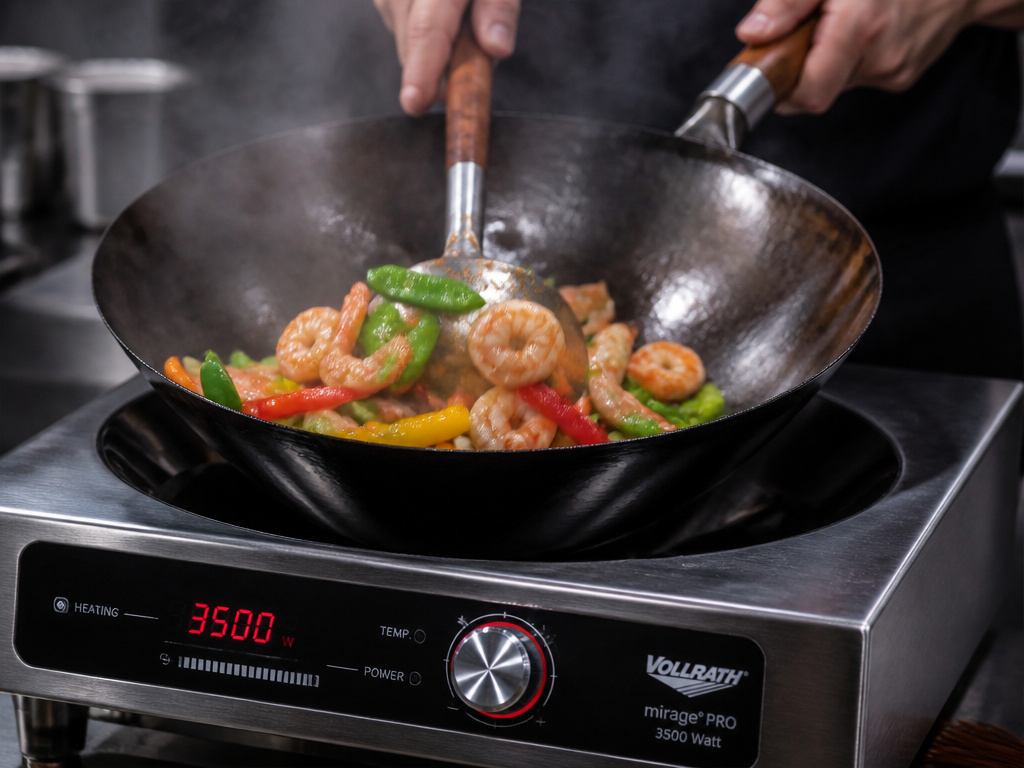
This is the professional workaround. Instead of fighting your flat hob, you buy an appliance designed for the job: a countertop induction wok. These units feature a recessed, bowl-shaped glass cooking surface that cradles a traditional 14-inch round-bottom carbon steel wok.
How They Work
The induction coil is shaped to match the curve of the wok, creating magnetic contact all the way up the sloping sides. This delivers heat where you need it for authentic stir-frying. Units like the Vollrath 6958301 and the Avantco 177IWC35 are commercial-grade, plugging into a 208-240V outlet (like an electric dryer) and delivering 3500 watts of power. That’s more than double the output of a typical home cooktop burner.
Key Specs from the Manuals
- Vollrath 6958301: 208-240V, 50/60 Hz, 3.0 – 3.5 kW, drawing 14.6 Amps. Includes a 14” carbon steel wok.
- Avantco 177IWC35: 3500W, 208-240V, 60Hz. Temperature range 140-460°F.
These are not subtle appliances. They are loud, powerful, and require specific electrical setup. But they are the only induction solution that genuinely replicates the enveloping heat of a gas wok burner.
Where this goes sideways: Plugging a 240V commercial unit into a standard 120V home outlet. It won’t work, and you risk blowing a circuit. Verify your kitchen’s voltage before even looking at these models.
If your kitchen can support it, a dedicated unit is the ultimate solution. Explore the specific options in our review of dedicated induction wok burners.
The Step-by-Step Guide to Using Your Wok on Induction

If you have a compatible flat-bottom wok, the process is straightforward but has specific steps to prevent damage.
Before you start:
- Perform the magnet and flatness test. Do not skip this.
- Ensure your wok is completely dry. Water droplets on the base can cause thermal shock to the glass.
- Have all ingredients prepped (mise en place). Induction heats so fast you won’t have time to chop once you start.
The Cooking Sequence
- Place the wok on the cold hob. Center it perfectly over the cooking zone.
- Add your cooking oil first. For induction, you should always add cold oil to a cold pan. This is critical.
- Select your power setting. Start at a medium power (level 5-7 out of 10) to warm the oil. For stir-fry, you’ll likely go to max power (9 or 10, but never “Boost” for oil).
- Cook as normal. The responsiveness is instant. Lower the power the second you need less heat.
- When finished, remove the wok. Then turn off the hob. Most hobs have a residual heat light that stays on.
- Let the glass cool completely before cleaning. Use a ceramic glass cleaner, not abrasive scrubs.
Never use the “Booster” or max-power pre-set to heat oil. Miele’s manual warns to “Heat oil or fat for a maximum of one minute” and never with the Booster function. The base can reach the auto-ignition point for oil in seconds, creating a serious fire hazard.
Why This Sequence Matters
Induction transfers energy with incredible efficiency. A pan base can jump 300 degrees Fahrenheit in under 30 seconds. Adding oil first acts as a buffer, distributing the initial thermal surge. Pre-heating an empty pan, as the Vollrath manual cautions, can lead to “cookware overheating and being damaged” almost immediately. The metal can warp or, in extreme cases, the thermal shock can crack the glass cooktop.
Troubleshooting: Error Codes and Weak Heat
Induction hobs communicate through error codes. Here’s what they usually mean for wok cooking.
- Flashing “F9”, “U”, or “Pan” symbol: The cooktop does not detect a compatible pan. Your wok is either not magnetic, too small (under 5″ diameter), or its base is warped. Re-test with a magnet.
- Flashing “F2” or “H” (Overheat): The unit’s internal electronics are too hot. This happens if ventilation is blocked, the room is too hot (above 104°F), or you’ve been cooking at max power for an extended period. Turn it off, let it cool, and ensure the vents are clear.
- Loud buzzing/clicking during use: This is often normal, it’s the sound of magnetic components vibrating. However, if it’s accompanied by erratic heating, it usually indicates poor pan contact. Check for flatness.
- Heat is weak or only works on one side: The wok is not centered, or the base is warped. The induction coil only heats the area directly above it. A warped pan makes contact on one side only, creating a single hot spot.
If your wok fails these tests, it’s time to shop for a purpose-built one. Our guide to choosing a wok for induction stoves focuses on home cooktop compatibility and flat-base performance.
Frequently Asked Questions
Can I use my carbon steel wok on induction?
You can only use a carbon steel wok on induction if it has a flat, magnetic base. Traditional round-bottom carbon steel woks will not work. Many modern carbon steel woks have a thicker magnetic steel disk welded to the bottom for this exact purpose.
Do I need special cookware for induction wok cooking?
Yes. The requirement is absolute: your wok must have a flat, ferromagnetic base. This is the definition of special cookware for induction. “Induction-ready” is the label to look for, but always verify with the magnet test.
What is the best type of wok for an induction hob?
Flat-bottomed carbon steel wok with a dedicated induction base offers the best balance of high heat retention and compatibility. For those who want ultimate convenience and even heating, a multi-ply magnetic stainless steel wok is a excellent, low-maintenance choice.
Will an induction hob crack my wok?
The hob won’t crack your wok, but an incompatible or warped wok can crack the glass cooktop. Thermal stress from uneven heating is the cause. Using a perfectly flat, correctly sized pan eliminates this risk. The manuals are clear: damaged or warped pans “can cause premature failure” of the appliance.
Is a dedicated induction wok burner worth it?
Only if you are a serious enthusiast with the necessary 240V electrical outlet and you demand true restaurant-style wok heat. For 95% of home cooks, a high-quality flat-bottom wok on a standard induction hob is more than capable. It’s a significant investment in power and space.
The Bottom Line
You can absolutely wok on induction, but you cannot compromise on the pan. The partnership requires a flat, magnetic base. Start with a magnet from your fridge. If it sticks solidly to the center of your wok’s bottom, you’re in business. If not, you’re looking at a new pan.
Skip the adapter plates and the guesswork. Choose a flat-bottom carbon steel wok with an induction disk, or a clad stainless steel model. Respect the power, never pre-heat empty, and always add oil first. That discipline gives you blistering, responsive heat that can rival gas, with far more control. For everything else, from searing meats to simmering sauces, your standard induction-ready cookware will work just fine. The wok is the one piece that asks for a little more attention. Give it the right base, and it will reward you for years.
