
Is HexClad Cookware Induction Compatible? Here’s Your Answer
This post contains affiliate links. As an Amazon Associate, we earn from qualifying purchases.
Yes, HexClad cookware is induction compatible. Every pan, pot, and skillet in their original hybrid line works on an induction cooktop because the core construction includes a layer of magnetic stainless steel. The proprietary non-stick coating on top does not interfere with the magnetic field needed for induction heating.
That’s the short, direct answer from the manufacturer. The longer answer explains why that matters for your cooking and how to be absolutely certain your specific pan will perform. Induction compatibility isn’t a marketing term, it’s a physical property you can verify in ten seconds with a tool from your fridge.
HexClad built its reputation on a three-metal hybrid design. It sandwiches a non-stick surface between raised stainless steel ridges. For induction, the critical layer is the magnetic stainless steel that forms the pan’s base. This layer reacts to the alternating magnetic field generated by your induction cooktop, creating heat directly in the pan. The rest of the guide breaks down the physics, the verification test, and how to get the best performance from HexClad on an induction stove.
Key Takeaways
- HexClad states all its original hybrid cookware is induction-ready due to a magnetic stainless steel base layer.
- You must perform a simple magnet test, if a fridge magnet sticks firmly to the center of the pan’s bottom, it will work on induction.
- The pan’s non-stick TerraBond coating does not block the magnetic field; compatibility depends solely on the metal beneath it.
- For optimal performance on induction, use moderate heat settings and avoid dragging the pan across the glass cooktop surface to prevent scratching.
- Always look for the standard induction symbol (a coiled spiral line) stamped on the cookware or its packaging as the manufacturer’s guarantee.
How Induction Cooking Works & What Makes a Pan Compatible
Induction cooking doesn’t heat the cooktop. It heats the pan directly through electromagnetic induction. The cooktop generates a high-frequency alternating magnetic field. When a ferromagnetic material, like magnetic stainless steel or cast iron, is placed within this field, the molecules are agitated, creating heat instantly inside the pan itself.
Induction compatibility requires a cookware base made of a magnetic material. The cooktop’s coil induces electrical currents (eddy currents) in that magnetic layer, and the resistance of the metal to these currents generates heat. Non-magnetic materials like pure aluminum, copper, or glass do not respond.
This means a pan can have layers of different metals, but the base layer that contacts the cooktop must be magnetic. This is the core principle behind all induction-ready cookware. HexClad’s design uses a magnetic stainless steel core, which is why it qualifies. Many high-quality stainless steel cookware sets also use this type of steel for their induction-compatible lines.
The raised stainless steel ridges and the non-stick valleys on a HexClad pan’s cooking surface are irrelevant to the induction function. The heat is generated in the base and then conducted upward through the pan’s body.
The Simple, Foolproof Test for Any Pan
Never take a manufacturer’s claim or a logo on a box at face value. The verification is physical, immediate, and free.
Grab a standard refrigerator magnet. Place the pan upside down on a flat surface. Press the magnet firmly against the center of the pan’s bottom. If the magnet sticks with a strong, definite pull, the pan is induction compatible. If it slides off or holds only a weak attraction, the pan will not work properly on an induction hob.
This test works because it directly checks for the ferromagnetic property the cooktop needs. It’s the most reliable method for any cookware, new or old. It also helps you identify pans in your existing collection that might work, even if they aren’t marketed as induction compatible cookware. Some clad stainless steel pans with an aluminum core still have a magnetic stainless steel outer layer and will pass this test.
Where this goes sideways: Testing only the very edge of a clad pan. Some pans have a non-magnetic rim or a sandwich construction that is only magnetic in the central cooking zone. Always test the dead center of the base for an accurate result.
HexClad’s Construction: Why It Works on Induction
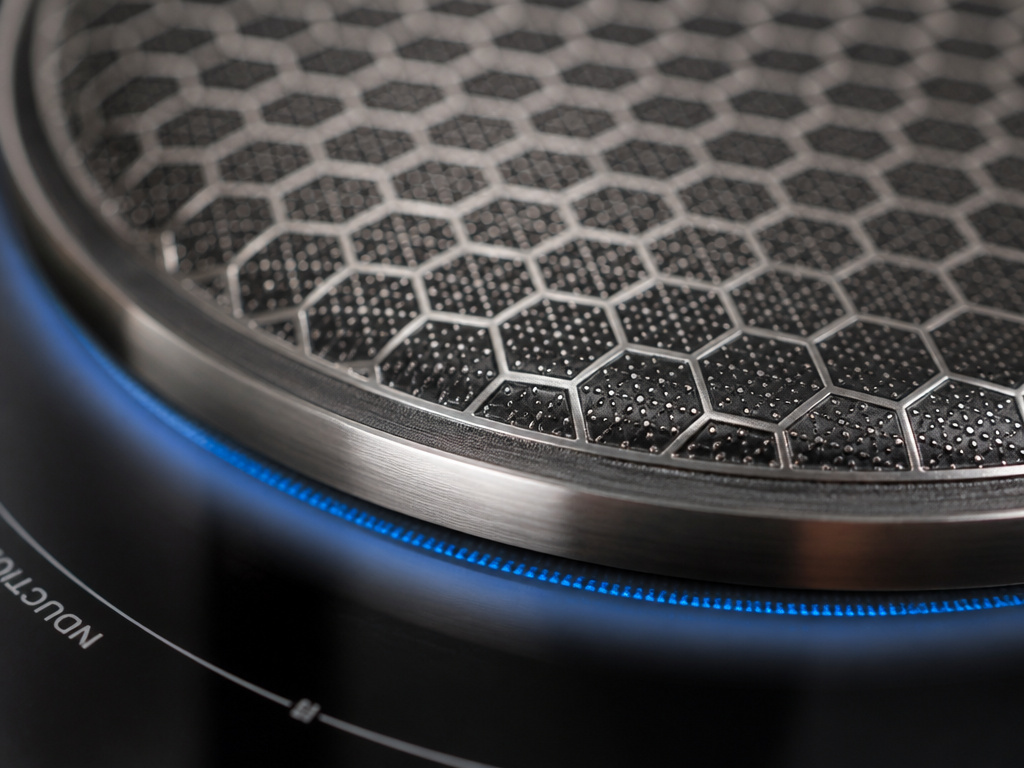
HexClad describes its product as a hybrid. The cooking surface is a pattern of laser-etched stainless steel peaks surrounding a proprietary non-stick ceramic coating (TerraBond) in the valleys. The body of the pan, however, is built on a core of magnetic stainless steel.
This magnetic base is the workhorse for induction cooking. When you place the pan on an active induction zone, the magnetic field penetrates the glass and interacts with this steel layer. The entire base plate heats up uniformly and quickly. From there, heat transfers efficiently to the stainless steel ridges for searing and to the ceramic-coated valleys for easy food release.
| Pan Layer | Material | Role in Induction Cooking |
|---|---|---|
| Base Plate | Magnetic Stainless Steel | The reactive layer. Generates heat when exposed to the cooktop’s magnetic field. |
| Body & Ridges | Stainless Steel | Conducts and distributes heat from the base. Provides a durable, searing surface. |
| Cooking Surface | TerraBond Ceramic Coating | Provides non-stick properties. Does not affect magnetic induction. |
This construction is why HexClad falls into the category of cookware that works on induction. It’s not a special “induction line”, the standard hybrid design already contains the necessary magnetic material. When you’re evaluating best induction cookware, this built-in compatibility is a key feature.
Identifying Induction-Ready HexClad & Proper Care
HexClad typically stamps the universal induction symbol on the bottom of its pans. This symbol looks like a coiled spiral or a series of loops inside a circle. It’s your visual guarantee from the manufacturer. You should also find it on the product packaging.
If you can’t find the symbol, the magnet test is your authority. Assuming it passes, using HexClad on induction is straightforward, but a few practices will extend the life of both your pan and cooktop.
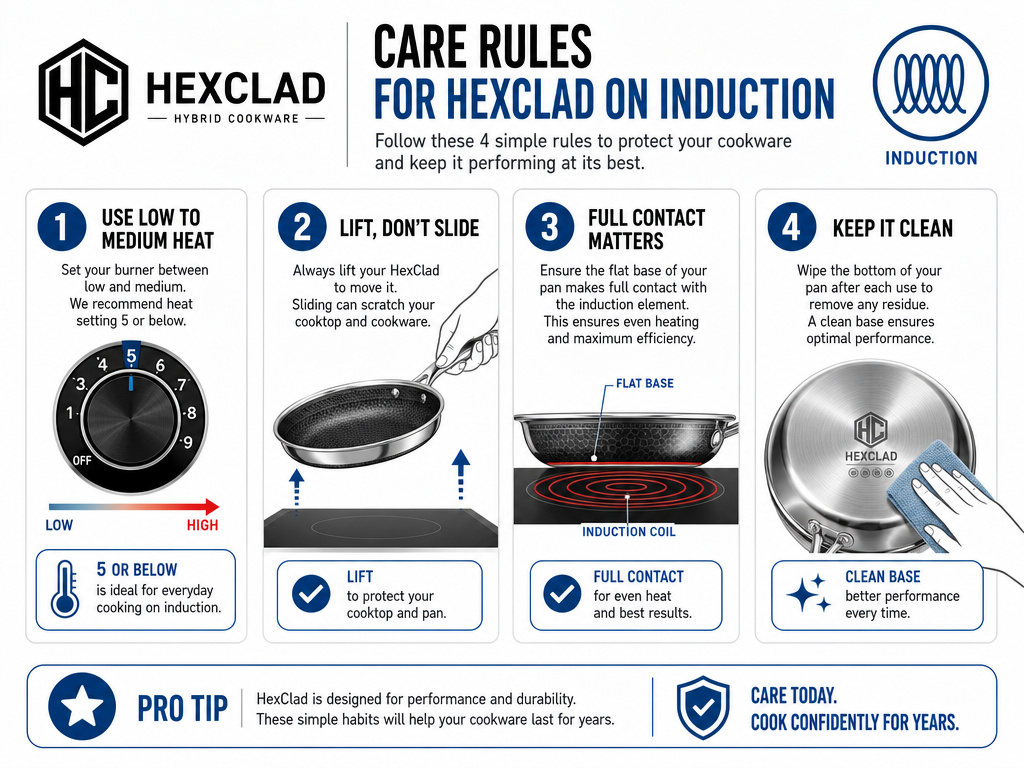
- Start with Medium Heat. Induction heats incredibly fast. Setting a dial to high (often 9 or 10) can shock the pan with intense heat too quickly. Start at a medium setting (5 or 6) and adjust up. You’ll rarely need the maximum power.
- Lift, Don’t Slide. Always lift the pan to move or remove it from the induction zone. Dragging it across the glass-ceramic surface can scratch both the cooktop and the pan’s base.
- Ensure Full, Flat Contact. The entire flat center of the pan’s base should be in contact with the cooking zone. If the pan is warped or sits on a smaller burner, heat distribution will be uneven and inefficient.
- Clean the Base. Wipe the bottom of your HexClad pans after cooling. Oils and residues can bake onto the base and then onto your cooktop, creating stubborn stains.
These rules apply broadly to all induction compatible pans, not just HexClad. They protect your investment and ensure consistent performance.
HexClad vs. Other Induction-Compatible Cookware Types
HexClad occupies a specific niche. It’s not a pure stainless steel pan, nor is it a traditional non-stick. Understanding how it stacks up against other common induction cookware materials helps you decide if it’s right for your kitchen.
| Cookware Type | Induction Compatible? | Best For | Consideration on Induction |
|---|---|---|---|
| HexClad Hybrid | Yes (magnetic steel base) | Searing, easy cleanup, versatile daily use | Excellent heat response. Avoid high-heat shock. |
| Clad Stainless Steel | Often (if outer layer is magnetic) | Browning, deglazing, oven-safe versatility | Even heating, durable. Can have hot spots if base is warped. |
| Cast Iron / Carbon Steel | Yes (highly magnetic) | High-heat searing, heat retention | Very efficient. Heavy, can scratch glass cooktop if dragged. |
| Traditional Non-Stick | Sometimes (requires magnetic base plate) | Eggs, delicate fish, low-fat cooking | Often has limited max temperature. Coating can degrade faster under intense induction heat. |
| Pure Aluminum or Copper | No (non-magnetic) | Even heating (on gas/electric) | Requires an induction interface disk, which slows heating and adds a layer. |
If your priority is a durable non-stick surface that can also handle high heat for searing, HexClad is a strong contender among best non-stick induction pans. If you do a lot of sautéing and sauce-making, a traditional clad stainless steel on induction might be more versatile. For the ultimate in heat retention and searing power, enameled cast iron is a classic choice, though it’s significantly heavier.
Frequently Asked Questions
Does the HexClad non-stick coating wear out faster on induction?
Not inherently. The coating’s lifespan depends more on your cooking tools and cleaning habits than the heat source. Because induction allows very precise temperature control, you can actually avoid overheating the pan more easily than with gas or electric coils, which may extend the coating’s life. Always use silicone, wood, or nylon tools.
Will all HexClad products, including woks and grill pans, work on induction?
You must check each specific product. While the core cookware line is induction-ready, specialty items like a round-bottom wok or a grill pan with raised ribs may not have full, flat magnetic base contact. The product description or packaging will specify. When in doubt, use the magnet test on the flattest part of the base.
My magnet sticks, but the cooktop flashes an error code. What’s wrong?
This usually indicates poor contact. The pan might be slightly warped, or the cooktop’s sensor isn’t detecting enough magnetic material. Ensure the pan is centered on the cooking zone and that the base is completely flat and clean. Some older or smaller induction units also have a minimum pan diameter they can activate; a very small saucepan might not register.
Is HexClad considered one of the best induction cookware sets?
It depends on your cooking style. HexClad excels at providing a non-stick experience with better searing ability than a standard non-stick pan. For a set that prioritizes easy cleanup and versatility, it ranks highly. For ultimate browning and deglazing, many chefs prefer a fully clad stainless steel set. Review best induction ready cookware lists to see how different brands compare for specific tasks.
Can I use HexClad on an induction cooktop with a boost function?
Yes, but use the boost function sparingly. Boost delivers maximum power for a short time to rapidly bring water to a boil. It’s safe for the magnetic base, but the intense, focused heat can be harsh on any non-stick coating over the long term. For boiling water, it’s fine. For preheating the pan for searing, a regular high setting is sufficient and gentler.
Before You Go
HexClad cookware is built for induction from the ground up. The magnetic stainless steel base is the key. Verify it yourself with a magnet, that physical test never lies. Once confirmed, remember that induction’s speed is its own learning curve. Start at medium heat, lift your pans instead of sliding them, and enjoy the precise control.
Your cookware is an investment. Knowing the principles of induction cooking and how your pans meet those requirements for induction cookware means you’ll use them correctly from day one. That knowledge turns a marketing claim into a reliable, daily performance you can count on.
