
Does Carbon Steel Skillet Work on Induction? The Magnet Test
This post contains affiliate links. As an Amazon Associate, we earn from qualifying purchases.
A carbon steel skillet works on an induction cooktop if, and only if, a magnet sticks firmly to its base. The pan must be ferromagnetic because induction generates heat through a magnetic field. A flat, stable base that matches the size of the induction burner element is just as critical as the magnet test itself.
That magnetic requirement is the gate. What happens inside the gate decides whether your skillet performs well or fails spectacularly. Induction’s rapid, direct heat transfer exposes every weakness in a pan’s construction. A base that’s slightly warped, too small, or too thin turns a minor flaw into a major cooking problem in minutes.
What follows: the right way to run the magnet test, the three physical specs that matter more than the label on the box, and the specific model caveat that changes the answer for some brands.
Key Takeaways
- The magnet must stick firmly everywhere on the skillet’s base, not just in the center, to ensure even heating and avoid cold spots.
- A pan smaller than the induction burner’s activation zone won’t heat at all, the cooktop’s safety sensor reads it as empty.
- Carbon steel is prone to warping on induction, especially in larger (12-inch+) skillets, due to the intense, instantaneous heat transfer.
- All KitchenAid cookware made after 2013 is induction-capable, a manufacturer-specific fact that overrides general material rules.
- Round-bottom carbon steel woks require a flat induction adapter plate; their curved base breaks contact with the cooktop surface.
How Induction Cooktops Work (The Magnetic Non-Negotiable)
Induction doesn’t heat a burner. It creates an oscillating magnetic field. When a ferromagnetic pan, one a magnet sticks to, sits in that field, the metal’s molecules vibrate rapidly, generating heat directly inside the cookware.
Induction cooktops generate heat through magnetic energy. Instead of heating a burner element, the cooktop creates a magnetic field that transfers energy directly into the cookware. For this process to work, the cookware must contain ferrous metal, meaning it must be magnetic.
This is why aluminum, copper, and glass don’t work alone. They aren’t magnetic. Some pans clad these materials with a magnetic stainless steel layer, which is why you should always test with a magnet, even on a pan you assume won’t work. The underlying principle of how induction works is this direct magnetic coupling.
If the physics sounds abstract, the consequence is concrete. Heat forms instantly in the pan, not slowly from a hot coil. This makes induction fast and efficient, but it also means the pan itself is the only thing getting hot. Any gap between the pan and the cooktop, or a lack of magnetic material, stops the process cold.
The Definitive Magnet Test (and How to Do It Right)
Grab a standard refrigerator magnet. Don’t use a weak promotional magnet; use one with a decent pull.
Place the magnet on the center of the skillet’s cooking surface. If it sticks, you have a good start. Now, slide the magnet to the outer edge of the flat cooking surface. It should hold with equal force all the way to the perimeter.
Where this goes sideways: Testing only the center. A magnet that sticks firmly in the middle but weakly at the edges signals a clad construction or uneven material thickness. That pan will heat unevenly, with a hot spot in the center and cooler outer rings.
This is the nuance most guides skip. According to CHOICE, the magnet should “stick well everywhere on the base, right up to the edges – and ideally along the sides as well.” If the hold is weak anywhere, that skillet is a poor candidate for induction, even if it technically “works.”
The test is the universal decoder for induction compatible materials. It cuts through marketing claims about “induction-ready” labels. If the magnet falls off, the label is wrong for your specific model. This methodology is echoed in resources like the Consumer Reports induction compatibility guide, which recommends the same simple check.
Why the Magnet Test Isn’t Perfect
A positive magnet test is necessary, but it’s not sufficient. Two other physical factors can override a magnetic base: size and flatness.
Pan Size and Burner Activation
Induction burners have a minimum pan-diameter sensor. If your 8-inch carbon steel skillet sits on a burner designed for a 10-inch pan, the cooktop may not turn on. It reads the pan as absent. Samsung’s manual states the magnetic portion of the base “should match the size of the element used.” Using a too-small skillet can also damage the cookware’s sides and handle from concentrated heat.
| Pan Size vs. Burner | Result | Why It Happens |
|---|---|---|
| Pan smaller than element | No heat / Error code | Cooktop sensor doesn’t detect sufficient ferromagnetic material. |
| Pan matches element size | Optimal heating | Magnetic field transfers energy evenly across the full base. |
| Pan larger than element | Uneven heating | Center overheats while outer edges receive less magnetic energy. |
The Flatness Factor
Induction requires full, flush contact. A warped carbon steel skillet, one that rocks on a flat counter, will have air gaps. These gaps insulate parts of the pan from the magnetic field, creating wild temperature variations. You’ll see oil pool in the cold spots while the center scorches your food. This is a common failure mode for older or lower-quality skillets, and it’s a primary reason some cooks think their “compatible” pan performs badly.
The Real-World Risks: Warping and Uneven Bases
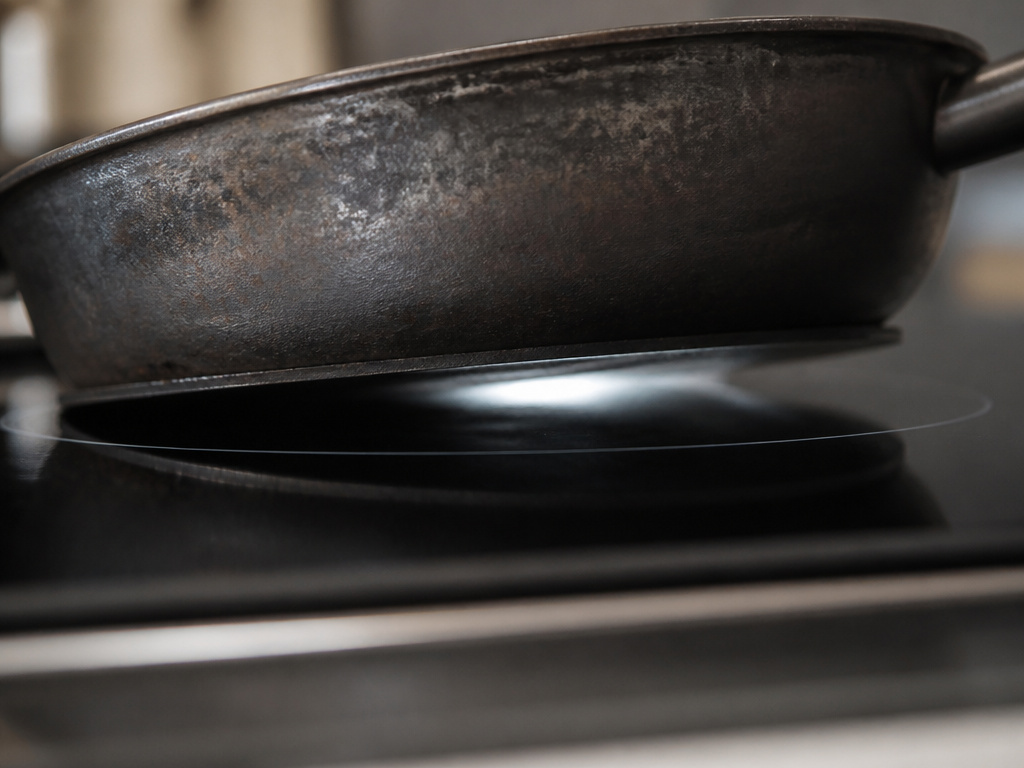 Carbon steel is thin and responsive. That’s its virtue on gas, where heat licks up the sides. On induction, that virtue becomes a vulnerability. The heat is so instantaneous and concentrated that thermal stress can distort the metal.
Every brand of carbon steel is prone to warping on induction because of the rapid heat transfer. This is typically more common in 12” or larger pans.
That’s a direct admission from Misen about their carbon nonstick line. The larger the surface area, the harder it is for the metal to expand evenly under the intense, localized heat. The result is a permanent warp, often a convex bulge in the center that ruins contact.
How to minimize warping risk:
- Preheat low and slow. Never crank an induction burner to high with a cold carbon steel skillet on it. Start at a medium-low setting for 60-90 seconds.
- Use a burner that matches the pan’s size. A 12-inch skillet on a 12-inch burner element heats more evenly than on a smaller, more intense 8-inch element.
- Consider thicker models. Some professional-grade carbon steel skillets have a slightly thicker gauge, which resists warping better but sacrifices some responsiveness.
This risk profile is a key part of evaluating carbon steel cookware for an induction kitchen. It’s not a deal-breaker, but it’s a mandatory consideration that doesn’t exist for gas or standard electric.
Manufacturer Specifics and Edge Cases
 General rules break down with specific brands and designs. Always check the manufacturer’s documentation first.
KitchenAid’s Clear-Cut Rule
All KitchenAid cookware manufactured after 2013 is induction capable. If you have a older set, the magnet test is your answer. This is a perfect example of a brand-specific fact that simplifies the decision.
Round-Bottom Woks and Specialty Pans
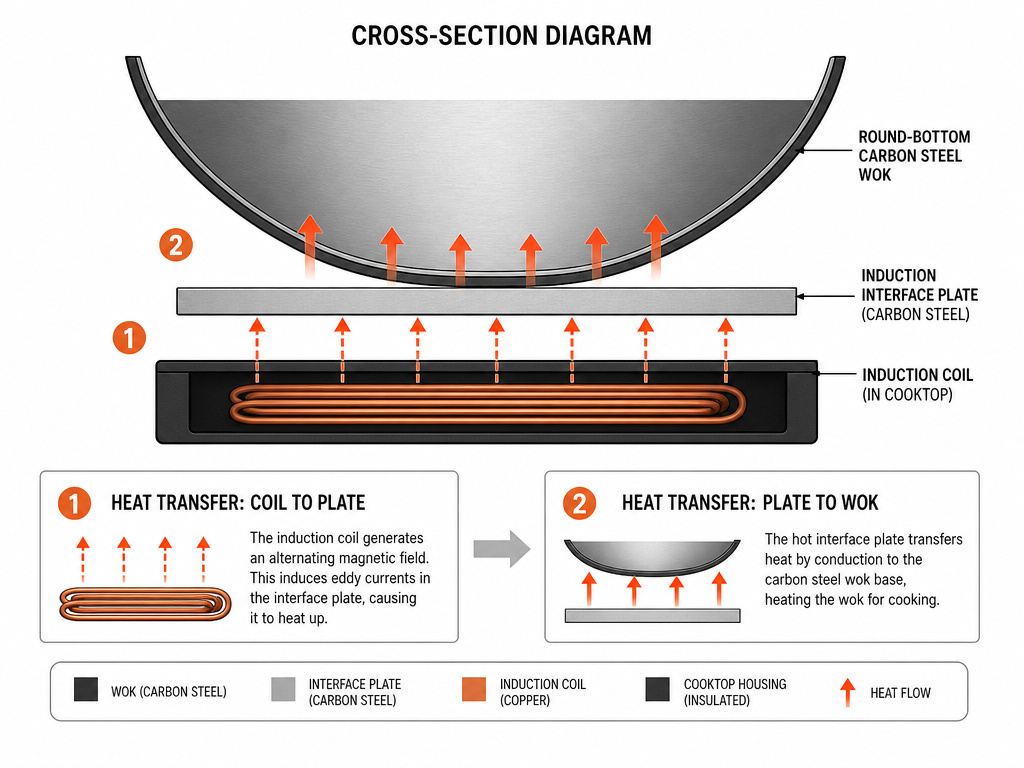
A classic carbon steel wok has a round bottom. It will fail the flatness test catastrophically. To use one on induction, you must place it on a flat induction interface plate, a metal disk that heats up and transfers heat to the wok conventionally. This defeats induction’s speed and efficiency but lets you keep the tool.
“Induction-Ready” Nonstick and Clad Cookware
Many modern nonstick pans, like some from GreenPan, use a magnetic stainless steel base under a nonstick coating. They pass the magnet test. The same goes for copper-core pans clad in magnetic stainless. This is why testing is non-negotiable; you can’t judge by the primary cooking surface material alone.
Understanding these exceptions is crucial when assessing your cookware requirements for induction. “Special” doesn’t always mean “new”; it means “verified.”
Carbon Steel vs. Other Induction-Compatible Materials
How does carbon steel stack up against the usual induction suspects? It occupies a specific niche.
| Material | Induction Compatible? | Best For | Watch Out For |
|---|---|---|---|
| Carbon Steel | Yes (if magnetic) | Searing, sautéing, fast temperature changes. | Warping on high heat, requires seasoning. |
| Cast Iron | Yes | Slow, even heating, roasting, baking. | Extreme weight, slow to heat and cool. |
| Magnetic Stainless Steel | Yes | Sauces, boiling, all-purpose use; often dishwasher safe. | Can stick if not properly preheated. |
| Enameled Cast Iron | Yes (if base is cast iron) | Braising, slow-cooking, acidic dishes. | Chipped enamel ruins it; heavy. |
Carbon steel wins on speed and maneuverability. It heats nearly as fast as induction itself and is much lighter than cast iron. For a direct comparison of durability and use, see how it differs from a cast iron skillet. Its main rival for searing is actually stainless steel on induction, which offers easier cleaning but less natural nonstick character over time.
Before You Start: The Pre-Use Checklist
Don’t just throw your skillet on the burner. Run through this list to prevent damage and poor performance.
- Verify with a magnet. Test the center and edges firmly.
- Check for flatness. Place the skillet on a perfectly flat countertop. Press the center. If it rocks, it’s warped and will heat unevenly.
- Match the burner size. Find the induction burner that most closely matches your skillet’s base diameter.
- Inspect the cooktop. Ensure the glass surface is clean and dry. A crumb or water droplet can create a micro-gap.
- Season your skillet (if needed). A well-seasoned carbon steel pan performs better and is easier to maintain. Fresh, bare metal will rust.
This checklist embodies the core principles of using induction-ready cookware. Compatibility is a combination of physics, geometry, and maintenance.
Frequently Asked Questions
Can I use my carbon steel wok on induction?
Only if it has a flat bottom. A traditional round-bottom carbon steel wok will not make sufficient contact. You must use it with a flat induction interface plate, which turns the induction cooktop into a conventional heating element for the plate.
Why won’t my induction cooktop turn on with my carbon steel pan?
Two likely reasons. First, the pan is too small for the specific burner you’ve selected, so the cooktop’s sensor doesn’t detect it. Second, the pan’s base is not sufficiently magnetic. Even if a magnet sticks weakly, it might not meet the minimum magnetic threshold for that particular cooktop model.
Does carbon steel work on induction better than stainless steel?
“Better” depends on the task. Carbon steel heats and cools faster, making it superior for quick searing and stir-frying. Magnetic stainless steel (like 18/10 or 18/0 grades) is more inert, better for acidic sauces, and often easier to clean. For a breakdown of the best uses for each, consult a guide on skillet materials.
Is all carbon steel cookware induction compatible?
No. While the vast majority is due to its iron content, some carbon steel pans may have non-magnetic alloying elements or a base treatment that reduces magnetism. Always perform the magnet test. It’s the only guarantee.
How do I prevent my carbon steel pan from warping on induction?
Always preheat gradually. Start on a medium-low setting for at least a minute before increasing the heat. Avoid placing a cold, empty pan on a max-power burner. Using a burner that matches the pan’s size also distributes thermal stress more evenly.
The Bottom Line
Yes, a carbon steel skillet works on induction, if it passes a rigorous magnet test and has a flat, properly sized base. The material’s tendency to warp under induction’s intense heat is its biggest drawback, a trade-off for its legendary speed and lightness.
Your move is simple. Get a magnet. Test your pan at the center and edges. If it holds strong, place it on a correctly sized burner and preheat gently. That’s the entire ritual. For a specific model recommendation, the best carbon steel pans for induction often feature a slightly thicker gauge or a reinforced base to combat warping. Choose one of those, and you’re not just buying a pan; you’re buying peace of mind on a fast, modern cooktop.
