
How a Dumpling Steamer Works: Understanding Steam & Limits
This post contains affiliate links. As an Amazon Associate, we earn from qualifying purchases.
A dumpling steamer works by boiling water to produce a constant flow of moist heat that gently cooks food without direct contact with liquid. The core mechanism is identical across bamboo and electric models: a heated water reservoir generates steam, which rises through one or more perforated tiers, surrounding the food with 212°F (100°C) vapor. This moist heat transfers energy efficiently, cooking dumplings evenly while retaining their juices and delicate wrappers.
That 212°F ceiling is the whole game. It’s why a pork and chive dumpling cooks through without the filling drying out and why the wrapper stays tender instead of turning to mush. The device itself is just a delivery system for that consistent, gentle heat.
What follows is a breakdown of the physics, the two main delivery systems (bamboo and electric), their specific limitations, and the operational mistakes that burn out heating elements or void a two-year warranty in a single use.
Key Takeaways
- Steam cooks at a constant 212°F (100°C) at sea level, providing gentle, even heat that preserves texture and moisture far better than boiling or frying.
- Every electric steamer has a finite water reservoir, often around 1.2 liters, which translates to a hard runtime limit, typically 60 minutes before boil-dry protection engages.
- Never add anything but water to an electric steamer’s reservoir. Salt, broth, or vinegar causes mineral scaling and corrosion that voids the warranty on models like the Ovente FS53.
- Bamboo steamers like the MìLà set rely on an external heat source (a wok) and require a liner (parchment, cabbage) to prevent sticking and absorb excess moisture.
- Descaling an electric steamer every 3 months isn’t a suggestion; it’s mandatory maintenance to prevent mineral deposits from insulating the heating element and drastically reducing its lifespan.
The Physics of Steam: How Moist Heat Cooks
Forget the appliance for a second. The cooking happens in the vapor.
Steam is water vapor at 212°F (100°C) at standard atmospheric pressure. This moist heat transfers energy to food more efficiently than dry air, condensing on the cooler surface of the food and releasing latent heat as it changes phase from gas to liquid.
This phase-change release is why steaming is so effective. The energy transfer doesn’t rely solely on air temperature. When steam touches the cooler surface of a dumpling, it condenses, dumping a significant amount of heat directly into the wrapper and filling. This cooks food quickly and evenly from the outside in.
The constant temperature is the other half of the equation. Unlike an oven or a pan where heat can spike, steam caps at 212°F. This prevents the rapid protein coagulation and moisture expulsion that makes boiled dumplings tough or fried ones greasy. The result is a cooked-through filling that stays juicy and a wrapper that remains delicate.
The 60-minute ceiling on most electric models exists because of this physics. A heating element can only vaporize the water in the reservoir. Once that water is gone, the element overheats. That’s why boil-dry protection is non-negotiable.
Bamboo vs. Electric: A Head-to-Head on Mechanics
The end result, perfectly steamed dumplings, is the same. The path there is completely different. Your choice dictates your prep, your monitoring, and your cleanup.
| Mechanism | Bamboo Steamer (e.g., MìLà) | Electric Steamer (e.g., Ovente FS53, Russell Hobbs RHSTM3) |
|---|---|---|
| Heat Source | External (wok, pot of boiling water) | Internal (400W–900W immersed heating element) |
| Water Management | You maintain water level in the base pot. | Self-contained reservoir with a measured capacity (e.g., 1.2L). |
| Steam Generation | Steam rises from the boiling water below, passing through the woven bamboo. | Heating element boils water in a sealed base, forcing steam up a central column. |
| Capacity Control | Add or remove stacking tiers. | Fixed number of stacking plastic bowls (usually 2 or 3). |
| Safety Features | None inherent; you must monitor the base pot to prevent it from boiling dry. | Boil-dry protection auto-shuts off the element; timer auto-shutoff. |
| Primary Failure Mode | Base pot boils dry, damaging the pot and potentially scorching the bamboo. | Mineral scaling from hard water or added liquids insulates the heating element, causing burnout. |
The Traditional Bamboo Steamer System
A bamboo steamer is a passive device. It doesn’t make heat; it directs it. You place it over a pot or wok of vigorously boiling water. The steam rises, enters through the bottom of the woven basket, and circulates around the food before exiting loosely through the lid.
The woven bamboo itself is functional. The gaps between the slats allow for steam circulation while also absorbing excess condensation, which helps prevent soggy dumpling bottoms. This is why you must use a liner, parchment paper, cabbage leaves, or a dedicated silicone mat. The liner provides a non-stick surface and catches any drips, but it also keeps the dumplings from direct contact with the bamboo, which can become saturated and impart a flavor over time.
The MìLà bamboo steamer baskets, for example, are two 10-inch tiers that each hold about a dozen frozen soup dumplings. The setup is simple, but it demands your attention. You are the boil-dry protection. If the wok beneath runs dry, you risk warping the bamboo and ruining your cookware.
The Modern Electric Steamer System
An electric steamer is a closed, automated system. You pour water into a dedicated reservoir, the Russell Hobbs RHSTM3 holds 1.2 liters, set a timer, and press start. A sealed heating element at the bottom of the base unit brings that water to a boil.
The generated steam is then funneled up through a central column or steam guide and distributed into the stacked cooking tiers. Models like the Ovente FS53 use a 400W element for this job. The plastic bowls are designed with precise venting to ensure even steam distribution across each level.
Where this goes sideways: Adding anything but pure water to the reservoir. The Ovente FS53 manual explicitly forbids salt, broth, or wine. These liquids accelerate limescale formation and can corrode the heating element or its housing, a repair not covered under the standard one-year warranty.
The built-in 60-minute timer on most models isn’t arbitrary. It’s matched to the reservoir capacity. A 1.2-liter reservoir provides roughly 60 minutes of steam. Exceed that, and the boil-dry protection will trigger, shutting off the element to prevent a meltdown.
The Step-by-Step Process for Each Type
The core sequence is fill, load, steam, and rest. The devil is in the details specific to each system.
How to Use a Bamboo Steamer
- Prepare Your Base: Fill a wok or wide pot with about 2 inches of water. Bring it to a rolling boil. The steamer should sit above the water, not in it. Use a steamer rack if your pot doesn’t have a curved bottom.
- Line the Basket: Cut parchment paper to fit the basket, or use a single large cabbage leaf. This is the step that prevents sticking and messy cleanup. Never skip it.
- Load the Dumplings: Arrange dumplings in a single layer with about an inch between them. Crowding causes them to stick together and steam unevenly. If using multiple tiers, place heartier items (like meat buns) on the bottom where the steam is hottest.
- Steam and Monitor: Cover with the bamboo lid. Steam for the time specified by your recipe, often 10-12 minutes for frozen soup dumplings. Listen for the boil. If the sound of bubbling water stops, immediately add more boiling water to the base pot.
- Rest Before Serving: Turn off the heat. Let the dumplings sit with the lid on for 1 minute, then remove the lid for a final minute. This resting stage allows the wrappers to set and prevents them from tearing when you pick them up.
How to Use an Electric Steamer
- Fill the Reservoir with Water Only: Use cool, fresh water. Fill to the line corresponding to your cook time (e.g., the Kogan steamer has a “max” line for 15-60 minutes, a “min” line for shorter cooks). This is where using a measuring cup helps.
- Assemble the Stack: Place the drip tray and then the cooking bowls onto the base. Put foods that need the most cooking (root vegetables, dense proteins) in the lower bowl, as steam rises from the bottom up.
- Set the Timer and Start: Close the lid. Set the mechanical or digital timer. The heating element will engage, and steam will begin to flow within a few minutes.
- Do Not Interrupt: Avoid lifting the lid during cooking. Each time you do, you release a burst of steam and drop the temperature inside, adding several minutes to your cook time.
- Let the Cycle Complete: The steamer will typically beep or turn off when the timer ends. Unplug the unit before removing the lid to avoid a steam burn. The heating element surface remains hot for at least 30 minutes.
Critical Limitations and Maintenance Rules
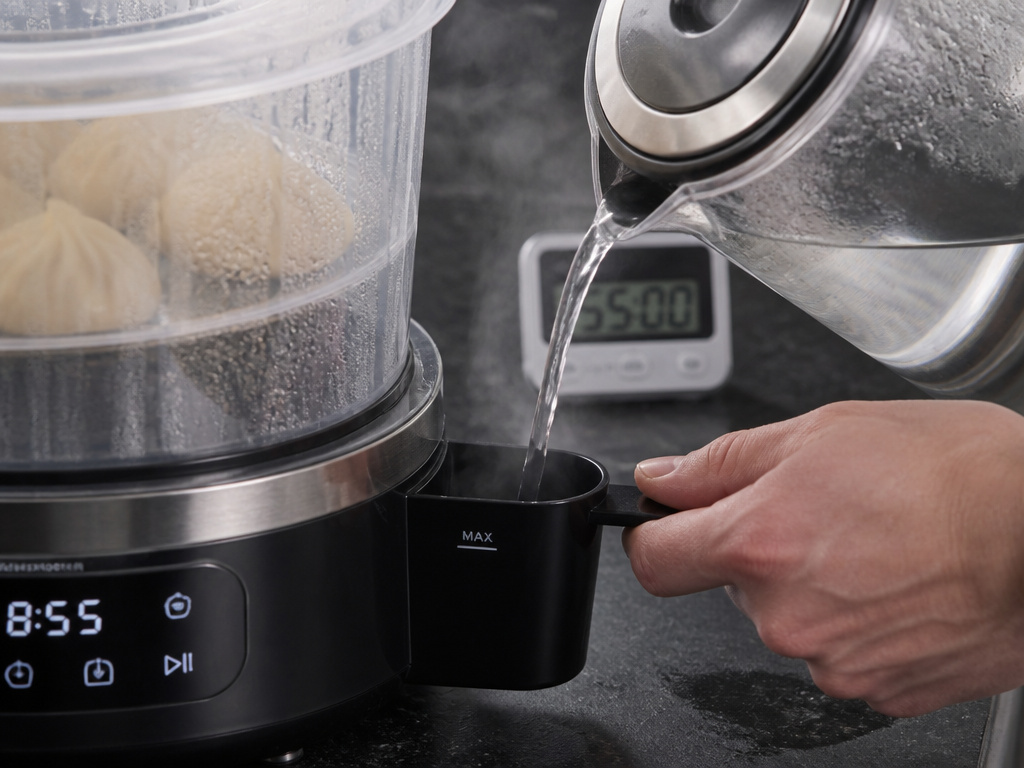
These aren’t gentle suggestions. They are the operational boundaries that determine whether your steamer lasts two years or two months.
The 60-Minute Reservoir Limit
That 1.2-liter reservoir in the Russell Hobbs RHSTM3 is a physical constraint. It provides about 60 minutes of steam. If your recipe requires longer, you must refill the reservoir during cooking. Most manuals instruct you to use caution, add boiling water through the fill inlet to avoid thermal shock to the hot element.
Ignoring this limit forces the boil-dry protection to engage constantly. While it’s a safety feature, frequent triggering stresses the thermostat and can lead to premature failure.
The “Water Only” Mandate and Warranty Voidance
This is the most commonly ignored rule with the most expensive consequence.
Common mistake: Adding vinegar or lemon juice to the water to “keep dumplings white” or using broth for flavor. The Ovente FS53 manual states this voids the warranty. Acids and minerals create aggressive scaling that fuses to the heating element, acting as an insulator. The element then overheats trying to boil the water and burns out.
Descaling every 3 months is the direct counter to this, even if you only use pure water. Hard water leaves mineral deposits. A descaling solution dissolves them. Skip this, and over a year, the layer of scale can be thick enough to cut steaming efficiency in half.
Bamboo Steamer Care and Longevity
A bamboo steamer isn’t dishwasher safe. It’s not even soak-safe.
Hand-wash it quickly with a soft brush and mild soap. Rinse and immediately towel-dry, then air-dry it completely upright before storing. Letting it sit in water causes the bamboo to swell, crack, and become a breeding ground for mold. That earthy scent you love will turn to a musty, sour odor.
Store it in a dry, ventilated cupboard. Never seal it in a plastic bag while damp.
Frequently Asked Questions
Can you steam frozen dumplings directly?
Yes, and it’s often the best method. Steam for 11-12 minutes from frozen, following the rest period. The steady 212°F heat thaws and cooks them evenly without the risk of a soggy wrapper that can happen with boiling.
Why do my dumplings stick to the steamer basket?
You didn’t use a liner. Even with a liner, sticking can happen if the dumplings are overcrowded or if the steam isn’t vigorous enough, allowing condensation to pool. Ensure your water is at a full boil before adding the basket and leave space between each dumpling.
Is a bamboo or electric steamer better for dumplings?
It’s a trade-off between authenticity and convenience. A bamboo steamer offers superior moisture control (the bamboo absorbs excess) and is ideal for traditional dim sum presentation. An electric steamer provides set-and-forget convenience, precise timing, and automatic safety shut-offs, making it foolproof for weeknight dinners.
How much water do I put in an electric steamer?
Consult your manual for the specific fill lines. The universal rule: for cooks under 15 minutes, fill to the minimum line. For cooks between 15 and the unit’s maximum (usually 60 minutes), fill to the maximum line. Overfilling can cause water to bubble up into the food bowls.
Can I stack different foods in a multi-tier steamer?
You can, but you must sequence them. Place the food that needs the longest cook time (like potatoes or chicken) in the bottom tier, closest to the steam source. Place more delicate items (like fish fillets or leafy greens) in the top tier. The steam will be slightly cooler and less direct by the time it reaches the top.
The Bottom Line
A dumpling steamer works because steam is a remarkably efficient and gentle conductor of heat. Whether you choose the hands-on tradition of a bamboo set or the automated ease of an electric model, success hinges on respecting the system’s limits.
For the electric route, that means water only in the reservoir and a descale every season. For the bamboo path, it means vigilant monitoring of your water level and committed, immediate cleaning. Get those right, and the machine, simple or complex, disappears, leaving you with nothing but perfectly steamed dumplings, every time.
