
What Can Be Cooked in a Slow Cooker: The Ultimate Guide
This post contains affiliate links. As an Amazon Associate, we earn from qualifying purchases.
You can cook almost any high-moisture, long-cooking dish in a slow cooker—stews, soups, braised meats, beans, stocks, and even some breads and desserts. The real limit isn’t the recipe idea; it’s matching your ingredients to the slow cooker’s low-and-slow heat transfer and sealed environment. Stick to foods that release liquid and benefit from hours of gentle simmering, and avoid anything that cooks in minutes or needs dry, direct heat.
That “almost” is where most guides stop. They list categories. Your manual lists fill lines. Neither connects the two. The difference between a perfect pot roast and a dried-out, stuck-on mess is three specific, mechanical rules hidden in the spec sheets.
What follows is the translation: the fill-level math from four major brands, the one step that adds 20 minutes every time you do it, and the exact food textures that break down before the timer beeps.
Key Takeaways
- Fill the ceramic pot half to three-quarters full, never less. A half-full pot cooks hotter and faster, burning food 1-2 hours before the recipe time ends.
- Every time you lift the lid, you add 15-20 minutes to the total cook time because you release the critical steam that maintains temperature.
- Avoid pasta, delicate seafood, and milk/cream for the main cook cycle; add them in the last 30-60 minutes or they turn to mush or curdle.
- A slow cooker older than its typical 2-year warranty that cannot reach 185°F may be unsafe to use for meat dishes.
- For baking breads or cakes, you must lay a tea towel under the lid to absorb condensation and prevent a soggy top.
The Golden Rule: High-Moisture, Long-Cooking Foods
A slow cooker works by surrounding food with gentle, radiant heat and trapping steam. This environment excels at breaking down connective tissue in meat and softening fibrous vegetables over many hours. The ideal candidates are dishes that start with moisture and get better with time.
The removable stoneware crock should be at least half-filled for best results. If only half-filled, check for doneness 1 to 2 hours earlier than the recipe. – Hamilton Beach 03-2300-W manual
This isn’t a suggestion. It’s a thermal mass requirement. A half-full pot has less food to absorb the same amount of heat, so the temperature spikes. Your chili scorches on the sides while the center remains undercooked.
| Category | Best Examples | Why It Works | Common Mistake |
|---|---|---|---|
| Soups & Stews | Beef stew, chicken noodle, split pea, chili. | High liquid content conducts heat evenly and prevents scorching. | Reducing liquid from the stovetop recipe. Slow cookers need that liquid to create steam. |
| Braised Meats | Pot roast, pulled pork, lamb shanks, whole chicken. | Connective tissue (collagen) dissolves into gelatin over 6-8 hours, making tough cuts tender. | Using lean, expensive cuts like filet. They dry out. Use chuck roast, pork shoulder, chicken thighs. |
| Beans & Legumes | Dried beans, lentils, chickpeas. | Slow, even heat penetrates dried beans fully without bursting the skins. | Adding salt or acidic ingredients (tomatoes) at the start. It toughens skins. Add in last hour. |
| Stocks & Broths | Chicken stock, beef bone broth, vegetable stock. | Long extraction time pulls maximum flavor and gelatin from bones and aromatics. | Boiling instead of simmering. A slow cooker’s Simmer setting (around 185°F) is perfect. |
| Sauces & Condiments | Applesauce, barbecue sauce, marinara. | Concentrates flavor through slow evaporation without burning. | Not stirring occasionally. Sauces can stick at the edges on High. |
The slow cooker cooking process is forgiving, but it has a physics problem. Without enough mass, it can’t regulate. This is why manual specs are non-negotiable.
What Not to Cook in a Slow Cooker (And Why)
Some foods fail structurally under long, wet heat. Others pose a safety risk. Knowing the “why” saves a meal.
Pasta and most grains. Russell Hobbs manuals state it directly: pasta becomes too soft. The starch absorbs liquid for hours, swelling into a bloated, gummy mass. If you must add pasta, cook it separately and stir it in at the end. The same goes for rice in most recipes—it turns to mush.
Delicate seafood. Shrimp, scallops, and flaky white fish cook in minutes. Leave them in a slow cooker for hours and you get rubbery, overcooked protein. Add seafood in the last 20-30 minutes on High.
Dairy: milk, cream, sour cream. The prolonged heat and acidity from other ingredients will curdle them. Evaporated milk or condensed soup holds up better. If a recipe calls for fresh dairy, stir it in during the last 30 minutes.
Quick-cooking vegetables. Peas, spinach, zucchini, and broccoli turn to gray, flavorless mush. Add them in the last 45-60 minutes to retain color and texture.
Frozen meat blocks. This is a major safety gap. A frozen roast in a slow cooker can linger in the “danger zone” (40°F–140°F) for too long, allowing bacteria to multiply. The USDA slow cooker safety guide is clear: always thaw first.
Where this goes sideways: Adding frozen meat to save time. The center stays cold while the outer layers cook, creating a perfect environment for bacterial growth. Thaw in the fridge overnight.
Surprising Wins: Breads, Cakes, and More
Your slow cooker can bake. The key is managing the condensation that normally makes food soggy.
Both Russell Hobbs recipe books include a Cheddar Cheese & Bacon Scrolls recipe. The method is specific: after placing the dough in the pot, you lay a clean tea towel over the bowl before putting the lid on. The cloth absorbs the dripping condensation, allowing the top to bake and brown instead of steam.
This technique works for: – Dense quick breads (banana, pumpkin) – Steamed puddings (like a chocolate pudding cake) – Breakfast casseroles and stratas
The result is moist, evenly cooked bread with a tender crust. It won’t be crusty like oven bread, but it’s a fantastic hands-off method.
Hard-boiled eggs? Yes. Place eggs in a single layer, add 1/2 cup of water, cook on Low for 2 hours. They peel easily. Oatmeal and porridge. The ultimate set-and-forget breakfast. Use a 1:4 oats-to-liquid ratio on Low for 6-8 hours. Dips and fondues. Keep cheese or spinach-artichoke dip perfectly warm for a party on the Warm setting (never for more than 4 hours).
The Manual’s Hidden Math: Fill Levels, Times, and Temperatures
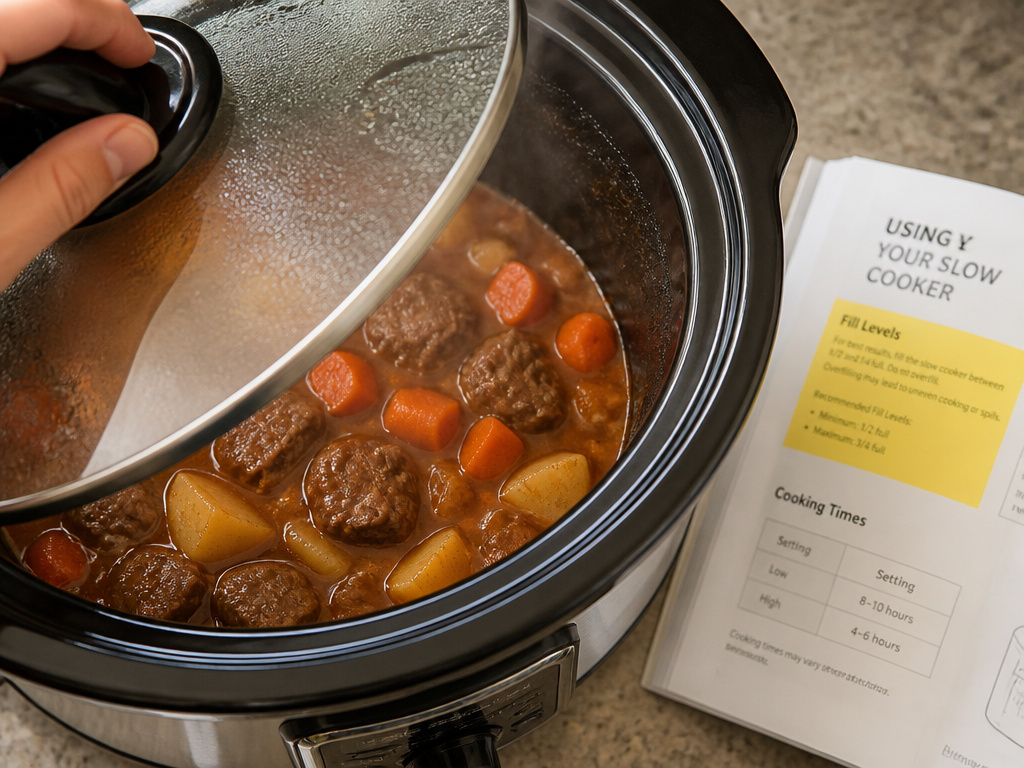 Manufacturer booklets contain numeric rules most people skip. These numbers are your calibration.
| Brand & Model | Minimum Fill | Maximum Fill | Key Spec |
|---|---|---|---|
| Cuisinart PSC-650A | Half full | 7cm from top rim (~3/4 full) | Food should be at room temp. If cold, cook on High first 2 hours. |
| Hamilton Beach 03-2300-W | Half full | 2 inches (5cm) from top for soups | Half-full? Check for doneness 1-2 hours early. |
| Russell Hobbs RHSC7 | Not specified | 3/4 full | Each lid removal adds 15-20 min cooking time. |
| Crock-Pot SCCPVL710S-33A | 1/2 full | 3/4 full | Do not cook on Warm setting. |
Lid removal is a timer penalty. That Russell Hobbs note isn’t trivial. Lifting the lid releases a massive amount of steam and heat. It can take the cooker 20 minutes to recover. If you peek three times, you’ve added an hour. Trust the process.
Starting temperature matters. The Cuisinart rule exists because adding fridge-cold ingredients drops the pot’s temperature dramatically. It can delay the climb to a safe 140°F. Starting on High for 1-2 hours solves this.
Altitude and voltage. Hamilton Beach notes that voltage variations or high altitude can extend cooking times. Your 8-hour stew might need 9. If you live above 3,000 feet, add a buffer.
Safety and Leftovers: The Non-Negotiables
 Slow cooking is safe when the appliance functions correctly. The MSU Extension safe cooking PDF provides a critical benchmark: if a slow cooker cannot reach 185°F and is older than its warranty period (generally 2 years), replace it. It may not be killing bacteria.
Before you start: Plug the cooker into a working outlet directly (not an extension cord). Ensure the ceramic pot is seated correctly and has no cracks. Thaw all meat. Wash your hands.
- Power failure protocol. If the power goes out and you’re not home, discard the food. You cannot know how long it sat in the danger zone. If you are home and the food was already cooked, it’s safe for up to 2 hours with the power off.
- The 2-hour fridge rule. After cooking, transfer leftovers to shallow containers and refrigerate within two hours. Do not store food in the ceramic pot—it cools too slowly.
- Reheating. Never reheat leftovers in the slow cooker. It takes too long to pass through the danger zone again. Reheat on the stove or in the microwave to 165°F, then transfer to a preheated slow cooker to keep warm.
- Storage. You can safely leave food in a slow cooker for up to two hours after it turns off. After that, bacteria begin to multiply. Overnight storage at room temperature is a hard no.
Choosing a good slow cooker with a clear, reliable temperature profile is your first safety step. A programmable model that switches to Warm automatically is worth the investment.
Adapting Your Own Recipes
You can convert almost any braise or soup. Follow this three-step checklist.
1. Adjust the liquid. Slow cookers lose very little liquid to evaporation. Reduce the broth, water, or wine in your standard recipe by about one-third. You can always add more later. 2. Layer correctly. Place hard, slow-cooking vegetables (potatoes, carrots) on the bottom, near the heat source. Add meat and softer veggies on top. 3. Downsize the spices. Long cooking mellows but also intensifies some flavors. Go easy on potent dried herbs like rosemary or thyme. Add fresh herbs at the very end.
For a classic beef stew, you’d brown the meat (for flavor), add a third less beef broth, and set it on Low for 8 hours. Add frozen peas in the last 45 minutes.
Common mistake: Dumping a stovetop recipe directly into the pot without adjusting liquid. You’ll end up with soup instead of stew.
The difference from an Instant Pot is pressure versus time. An Instant Pot can speed up braises, but a slow cooker’s gentle heat is unmatched for developing deep, blended flavors without supervision.
Frequently Asked Questions
Can you cook raw meat in a slow cooker?
Yes, that’s its primary purpose. For safety, always use thawed meat, ensure the pot is at least half full, and start on the High setting for the first hour if the meat is refrigerator-cold. The meat must reach 140°F within two hours of starting.
Do you need to add water?
You need some liquid, but not necessarily water. The food will release juices, and recipes include broth, sauce, or wine. The liquid in a slow cooker creates the steam that cooks the food and prevents burning. A good rule is at least 1/2 cup of liquid for a typical 4-6 quart recipe.
Is it safe to leave it on while at work?
Yes, that’s the design. Modern programmable cookers run for a set time then switch to Warm. Ensure the unit is on a stable, clear surface. The broader question of whether you can leave a slow cooker on overnight has the same answer: yes, if it’s in good working order and you’ve followed the fill-level rules.
Are slow cooker liners safe?
Slow cooker liners are made from food-grade nylon and are generally considered safe for use at slow-cooker temperatures. They make cleanup trivial. However, ensure you don’t pierce the liner with utensils during cooking, and never use them in an oven or on a stovetop.
Why is my meat still tough?
The meat hasn’t cooked long enough. Tough, lean cuts need sufficient time for collagen to break down. If it’s tough after the suggested time, continue cooking on Low for 1-2 hour increments until it shreds easily with a fork. Also, check that you have enough liquid.
Before You Go
A slow cooker asks for two things: the right kind of wet, fibrous, or tough food, and your patience. Match your ingredients to its gentle heat—soups, stews, braises, beans. Respect the fill lines in your manual and keep the lid on.
Skip the pasta, the quick-cook seafood, and the frozen roast. For everything else, from Sunday pot roast to Tuesday’s black beans, it’s the most reliable pot on your counter. Your job is to load it correctly. Its job is the next eight hours.
