
How Does a Steam Pot Work? The Science of Steam & Pressure
This post contains affiliate links. As an Amazon Associate, we earn from qualifying purchases.
A steam pot works by circulating pressurized steam inside a sealed, double-wall jacket surrounding the cooking bowl. This direct contact transfers intense, even heat to the food, cooking it faster and more uniformly than boiling. Steam pressure between 5 and 45 PSI raises the jacket temperature to between 227°F and 274°F, cutting cooking time by half or more compared to a standard pot.
That jacket is the whole game. It turns a simple pot into a pressure vessel, where the steam’s energy is forced directly into the metal, not just the air around it.
What follows is a breakdown of the jacket’s mechanics, the two main system types (direct steam and electric), the critical components that keep it safe, and the specific checks that prevent a $5,000 commercial kettle from failing in a year.
Key Takeaways
- The steam jacket, a sealed cavity between two stainless steel walls, is the core component, acting as a high-efficiency heat exchanger.
- Steam pressure dictates temperature. At 30 PSI, the jacket reaches 274°F (135°C), dramatically accelerating cooking times for soups, sauces, and grains.
- Condensate management is non-optional. A steam trap must be installed to drain water from the jacket, or efficiency plummets and corrosion starts.
- Self-contained electric kettles (like the Groen EE Series) use an internal boiler and require daily vacuum checks and treated water to prevent scaling.
- Safety systems are mechanical, not digital. The safety relief valve and pressure gauge are your primary indicators; test the valve monthly.
The Core Mechanism: Steam Jacket and Pressure
Forget the loose steam of a home vegetable steamer. A commercial steam pot is a sealed pressure vessel. The cooking bowl has a twin: an outer stainless steel wall that wraps around its lower two-thirds, creating an empty chamber. This is the steam jacket.
Steam pressurized at 30 p.s.i. Attains a temperature of 274 degrees Fahrenheit (135 degrees Celsius). This sealed, high-temperature environment is what makes a steam kettle faster than an open boiling pot.
You introduce steam into this jacket through a manual control valve. The steam immediately condenses on the cooler inner bowl wall, releasing its latent heat energy directly into the metal. This phase change, from gas to water, is where most of the thermal transfer happens. The condensate (water) then drains out through a separate port, while fresh steam continues to flow in, maintaining pressure and temperature.
The higher the pressure, the higher the temperature inside the jacket. This relationship is fixed and predictable. It’s why these kettles have a pressure range stamped on them, usually 5 to 45 PSI. Operating at the top end of that range isn’t about brute force; it’s about cutting a 45-minute simmer down to 20 minutes.
| Steam Pressure (PSI) | Approx. Jacket Temperature (°F) | Typical Use Case |
|---|---|---|
| 5 – 15 PSI | 227°F – 250°F | Holding, gentle simmering |
| 20 – 30 PSI | 259°F – 274°F | Active cooking, rapid boiling |
| 35 – 45 PSI | 281°F – 297°F | Maximum speed for high-volume operations |
Running below minimum pressure means the jacket never gets hot enough to cook efficiently. You’ll burn energy waiting for a pot to boil. Exceeding the maximum rating risks over-pressurizing the welded seams, a catastrophic failure mode the safety valve is there to prevent.
Direct Steam vs. Electric Kettles: Two Paths to Heat
Not all steam pots are plumbed into a building’s boiler. There are two distinct systems, and the choice dictates your installation, maintenance, and cost.
Direct Steam Kettles are the classic commercial workhorses. Models like the Vulcan KDL series or Crown DMT series require a dedicated steam line connection (typically 3/4″ IPS). A building’s central boiler supplies steam at the required pressure, which you control with a valve on the kettle’s leg.
- Pros: Higher potential power (up to 45 PSI), faster heat-up, no internal components to fail.
- Cons: Requires expensive steam line installation, generates more ambient kitchen heat, relies on building boiler operation.
Self-Contained Electric Kettles have a built-in electric boiler inside their base. The Groen EE-20 and EE-40 are prime examples. They plug into a high-voltage outlet and create their own steam in a closed-loop jacket.
- Pros: Portable, no steam line needed, easier installation, often includes precise digital temperature controls.
- Cons: Lower maximum pressure (often capped at 30 PSI), slower to heat large volumes, requires meticulous water treatment to prevent limescale in the internal boiler.
Where this goes sideways: Connecting a direct-steam kettle without a pressure-reducing valve when your building supply is at 80 PSI. The kettle’s jacket, rated for 45 PSI, will see nearly double its design pressure at the safety valve. It might hold for a week before the relief valve starts weeping constantly, and a seam failure is next.
The decision isn’t about quality. It’s about infrastructure. If you have a steam line, use it. If you’re outfitting a new kitchen without one, the electric model is your only practical choice. For home cooks seeking this technology, a high-end electric steamer or the steaming function on an Instant Pot is the closest accessible analog.
Essential Components and Their Jobs
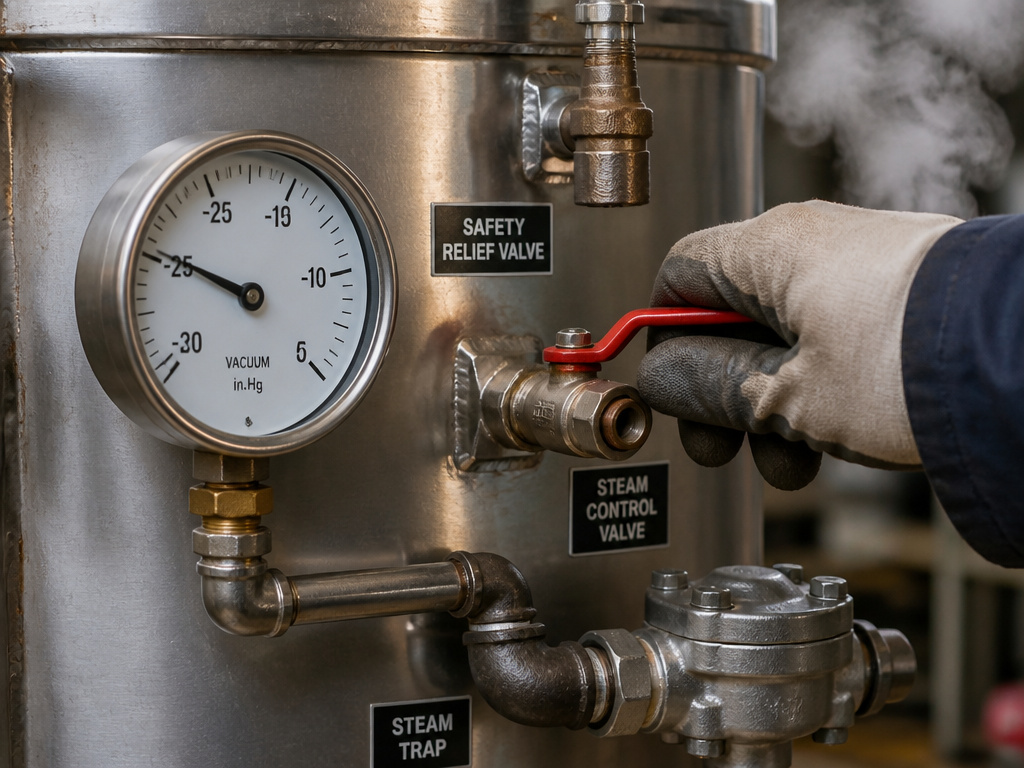
A steam pot is a simple machine made reliable by a few critical parts. Each has one job, and if it fails, the whole system suffers.
Steam Control Valve
This is the throttle. It’s a manual valve, usually a ball or gate type, mounted on the kettle’s frame. You use it to regulate the flow of steam into the jacket. Open it fully for maximum heat, throttle it back to hold a simmer. It’s the only control you have on a direct-steam model.
Pressure/Vacuum Gauge
This is your dashboard. For direct-steam kettles, it shows jacket pressure. For electric self-contained models, it should show a vacuum of -20 to -30 inches of mercury when cold. That vacuum proves the jacket is sealed. If an electric kettle’s gauge reads zero when cold, air has infiltrated the jacket, acting as an insulator and slowing heat-up times dramatically.
Safety Relief Valve
This is your mechanical fail-safe. It is a spring-loaded valve designed to open automatically and vent steam if the jacket pressure exceeds a set limit (e.g., 50 PSI). It is the last line of defense against over-pressurization.
Steam Trap
This is the most neglected but vital part. Installed on the condensate drain line, its job is to let water out but keep steam in. As steam condenses in the jacket, water pools. The thermostatic steam trap opens when it senses this cooler water, drains it, and then closes to retain steam pressure. A failed trap stuck open wastes steam; one stuck closed floods the jacket with water, killing efficiency and promoting corrosion.
Sight Glass (Electric Models Only)
Found on electric self-contained kettles, this small glass tube shows the water level in the closed-loop jacket. The water level must be maintained between the marked lines with distilled or treated water to prevent scaling on the internal heating elements.
The Step-by-Step Operating Cycle

Using a steam pot isn’t complicated, but it is procedural. Missing a step leads to poor performance or a safety hazard.
- Pre-Start Check (Electric Models): Verify the jacket water level is in the middle of the sight glass. Check that the pressure gauge shows a vacuum (-20 to -30 inHg). If not, you must purge air from the jacket before heating.
- Introduce Steam: For direct-steam kettles, slowly open the steam supply valve at the line, then open the kettle’s control valve. You’ll hear steam rushing into the jacket.
- Monitor Pressure: Watch the pressure gauge climb to your desired setting (e.g., 25 PSI for active cooking). Adjust the control valve to maintain it.
- Cooking: The double-wall design ensures furious, even heat. A full 40-gallon kettle of cold water can reach a rolling boil in under 10 minutes at high pressure.
- Condensate Management: The steam trap should emit periodic “puffs” or a steady drip of hot condensate into the drain line. No drainage means a clogged trap.
- Shutdown: Close the steam control valve completely. For electric models, turn the temperature dial to OFF. The gauge will slowly fall to zero (or back to vacuum for electric).
Common mistake: Cranking the steam valve open instantly on a cold kettle. The thermal shock from 300°F steam hitting a 70°F stainless steel bowl creates extreme stress on the welds. Always open the valve slowly over 10-15 seconds to allow gradual heating.
Critical Maintenance and Safety Protocols
These are not appliances you can ignore. The maintenance schedule is driven by wear, not whim.
Daily (Operator):
- Wipe down the exterior and bowl.
- For electric kettles: Check the jacket water sight glass and the vacuum/pressure gauge.
Monthly (Operator):
- Test the safety relief valve. With the kettle at operating pressure (around 15 PSI), lift the test lever for 5 seconds. You should see a strong blast of steam. If it’s weak or doesn’t reseal, take the kettle out of service immediately.
Every 6 Months (Technician):
- Lubricate the tilting mechanism’s worm gear with #2 lithium grease (for tilting models).
- Inspect the steam trap. Replace it if it’s not cycling or is leaking steam continuously.
- Check all steam line connections for leaks.
As Needed:
- Descale electric models. Use only manufacturer-approved solutions. Vinegar or citric acid can damage the stainless steel if used at the wrong concentration.
- Re-treat jacket water. If you add water to an electric kettle, it must be distilled water treated to a pH of 10.5-11.5 with a specific compound to prevent corrosion.
The safety systems are simple and mechanical for a reason. They must work without power. Your diligence in testing them is what prevents a routine cooking day from becoming an emergency.
Frequently Asked Questions
What’s the difference between a steam pot and a regular pot?
Regular pot heats food from a single bottom surface (conduction). A steam pot surrounds the food container with a pressurized steam jacket, heating the entire lower two-thirds of the bowl simultaneously (conduction + intense convection). This results in much faster, more even heating without hot spots.
Can you use a steam pot at home?
True commercial direct-steam kettles are impractical for homes due to the need for a high-pressure steam line. However, home cooks can achieve similar steam-cooking results with a high-quality bamboo steamer set over a wok or with the dedicated steaming function on a multi-cooker like an Instant Pot.
Why does my steam kettle take so long to heat up?
For direct-steam models: low steam supply pressure, a clogged steam trap flooding the jacket with water, or a failed control valve. For electric models: air in the jacket (loss of vacuum), low water level in the jacket, or scaled-up heating elements. Start by checking the pressure gauge and the steam trap’s drain output.
Is it normal for water to leak from my steam kettle?
Water (condensate) should steadily drip or flow from the condensate drain line connected to the steam trap. This is normal. Water leaking from any other location, around the bowl seams, valve stems, or gauge connections, indicates a seal failure and requires immediate service.
How do I clean a commercial steam kettle?
Never use abrasive pads on the stainless steel interior. After cooling, wash with hot, soapy water and a soft cloth. For stubborn residue, use a manufacturer-approved stainless steel cleaner. Always rinse thoroughly. Never leave acidic foods (like tomato sauce) sitting in the kettle, as they can pit the stainless steel over time.
The Bottom Line
A steam pot works by treating heat as a pressurized fluid, not just a ambient condition. The sealed jacket is the innovation, turning steam’s latent energy into direct, furious contact with the cooking vessel.
For a kitchen that makes gallons of soup, sauce, or pasta daily, the time savings are measurable in hours per week. The trade-off is a requirement for mechanical literacy, you must understand pressure, condensate, and valve checks. This isn’t a “set it and forget it” countertop appliance. It’s a tool for volume, governed by physics and maintained by routine.
If you have the steam line, a direct-steam kettle is a powerhouse. If you don’t, a well-maintained self-contained electric model like those from Groen is the next best thing. For the home cook, the principles live on in a good steamer insert or a multi-cooker’s steam setting. The goal is the same: harness the efficiency of steam, contained and directed, to cook faster and more evenly than boiling ever could.
