
What Is a Steamer Pot | The Two Types That Change Your Kitchen
This post contains affiliate links. As an Amazon Associate, we earn from qualifying purchases.
A steamer pot is a specialized piece of cookware that uses steam as the primary cooking medium. It consists of a water reservoir that generates steam and one or more stacked compartments that hold food above the boiling water. The two fundamental types are boiler-based systems, which use an external or integrated boiler, and boilerless systems, which heat water directly in a sealed reservoir.
That distinction between boiler and boilerless changes everything from how you install it to how you maintain it. The boiler type is a commercial workhorse built for speed and volume. The boilerless type is what you find in most home kitchens, simpler, more contained, and often more energy-efficient.
What follows is a breakdown of those two systems, the specs that actually matter, and how to pick the right one without overbuying. By the end, you’ll know whether your kitchen needs a $50 countertop unit or a piece of equipment that requires its own plumbing.
Key Takeaways
- A boiler-based steamer connects to a central boiler or has one built-in, delivering high-volume steam ideal for commercial kitchens but consuming significantly more water.
- A boilerless steamer heats water in a self-contained reservoir, recycling condensate; it’s the standard for home use and is more water-efficient.
- Water hardness above 50 ppm (or 3 grains per gallon) will scale and damage most steamers, using distilled or softened water is non-negotiable for longevity.
- Commercial units can use up to 40 gallons of water per hour, per EPA data, while efficient home models use a fraction of that.
- Never store any steamer with water in its reservoir; empty and dry it completely to prevent mineral buildup and bacterial growth.
Boiler-Based vs. Boilerless: The Core Distinction
The entire steamer pot category splits along one line: where the steam comes from. This isn’t a minor detail. It dictates the machine’s footprint, its water and electrical needs, and what you can realistically cook in it.
A boiler-based system uses a dedicated boiler to generate food-grade steam. This boiler can be built into the unit or, in large commercial settings, be a central system that feeds multiple stations. Steam is piped into a sealed cooking compartment. The steam that doesn’t condense on the food escapes as a mix of vapor and water through a drain. These systems also require a continuous flow of cooling water to temper the drain output to a safe temperature before it hits the sewer.
Boiler-based steam cookers can use up to 40 gallons (151 liters) of water per hour, while efficient models use about 5 gallons (19 liters) per hour. This data comes directly from the EPA’s commercial kitchen water efficiency guidelines.
That water consumption figure is the trade-off for immense power and consistency. A boiler-based steamer can hold a rock-solid 212°F (100°C) steam temperature indefinitely, which is why you see them in high-volume cafeterias and hotel kitchens. The downside is complexity. They need a dedicated drain line, a water supply, and regular professional descaling of the boiler itself.
A boilerless steamer is mechanically simpler. It has a sealed reservoir at its base. You add water, an internal heating element brings it to a boil, and the steam rises into the food compartments. Crucially, the steam that condenses on the food and the compartment walls drips back into the reservoir to be reheated. This closed-loop system is far more water- and energy-efficient. There’s no need for a continuous water supply or a drain for cooling, just a power outlet.
The boilerless design is why home countertop steamers exist. Models like the Tefal VC102316 or the NESCO ST-25 are all boilerless. They’re quieter, cheaper to run, and portable. The catch is capacity. That reservoir only holds so much water, so cooking times are limited before you need to refill. For a home cook steaming vegetables for four, that’s no issue. For a restaurant prepping 200 servings of dim sum, it’s a deal-breaker.
What a Steamer Pot Actually Looks Like
Forget the vague mental image. Whether commercial or domestic, a steamer pot has specific, non-negotiable parts. Missing one means you’re looking at something else.
The foundation is the base unit or reservoir. This is the chamber that holds the water and contains the heating mechanism. In a home model, it’s a plastic or metal bowl with a heating plate. In a commercial boilerless unit like the Groen SMARTSTEAM PRO, it’s a mirrored stainless steel cavity with a side-mounted convection fan.
Stacked on top are the food compartments or trays. These are perforated baskets that hold the food above the water line, allowing steam to circulate freely. Home units often use clear plastic for visibility; commercial ones use stainless steel pans that align with standard kitchen sheet pan sizes (like 12×20 inches).
A tight-fitting lid caps the stack. Its job is to contain the steam and pressure, forcing the vapor to circulate around the food rather than escaping. Some advanced commercial models have hinged, gasketed doors that lock shut.
Then come the control systems. A home unit might have a simple 60-minute timer and an on/off switch. A commercial digital steamer, like the Avantco 177QS series, has a programmable touchpad for setting precise steam cycles and holding temperatures.
How the Steam Pot Function Works
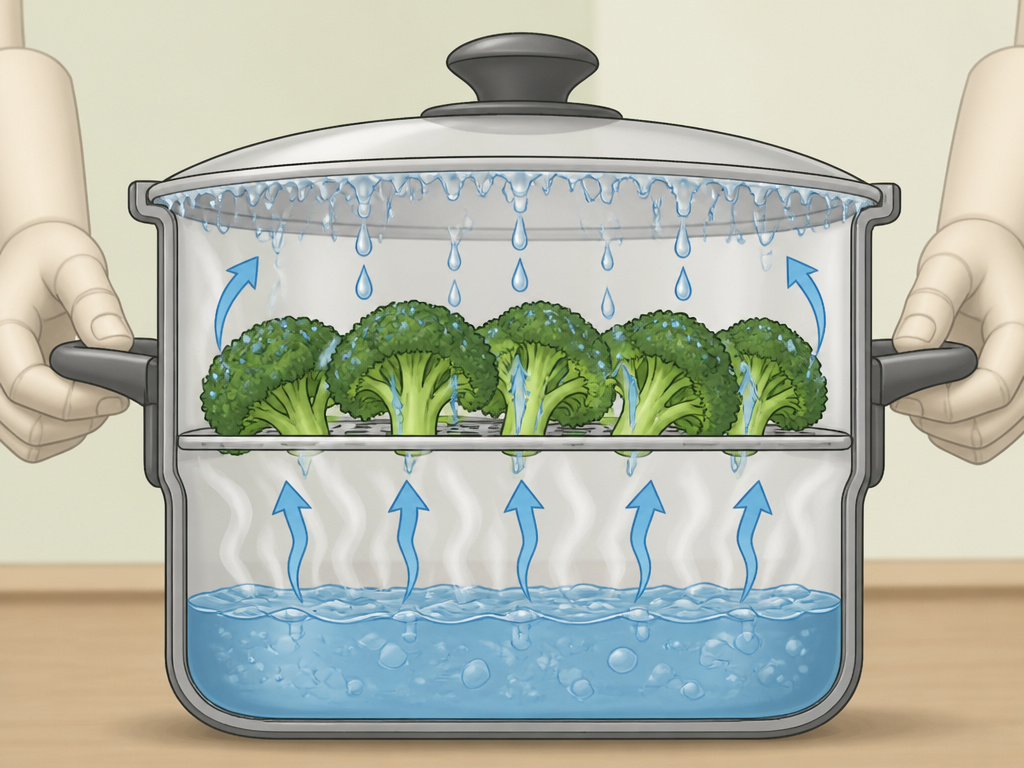 The process seems simple: water boils, steam rises, food cooks. The magic is in the physics of that steam transfer, and why it’s gentler than boiling or frying.
You pour cold water into the reservoir. The heating element, whether an electric coil in a home unit or a gas-fired boiler in a commercial one, brings that water to a rolling boil at 212°F (100°C) at sea level. As the water vaporizes, it expands into steam.
This steam is less dense than air, so it rises forcefully through the perforations in the trays. When the hot, moist vapor contacts the cooler surface of the food, it releases its latent heat energy and condenses back into water droplets. This phase change from gas to liquid transfers a massive amount of heat directly onto the food’s surface, cooking it quickly and evenly.
The condensation process is why steaming is so efficient. It delivers more heat per gram of vapor than dry air, which is why a steamer cooks broccoli faster than an oven at the same temperature.
Because the food isn’t submerged, water-soluble vitamins (like Vitamin C and many B vitamins) aren’t leached out into cooking water. The constant 212°F environment is also gentler than the direct, high heat of a pan, reducing the risk of burning or toughening proteins. This closed, humid environment is the entire reason a bamboo steamer works so well for delicate dumplings; the porous wood absorbs excess condensation, preventing soggy bottoms.
The system’s efficiency hinges on the lid. An open lid lets the steam and heat escape, dropping the internal temperature and drastically increasing cooking time. This is why the question of whether to cover a steamer has only one answer: always.
Commercial vs. Home Steamer Pots: A World Apart
 Calling a $50 countertop appliance and a $5,000 stainless steel commercial cabinet by the same name is a stretch. They share a principle, but their execution and purpose are different species.
| Aspect | Commercial Steamer Pot | Home Steamer Pot |
|---|---|---|
| Construction | 18-gauge stainless steel, welded seams, commercial-grade gaskets. | Often plastic or thin-gauge stainless, with simpler locking mechanisms. |
| Capacity | Holds multiple standard steam table pans (e.g., 10+ pans). | Typically 2-3 stacked baskets, suitable for family-sized portions. |
| Water & Drain Needs | Often requires direct water line and dedicated drain connection. | Manual fill and empty; no permanent plumbing needed. |
| Control Precision | Digital programmable controls, timer-based standby modes. | Basic dial timer or simple buttons. |
| Primary Use Case | High-volume, consistent output for service (schools, restaurants). | Occasional, flexible cooking for home meals. |
A commercial unit is built for punishment. The Groen SMARTSTEAM PRO manual specifies an 18-gauge stainless steel case and warns against installing it within two inches of another heat source like a fryer. Its internal components are rated for thousands of cycles. The EPA commercial steam cooker guide frames these machines as major water users, advising facilities to descale them at least twice a year and fix leaking door gaskets immediately to prevent waste.
A home unit is an appliance. The Tefal VC102316 manual focuses on user safety: don’t leave it unattended, use oven gloves to refill the tank, and descale every 7-10 uses with a vinegar solution. Its priority is convenience and safety, not 24/7 durability.
Where this goes sideways: Using a home steamer for a commercial volume task. The plastic components will warp under continuous heat, the small reservoir will require constant refilling, and the motor will burn out. They’re not built for that life.
The choice isn’t about quality; it’s about fit. Installing a commercial steamer in a home kitchen is overkill, expensive, and potentially dangerous without proper ventilation and plumbing. Using a home model to try and run a small food business is a shortcut to equipment failure.
Critical Specs and Maintenance Rules
You can’t judge a steamer by its lid. Three specifications determine whether it will work in your kitchen and for how long.
Water Hardness Tolerance: This is the most overlooked and critical spec. The Avantco portion steamer manual is explicit: “Maximum acceptable water hardness of 50ppm or 3 GCG. Using hard water can reduce the functionality and longevity of steamer.” Minerals in hard water (calcium and magnesium) precipitate out as scale when heated, coating heating elements and steam pathways. This insulates the element, causing it to overheat and fail, and restricts steam flow. If your tap water is hard, using distilled water isn’t a suggestion, it’s a requirement to avoid a costly repair.
Descaling Frequency: Every steamer pot needs it. The schedule varies wildly. The Tefal manual recommends a descaling cycle with a vinegar solution every 7 to 10 uses. A commercial boiler-based system, per the EPA, needs inspection and descaling at least twice per year. The process involves circulating a mild acid (like citric or phosphoric acid solution) through the system to dissolve mineral deposits. Neglecting it is the surest way to kill the appliance.
Reservoir Capacity vs. Runtime: This tells you how long you can cook before a refill. The NESCO ST-25 guide states that 1 cup (250 mL) of water yields about 30 minutes of steam. If you’re planning to steam a whole chicken for 90 minutes, you’ll need to refill the tank at least twice mid-cook. Always check this ratio before buying.
Proper cleaning a steamer extends beyond descaling. It means emptying and drying the reservoir after every use to prevent stagnant water and mildew, wiping down trays, and checking silicone gaskets for integrity. For a bamboo steamer, maintenance involves gentle hand-washing and air-drying to prevent mold and cracking.
What You Can (and Should) Cook in One
A steamer pot’s versatility is its superpower. It’s not just for broccoli.
Vegetables are the classic. The quick, moist heat preserves color, texture, and nutrients better than boiling. Proteins like fish fillets, chicken breasts, and dumplings cook evenly without drying out or needing added fat. Grains like rice can be steamed for a fluffier result, and eggs can be hard or soft-steamed in their shells.
The real trick is learning layering. Dense root vegetables like potatoes and carrots go in the bottom tray closest to the steam source, where heat is strongest. More delicate items like fish or leafy greens go in the top tray, where the steam is slightly cooler and gentler. This lets you cook an entire meal simultaneously. For specific ideas, our guide on steamer recipes lays out full meals.
If you’re out of specialized gear, don’t panic. There are plenty of effective steamer alternatives using a pot and a heatproof bowl or colander. The principle remains the same: create a chamber where steam is the only heat transfer agent.
Frequently Asked Questions
What’s the difference between a steamer pot and a steamer basket?
steamer basket is a single insert, usually metal or bamboo, that sits inside a standard pot you already own. A steamer pot** is a complete, integrated appliance with its own dedicated water reservoir, heating element, and stacked cooking compartments. The basket is a tool; the pot is a standalone cooking station.
Can I use tap water in my steamer pot?
You can, but you shouldn’t if your water is hard. Check your manual. Most manufacturers, especially for commercial models like Avantco, strongly recommend distilled or softened water to prevent rapid scale buildup. Using hard tap water voids many warranties and leads to premature failure.
How do I know if my steamer pot is boiler-based or boilerless?
Check the requirements. If the manual or spec sheet says it needs a direct water supply line and a drain connection, it’s almost certainly boiler-based. If you manually fill a reservoir with a cup or pitcher and there’s no mention of a drain, it’s boilerless. Home countertop models are exclusively boilerless.
Why does my steamer pot take so long to produce steam?
Three likely causes. First, you may have overfilled the reservoir, which means the element must heat a larger mass of water. Second, scale buildup on the heating element is insulating it, drastically reducing efficiency, time to descale. Third, the lid or door seal might be compromised, letting steam escape and preventing pressure from building.
Is a stainless steel or plastic steamer pot better?
Stainless steel is more durable, easier to clean, and doesn’t stain or retain odors. It’s the standard for commercial units and higher-end home models. Plastic is lighter, cheaper, and often transparent, which is useful for monitoring food. However, plastic can warp over time with high heat and may absorb smells from strong-flavored foods.
Do steamer pots work for canning or sterilizing?
They are excellent for sterilizing baby bottles, kitchen tools, and jars because the sustained 212°F steam kills most bacteria and molds. However, a standard steamer pot does not achieve the higher pressures and temperatures (240°F/116°C) required for safe pressure canning of low-acid foods like vegetables and meats. For that, you need a dedicated pressure canner.
Before You Go
A steamer pot is more than a niche gadget. For the home cook, it’s a health-conscious, efficient way to prepare vegetables, proteins, and grains with minimal fuss and clean-up. The boilerless countertop model is the default choice here.
For anyone in food service, the decision is between the high-output, high-water-use boiler-based system and the more efficient but lower-capacity commercial boilerless cabinet. Your local water hardness and menu volume make that call.
The one universal rule is maintenance. Whether it’s a $30 plastic unit or a $3000 stainless beast, distilled water and regular descaling are the price of admission. Skip them, and you’re just pre-paying for its replacement.
